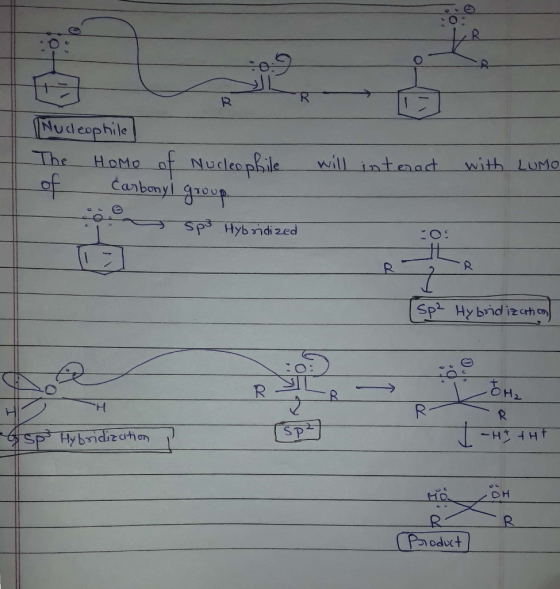
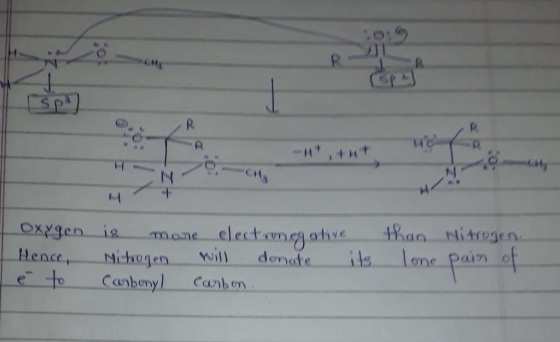
 Must be drawn on an orbital level sp2 sp3
etc.
Must be drawn on an orbital level sp2 sp3
etc.
Homework Answers
Add Answer to:
Must be drawn on an orbital level sp2 sp3
etc.
For the nucleophiles shown draw their...
9. (14 points) Consider the CNN bond in the following molecule: NH H3C CH3 For each...
 9. (14 points) Consider the CNN bond in the following molecule: NH H3C CH3 For each set of atom-centered orbitals shown: i. Identify the atomic orbitals or hybrids shown (e.g., p, sp3, etc.) in the box beneath each orbital ii. Clearly indicate the sign of the wave function by shading the appropriate lobes needed to generate the indicated molecular orbital. iii. Draw the orbital interaction that occurs between the two orbitals to form the indicated molecular orbital (o* or 7)....
Complete the Lewis structure of the compound shown below and indicate which of the following statements are true. 46 Η...
 Complete the Lewis structure of the compound shown below and indicate which of the following statements are true. 46 Η Η H C =C-C-N H=21日 An sp2 hybrid orbital on C-1 overlaps with an sp hybrid orbital on C-2 to form the sigma bond between C-1 and C-2. There are ten o bonds in this molecule. There are five i bonds in this molecule. The C-2 and C-3 atoms cannot rotate about the internuclear axis between the two atoms since...
Draw molecular orbital energy level diagram for CH3 by following the steps given below. Valance orbital...
 Draw molecular orbital energy level diagram for CH3 by following the steps given below. Valance orbital ionization potentials: H(1s) - 13.6 eV, C(2s) -19.5 eV, C(2p) -10.7 ev. (6C, 11) E x +y?,z? 1 1 1 203 3C on 1 1 1 1 1 1 1 T - 1 0 2 1 1 -1 | 1 -1 1 -1 -1 TOT- 2 25; 1 1 - 1 1 -1 1 -1 1 30, 1 1 1 -1 0 1 -1...
Pre-activity: The Hybrid and Molecular Orbital Models a)040-12. 1. Draw the Lewis structure for formaldehyde (CHO)...
 Pre-activity: The Hybrid and Molecular Orbital Models a)040-12. 1. Draw the Lewis structure for formaldehyde (CHO) in the box to the side, and label each bond as a or z. 2. Complete the table below to identify the valence orbitals for C, H and O in formaldehyde. O H C Where relevant, what is the hybridization of each atom? How many hybrid orbitals are present on each? What unhybridized atomic orbitals are present? Specify the number of each in parentheses....
The sack shown weighs 35 pounds. What are the tensions in each rope? you must draw...
 The sack shown weighs 35 pounds. What are the tensions in each rope? you must draw all relevant FBDs. Be sure to include o the name of the point that your FBD is depicting othe magnitudes of known forces, or a label of unknown forces (you can pick the names) o All internal forces drawn as tension. o All relevant angle information. 4
Assignments must be typed, with all calculations shown. Diagrams can be hand drawn --- insert your...
 Assignments must be typed, with all calculations shown. Diagrams can be hand drawn --- insert your diagrams in the appropriate sections of your document. To insert a diagram in Word, use the Insert tab and click on Pictures to upload the diagram. Handwritten assignments are not accepted. Assignments must be submitted in the appropriate Dropbox on Brightspace either as a Word or pdf file. Email attachments are not accepted. The assignment can be completed in groups of two or three,...
I kind of know where to start for these but I get so confused trying to draw the structure and how to read and interpret...
 I kind of know where to start for these but I get so confused
trying to draw the structure and how to read and interpret the
CNMR. Looking at the IR frequencies i think there is a benzene
ring, as well as sp2 and sp3 C-H bonds, there is no O-H or N-H
bonds, as well as no carbon triple bonds to nitrogen or carbon, and
no carbon double bonded to oxygen bonds.I know there has to be 8
hydrogens...
I kind of know where to start for these but I get so confused
trying to draw the structure and how to read and interpret the
CNMR. Looking at the IR frequencies i think there is a benzene
ring, as well as sp2 and sp3 C-H bonds, there is no O-H or N-H
bonds, as well as no carbon triple bonds to nitrogen or carbon, and
no carbon double bonded to oxygen bonds.I know there has to be 8
hydrogens...
B3. An octahedral transition metal complex with the structure shown below was isolated from the reaction...
 B3. An octahedral transition metal complex with the structure shown below was isolated from the reaction of CoCl2.6H20 and one equivalent of the organic ligand diethylenetriamine, H2NCH2CH2NHCH2CH2NH2, after oxidation with air and addition of Naci. I-Z H2N,,, NH2 com CICI a) Draw the structure for a different geometric isomer of the product which may also form from the same reaction, AND label the complex you have drawn with an appropriate stereochemical descriptor. The complex shown on the previous page is...
For each of the compounds listed below you must draw the Lewis dot structure in the...
For each of the compounds listed below you must draw the Lewis dot structure in the chart on page 4. a. H2O, water b. CF4, carbon tetrafluoride c. HCN, hydrogen cyanide (C in middle) d. ONBr, nitrosyl bromide e. (z)-C2H2F2, (z)-1,2-difluoroethylene (N in middle) f. (e)-C2H2F2, (e)-1,2-difluoroethylene g. CH3COCH3, acetone (the O is doubly bonded to middle, but is not bonded to any other C atoms) h. C6H14, hexane i. C6H12 (a ring), cyclohexane
In addition to interacting with s and p orbitals of ligands such as NH,, CN, etc.,...
 In addition to interacting with s and p orbitals of ligands such as NH,, CN, etc., d orbitals can also interact with other d-orbitals, resulting in the formation of metal-metal bonds. Thus, for a simple metal dimer (i.e., ignoring any other ligands), we can envision the following interactions: M1M2 ? bond bond 8 bond where the o bond represents a face-to-face interaction between the two d orbitals. Considering only the d orbitals on each metal and taking the metal-metal bond...
 9. (14 points) Consider the CNN bond in the following molecule: NH H3C CH3 For each set of atom-centered orbitals shown: i. Identify the atomic orbitals or hybrids shown (e.g., p, sp3, etc.) in the box beneath each orbital ii. Clearly indicate the sign of the wave function by shading the appropriate lobes needed to generate the indicated molecular orbital. iii. Draw the orbital interaction that occurs between the two orbitals to form the indicated molecular orbital (o* or 7)....
 Complete the Lewis structure of the compound shown below and indicate which of the following statements are true. 46 Η Η H C =C-C-N H=21日 An sp2 hybrid orbital on C-1 overlaps with an sp hybrid orbital on C-2 to form the sigma bond between C-1 and C-2. There are ten o bonds in this molecule. There are five i bonds in this molecule. The C-2 and C-3 atoms cannot rotate about the internuclear axis between the two atoms since...
 Draw molecular orbital energy level diagram for CH3 by following the steps given below. Valance orbital ionization potentials: H(1s) - 13.6 eV, C(2s) -19.5 eV, C(2p) -10.7 ev. (6C, 11) E x +y?,z? 1 1 1 203 3C on 1 1 1 1 1 1 1 T - 1 0 2 1 1 -1 | 1 -1 1 -1 -1 TOT- 2 25; 1 1 - 1 1 -1 1 -1 1 30, 1 1 1 -1 0 1 -1...
 Pre-activity: The Hybrid and Molecular Orbital Models a)040-12. 1. Draw the Lewis structure for formaldehyde (CHO) in the box to the side, and label each bond as a or z. 2. Complete the table below to identify the valence orbitals for C, H and O in formaldehyde. O H C Where relevant, what is the hybridization of each atom? How many hybrid orbitals are present on each? What unhybridized atomic orbitals are present? Specify the number of each in parentheses....
 The sack shown weighs 35 pounds. What are the tensions in each rope? you must draw all relevant FBDs. Be sure to include o the name of the point that your FBD is depicting othe magnitudes of known forces, or a label of unknown forces (you can pick the names) o All internal forces drawn as tension. o All relevant angle information. 4
 Assignments must be typed, with all calculations shown. Diagrams can be hand drawn --- insert your diagrams in the appropriate sections of your document. To insert a diagram in Word, use the Insert tab and click on Pictures to upload the diagram. Handwritten assignments are not accepted. Assignments must be submitted in the appropriate Dropbox on Brightspace either as a Word or pdf file. Email attachments are not accepted. The assignment can be completed in groups of two or three,...
 I kind of know where to start for these but I get so confused
trying to draw the structure and how to read and interpret the
CNMR. Looking at the IR frequencies i think there is a benzene
ring, as well as sp2 and sp3 C-H bonds, there is no O-H or N-H
bonds, as well as no carbon triple bonds to nitrogen or carbon, and
no carbon double bonded to oxygen bonds.I know there has to be 8
hydrogens...
I kind of know where to start for these but I get so confused
trying to draw the structure and how to read and interpret the
CNMR. Looking at the IR frequencies i think there is a benzene
ring, as well as sp2 and sp3 C-H bonds, there is no O-H or N-H
bonds, as well as no carbon triple bonds to nitrogen or carbon, and
no carbon double bonded to oxygen bonds.I know there has to be 8
hydrogens...
 B3. An octahedral transition metal complex with the structure shown below was isolated from the reaction of CoCl2.6H20 and one equivalent of the organic ligand diethylenetriamine, H2NCH2CH2NHCH2CH2NH2, after oxidation with air and addition of Naci. I-Z H2N,,, NH2 com CICI a) Draw the structure for a different geometric isomer of the product which may also form from the same reaction, AND label the complex you have drawn with an appropriate stereochemical descriptor. The complex shown on the previous page is...
 In addition to interacting with s and p orbitals of ligands such as NH,, CN, etc., d orbitals can also interact with other d-orbitals, resulting in the formation of metal-metal bonds. Thus, for a simple metal dimer (i.e., ignoring any other ligands), we can envision the following interactions: M1M2 ? bond bond 8 bond where the o bond represents a face-to-face interaction between the two d orbitals. Considering only the d orbitals on each metal and taking the metal-metal bond...
Most questions answered within 3 hours.
-
Where is the error in this code sequence?
String s1 = "Hello";
String s2 = "ello";...
asked 10 months ago -
Financial data for Joel de Paris, Inc., for last year
follow:
Joel de Paris, Inc.
Balance...
asked 10 months ago -
Consider this reaction:
Al2(SO4)3 (aq)+ BaCl3
(aq) Al2Cl6 (aq)- +
3BaSO4(s) . What is the...
asked 10 months ago -
Suppose that Savneet is considering increasing her
recent random sample from 20 car rentals to 40...
asked 10 months ago -
Trucks arrive at an unloading terminal at an average rate of 120
per hour.
Trucks arrive...
asked 10 months ago -
Why are methanol and ethanol completely soluble in water while
octanol is not very little soluble....
asked 10 months ago -
A facilities manager at a university reads in a research report
that the mean amount of...
asked 10 months ago -
When the CuSO4 is rehydrated by adding water to the anhydrous
compound, is this an endothermic...
asked 10 months ago -
A ray of sunlight is passing from diamond into crown glass; the
angle of incidence is...
asked 10 months ago -
A block of mass 0.249 kg is placed on top of a light, vertical
spring of...
asked 10 months ago -
how do the kidneys compensate in the presences of acidosis
a) trigger hyperventilate
b) reserve acid...
asked 10 months ago -
Question 501 pts
The rental rate of capital to the firm increases. Which of the
following...
asked 10 months ago