
Homework Answers
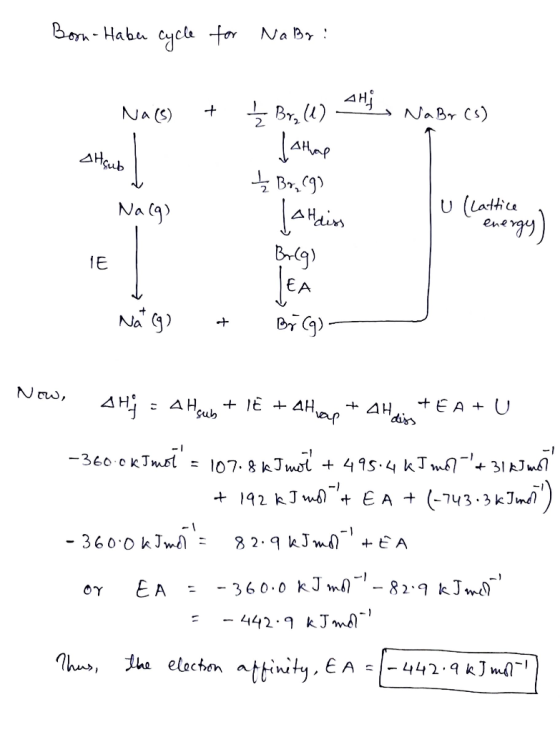
Electron affinity = -442.9 kJ mol-1
Add Answer to:
Review Problem 8.065 Construct an enthalpy diagram with the following data to calculate the electron affinity...
17. What is the first ionization energy (IE) of sodium (Na) based on the following information?...
 17. What is the first ionization energy (IE) of sodium (Na) based on the following information? A. +399.4 kJ B. +464.4 kJ C. +495.4 kJ D. +526.4 kJ E. +591.4 kJ Brig) + e + Br (g) Na(s) + / Bra(l) + NaBr(s) Na (g) + Br-(g) NaBr(s) Br2(g) + 2 Brig) Br(1) Br (g) Na(s) + Nag) AH (kJ mol-') -331.4 -360.0 -743.3 +192.0 +31.0 +107.8
Physical Chemistry: Use a Born-Haber cycle to find an experimentally based value for the lattice enthalpy...
 Physical Chemistry:
Use a Born-Haber cycle to find an experimentally based value for the lattice enthalpy of sodium bromide (NaBr(s)). The lattice enthalpy corresponds to the enthalpy change for the process NaBr(s) rightarrow Na^+(g) + Br^-(g) Use the following information in doing this problem. delta H degree_f(Na(g)) = 107.32 kJ/mol delta H degree_IE1(Na(g)) = 495.8 kJ/mol delta H degree_f(Br(g)) = 111.88 kJ/mol delta H degree_EA(Br(g)) = -324.6 kJ/mol delta H degree_f(NaBr(s)) = -361.06 kJ/mol The ionization enthalpy (IE_1) and electron...
Physical Chemistry:
Use a Born-Haber cycle to find an experimentally based value for the lattice enthalpy of sodium bromide (NaBr(s)). The lattice enthalpy corresponds to the enthalpy change for the process NaBr(s) rightarrow Na^+(g) + Br^-(g) Use the following information in doing this problem. delta H degree_f(Na(g)) = 107.32 kJ/mol delta H degree_IE1(Na(g)) = 495.8 kJ/mol delta H degree_f(Br(g)) = 111.88 kJ/mol delta H degree_EA(Br(g)) = -324.6 kJ/mol delta H degree_f(NaBr(s)) = -361.06 kJ/mol The ionization enthalpy (IE_1) and electron...
Consider the following information. The lattice energy of NaCl is ΔH lattice=−788 kJ/mol The enthalpy of...
Consider the following information. The lattice energy of NaCl is ΔH lattice=−788 kJ/mol The enthalpy of sublimation of Na is ΔHsub=107.5 kJ/mol The first ionization energy of Na is IE1=496 kJ/mol. The electron affinity of Cl is ΔHEA=−349 kJ/mol. The bond energy of Cl2 is BE=243 kJ/mol. Determine the enthalpy of formation, ΔHf, for NaCl(s). ΔHf= kJ/mol
Knowing the enthalpy of formation of calcium fluoride is -1228 KJ / mol, the enthalpy of...
Knowing the enthalpy of formation of calcium fluoride is -1228 KJ / mol, the enthalpy of the sublimation of calcium is 168kj/mole, the bond enthalpy of fluorine is 155kj/mole, the electron affinity of fluorine is -328 kj/mole, the first ionization enthalpy of calcium is 590kj/mole and the second ionization enthaply is 1145kj/mole, calculate the lattice enthalpy of calcium fluoride.
calculate the electron affinity of Cl from the following data for NaCl. Bond energy of Cl2=...
calculate the electron affinity of Cl from the following data for NaCl. Bond energy of Cl2= 239 kJ/mol; ΔHsub(Na)=109kJ/mol; IE(Na)=496kJ/mol; lattice enthalpy(Nacl)=-789kJ/mol and ΔHf, NaCl=-413kJ/mol.
2. Use the following data to calculate the lattice energy (U) of NaCl(s) from sodium me...
 2. Use the following data to calculate the lattice energy (U) of NaCl(s) from sodium me chlorine: Enthalpy of formation (4H) for NaCl(s) - -411 kJ/mol Enthalpy of sublimation (4Hub) of Na 107.3 kJ/mol The first ionization energy of Na (E,)-495.8 kJ/mol The bond dissociation energy (D) of Clh- 243 kJ/mol The electron affinity of Cl (Eea)- 348.6 kJ/mol.
1)a. Using the Born Haber cycle, determine the enthalpy for lattice formation of MgO. Mg (s),...
1)a. Using the Born Haber cycle, determine the enthalpy for lattice formation of MgO. Mg (s), ΔHsub = +148 kJ/mol bond dissociation energy for O2 = +499 kJ/mol 1st ionization energy for Mg = +738 kJ/mol 1st electron affinity for O = –141 kJ/mol 2nd ionization energy for Mg = +1450 kJ/mol 2nd electron affinity for O = +844 kJ/mol MgO(s), enthalpy of formation = –602 kJ/mol 1)b. Calculate the lattice formation energy of MgO using the Madelung constant....
Given the following information, calculate the lattice energy of CaF2 The enthalpy of formation of CaF2...
 Given the following information, calculate the lattice energy of CaF2 The enthalpy of formation of CaF2 -1228 kJ/mol Heat of sublimation of Ca 177.8 kJ/mol Bond dissociation energy of F2 159 kJ/mol First ionization energy of Ca 589.8 kJ/mol Second ionization energy of Ca 1145.4 kJ/mol . Electron affinity of F -328 kJ/mot [ Answer : -2644 KJİ I
Calculate the enthalpies of formation, ΔHfo, of the following group 1 fluoride compounds from their elements...
 Calculate the enthalpies of formation, ΔHfo, of the following
group 1 fluoride compounds from their elements using the Born–Haber
cycle.
NaF RbF Number Number kJ ol kJ mol AHO, kJ/mol Sublimation of Na(s) 108 86 Sublimation of Rb(s) 158 Dissociation of F2(g Ionization energy of Na(g) 496 ionization energy of Rb(g) 403 Electron affinity of F(g) -322 Lattice enthalpy of NaF(s) 926 Lattice enthalpy of RbF(s) 789
Calculate the enthalpies of formation, ΔHfo, of the following
group 1 fluoride compounds from their elements using the Born–Haber
cycle.
NaF RbF Number Number kJ ol kJ mol AHO, kJ/mol Sublimation of Na(s) 108 86 Sublimation of Rb(s) 158 Dissociation of F2(g Ionization energy of Na(g) 496 ionization energy of Rb(g) 403 Electron affinity of F(g) -322 Lattice enthalpy of NaF(s) 926 Lattice enthalpy of RbF(s) 789
Calculate the lattice energy of CaBr2. The standard heat of formation of CaBr2 is -675 kJ/mol....
Calculate the lattice energy of CaBr2. The standard heat of formation of CaBr2 is -675 kJ/mol. The first ionization energy of Ca is 590 kJ/mol and its second ionization energy is 1145 kJ/mol. The heat of sublimation of Ca[Ca(s)→Ca(g)] is 178 kJ/mol. The bond energy of Br2 is 193 kJ/mol, the heat of vaporization of Br2(l) is 31 kJ/mol, and the electron affinity of Br is -325 kJ/mol.
 17. What is the first ionization energy (IE) of sodium (Na) based on the following information? A. +399.4 kJ B. +464.4 kJ C. +495.4 kJ D. +526.4 kJ E. +591.4 kJ Brig) + e + Br (g) Na(s) + / Bra(l) + NaBr(s) Na (g) + Br-(g) NaBr(s) Br2(g) + 2 Brig) Br(1) Br (g) Na(s) + Nag) AH (kJ mol-') -331.4 -360.0 -743.3 +192.0 +31.0 +107.8
 Physical Chemistry:
Use a Born-Haber cycle to find an experimentally based value for the lattice enthalpy of sodium bromide (NaBr(s)). The lattice enthalpy corresponds to the enthalpy change for the process NaBr(s) rightarrow Na^+(g) + Br^-(g) Use the following information in doing this problem. delta H degree_f(Na(g)) = 107.32 kJ/mol delta H degree_IE1(Na(g)) = 495.8 kJ/mol delta H degree_f(Br(g)) = 111.88 kJ/mol delta H degree_EA(Br(g)) = -324.6 kJ/mol delta H degree_f(NaBr(s)) = -361.06 kJ/mol The ionization enthalpy (IE_1) and electron...
Physical Chemistry:
Use a Born-Haber cycle to find an experimentally based value for the lattice enthalpy of sodium bromide (NaBr(s)). The lattice enthalpy corresponds to the enthalpy change for the process NaBr(s) rightarrow Na^+(g) + Br^-(g) Use the following information in doing this problem. delta H degree_f(Na(g)) = 107.32 kJ/mol delta H degree_IE1(Na(g)) = 495.8 kJ/mol delta H degree_f(Br(g)) = 111.88 kJ/mol delta H degree_EA(Br(g)) = -324.6 kJ/mol delta H degree_f(NaBr(s)) = -361.06 kJ/mol The ionization enthalpy (IE_1) and electron...
 2. Use the following data to calculate the lattice energy (U) of NaCl(s) from sodium me chlorine: Enthalpy of formation (4H) for NaCl(s) - -411 kJ/mol Enthalpy of sublimation (4Hub) of Na 107.3 kJ/mol The first ionization energy of Na (E,)-495.8 kJ/mol The bond dissociation energy (D) of Clh- 243 kJ/mol The electron affinity of Cl (Eea)- 348.6 kJ/mol.
 Given the following information, calculate the lattice energy of CaF2 The enthalpy of formation of CaF2 -1228 kJ/mol Heat of sublimation of Ca 177.8 kJ/mol Bond dissociation energy of F2 159 kJ/mol First ionization energy of Ca 589.8 kJ/mol Second ionization energy of Ca 1145.4 kJ/mol . Electron affinity of F -328 kJ/mot [ Answer : -2644 KJİ I
 Calculate the enthalpies of formation, ΔHfo, of the following
group 1 fluoride compounds from their elements using the Born–Haber
cycle.
NaF RbF Number Number kJ ol kJ mol AHO, kJ/mol Sublimation of Na(s) 108 86 Sublimation of Rb(s) 158 Dissociation of F2(g Ionization energy of Na(g) 496 ionization energy of Rb(g) 403 Electron affinity of F(g) -322 Lattice enthalpy of NaF(s) 926 Lattice enthalpy of RbF(s) 789
Calculate the enthalpies of formation, ΔHfo, of the following
group 1 fluoride compounds from their elements using the Born–Haber
cycle.
NaF RbF Number Number kJ ol kJ mol AHO, kJ/mol Sublimation of Na(s) 108 86 Sublimation of Rb(s) 158 Dissociation of F2(g Ionization energy of Na(g) 496 ionization energy of Rb(g) 403 Electron affinity of F(g) -322 Lattice enthalpy of NaF(s) 926 Lattice enthalpy of RbF(s) 789
Most questions answered within 3 hours.
-
Where is the error in this code sequence?
String s1 = "Hello";
String s2 = "ello";...
asked 10 months ago -
Financial data for Joel de Paris, Inc., for last year
follow:
Joel de Paris, Inc.
Balance...
asked 10 months ago -
Consider this reaction:
Al2(SO4)3 (aq)+ BaCl3
(aq) Al2Cl6 (aq)- +
3BaSO4(s) . What is the...
asked 10 months ago -
Suppose that Savneet is considering increasing her
recent random sample from 20 car rentals to 40...
asked 10 months ago -
Trucks arrive at an unloading terminal at an average rate of 120
per hour.
Trucks arrive...
asked 10 months ago -
Why are methanol and ethanol completely soluble in water while
octanol is not very little soluble....
asked 10 months ago -
A facilities manager at a university reads in a research report
that the mean amount of...
asked 10 months ago -
When the CuSO4 is rehydrated by adding water to the anhydrous
compound, is this an endothermic...
asked 10 months ago -
A ray of sunlight is passing from diamond into crown glass; the
angle of incidence is...
asked 10 months ago -
A block of mass 0.249 kg is placed on top of a light, vertical
spring of...
asked 10 months ago -
how do the kidneys compensate in the presences of acidosis
a) trigger hyperventilate
b) reserve acid...
asked 10 months ago -
Question 501 pts
The rental rate of capital to the firm increases. Which of the
following...
asked 10 months ago