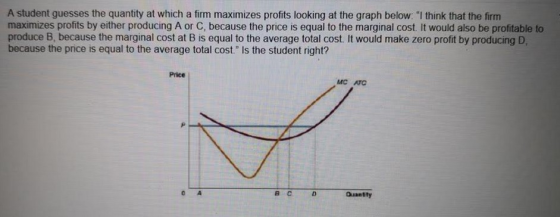
Please explain if the student is right not not ?
Homework Answers
Firm maximizes profit at the point : MR = MC
P = MC = MR ( in competitive market ) . So profit maximization occurs at C . The point is where MC cuts MR from below .
The price level is above ATC .
At point A it does not maximize profit . B is also not profit maximization point , but yes it would be profitable .
Add Answer to:
Please explain if the student is right not not ?
A student guesses the quantity at...
The graph below shows a monopolist's demand (D), marginal revenue (MR), marginal cost (MC), and average...
 The graph below shows a monopolist's demand (D), marginal
revenue (MR), marginal cost (MC), and average total cost (ATC)
curves. Management wants to adjust the production output quantity
to maximize the firm's profits. What quantity should the firm aim
for?
Give your answer by dragging the Q line to a new position to mark
the quantity at which profit is as large as possible.
Price and cost ATC MC MR Quantity
The graph below shows a monopolist's demand (D), marginal
revenue (MR), marginal cost (MC), and average total cost (ATC)
curves. Management wants to adjust the production output quantity
to maximize the firm's profits. What quantity should the firm aim
for?
Give your answer by dragging the Q line to a new position to mark
the quantity at which profit is as large as possible.
Price and cost ATC MC MR Quantity
MC ATC MR L M QUANTITY 1. Use Figure 40.1 to answer these questions. (A) At...
 MC ATC MR L M QUANTITY 1. Use Figure 40.1 to answer these questions. (A) At what level of output will this firm operate? (B) What is marginal revenue at this level of output? (C) What price will this firm charge for its product? (D) The area of which rectangle is equal to total revenue? (E) What is the firm's average total cost? (F) The area of which rectangle is equal to the firm's total cost? (G) Is the firm...
The graph below shows a monopolist's demand (D), marginal revenue (MR), marginal cost (MC), and average total cost (ATC) curves. Management wants to adjust the production output quantity to maximize the firm's profits. What quantity should the firm aim fo
 The graph below shows a monopolist's demand (D), marginal revenue (MR), marginal cost (MC), and average total cost (ATC) curves. Management wants to adjust the production output quantity to maximize the firm's profits. What quantity should the firm aim for?Give your answer by dragging the Q line to a new position to mark the quantity at which profit is as large as possible. To refer to the graphing tutorial for this question type, please click here.
The graph to the right depicts the average cost curves and the marginal cost curve for...
 The graph to the right depicts the average cost curves and the marginal cost curve for a typical firm in a competitive industry. 1.) Using the line drawing fool, draw the firm's demand curve at a market price such that the firm is breaking even. Label your curved, 2.) Using the line drawing tool, draw the firm's demand curve at a market price such that the firm is at its shutdown price. Label your curved, Carefully follow the instructions above,...
QUESTION 1 Table 13-16 Quantity Total Cost Fixed Cost Variable Cost Marginal Cost Average Fixed Cost...
 QUESTION 1 Table 13-16 Quantity Total Cost Fixed Cost Variable Cost Marginal Cost Average Fixed Cost Average Variable Cost Average Total Cost 0 $24 $50 3 $108 $40 Refer to Table 13-16. What is the total cost of producing 2 units of output? a. $76 b. $50 c. $58 d. $74 Figure 14-13 Suppose a firm in a competitive industry has the following cost curves: sem MC ATC AVC Refer to Figure 14-13. If the price is $6 in the...
MR, MC, and ATC $12.00 MC $10.00 $8.00 $6.00 $4.00 ATC ATC = $2.75 $2.00 MR...
 MR, MC, and ATC $12.00 MC $10.00 $8.00 $6.00 $4.00 ATC ATC = $2.75 $2.00 MR P = $1.50 $0.00 0 1 120 20 40 Average Total Cost (ATC) 60 - Marginal Cost (MC) 80 100 R Marginal Revenue (MR) Question 2 of Quiz 4: If the firm maximizes the profit, calculate the profit of the perfectly competitive firm when the price is $1.5, show your calculation. Is that equal to the size of the red rectangle?
12.00 Lauren grows grapes. Her average variable cost (AVC), average total cost (ATC), and marginal cost...
 12.00 Lauren grows grapes. Her average variable cost (AVC), average total cost (ATC), and marginal cost (MC) of production are illustrated in the figure to the right. 11.00 Assume the market for grapes is perfectly competitive and that the market price is $2.00 per crate. MC Characterize Lauren's economic profits. Assume she produces such that she maximizes profits in the short run. ATC Using the rectangle drawing tool, shade in Lauren's economic profits. Attach the correct label to indicate whether...
Suppose a firm producing table lamps has the following costs: Quantity 1,000 2,000 3,000 4,000 5,000...
 Suppose a firm producing table lamps has the following costs: Quantity 1,000 2,000 3,000 4,000 5,000 6,000 7,000 8,000 9,000 Average Total Cost $15.00 9.75 8.25 7.50 7.75 8.50 9.75 10.50 12.00 Ben and Jerry are managers at the company, and they have this discussion: Ben: We should produce 4,000 lamps per month because that will minimize our average costs. Jerry: But shouldn't we maximize profits rather than minimize costs? To maximize profits, don't we need to take demand into...
In long run equilibrium, a competitive firm maximizes profits by a. producing an output level where...
In long run equilibrium, a competitive firm maximizes profits by a. producing an output level where marginal revenue equals marginal cost. b. charging a price equal to marginal revenue and marginal cost. c. charging a price where marginal cost equals average total cost. d. All of the above are correct.
The graph below depicts the cost curves of ABC Water and Heat. ABC has a natural...
 The graph below depicts the cost curves of ABC Water and Heat. ABC has a natural monopoly in natural gas delivery in its immediate area. Monopoly pricing Marginal cost pricing Average cost pricing Price ($/MMBTU) Average total cost Marginal cost Marginal revenue Demand Quantity (MMBTU) a. Place the point labelled “Monopoly pricing" at the appropriate coordinates to indicate the monopoly price and quantity b. Suppose the government tries to achieve allocative efficiency (P = MC) by imposing a marginal cost...
 The graph below shows a monopolist's demand (D), marginal
revenue (MR), marginal cost (MC), and average total cost (ATC)
curves. Management wants to adjust the production output quantity
to maximize the firm's profits. What quantity should the firm aim
for?
Give your answer by dragging the Q line to a new position to mark
the quantity at which profit is as large as possible.
Price and cost ATC MC MR Quantity
The graph below shows a monopolist's demand (D), marginal
revenue (MR), marginal cost (MC), and average total cost (ATC)
curves. Management wants to adjust the production output quantity
to maximize the firm's profits. What quantity should the firm aim
for?
Give your answer by dragging the Q line to a new position to mark
the quantity at which profit is as large as possible.
Price and cost ATC MC MR Quantity
 MC ATC MR L M QUANTITY 1. Use Figure 40.1 to answer these questions. (A) At what level of output will this firm operate? (B) What is marginal revenue at this level of output? (C) What price will this firm charge for its product? (D) The area of which rectangle is equal to total revenue? (E) What is the firm's average total cost? (F) The area of which rectangle is equal to the firm's total cost? (G) Is the firm...
 The graph to the right depicts the average cost curves and the marginal cost curve for a typical firm in a competitive industry. 1.) Using the line drawing fool, draw the firm's demand curve at a market price such that the firm is breaking even. Label your curved, 2.) Using the line drawing tool, draw the firm's demand curve at a market price such that the firm is at its shutdown price. Label your curved, Carefully follow the instructions above,...
 QUESTION 1 Table 13-16 Quantity Total Cost Fixed Cost Variable Cost Marginal Cost Average Fixed Cost Average Variable Cost Average Total Cost 0 $24 $50 3 $108 $40 Refer to Table 13-16. What is the total cost of producing 2 units of output? a. $76 b. $50 c. $58 d. $74 Figure 14-13 Suppose a firm in a competitive industry has the following cost curves: sem MC ATC AVC Refer to Figure 14-13. If the price is $6 in the...
 MR, MC, and ATC $12.00 MC $10.00 $8.00 $6.00 $4.00 ATC ATC = $2.75 $2.00 MR P = $1.50 $0.00 0 1 120 20 40 Average Total Cost (ATC) 60 - Marginal Cost (MC) 80 100 R Marginal Revenue (MR) Question 2 of Quiz 4: If the firm maximizes the profit, calculate the profit of the perfectly competitive firm when the price is $1.5, show your calculation. Is that equal to the size of the red rectangle?
 12.00 Lauren grows grapes. Her average variable cost (AVC), average total cost (ATC), and marginal cost (MC) of production are illustrated in the figure to the right. 11.00 Assume the market for grapes is perfectly competitive and that the market price is $2.00 per crate. MC Characterize Lauren's economic profits. Assume she produces such that she maximizes profits in the short run. ATC Using the rectangle drawing tool, shade in Lauren's economic profits. Attach the correct label to indicate whether...
 Suppose a firm producing table lamps has the following costs: Quantity 1,000 2,000 3,000 4,000 5,000 6,000 7,000 8,000 9,000 Average Total Cost $15.00 9.75 8.25 7.50 7.75 8.50 9.75 10.50 12.00 Ben and Jerry are managers at the company, and they have this discussion: Ben: We should produce 4,000 lamps per month because that will minimize our average costs. Jerry: But shouldn't we maximize profits rather than minimize costs? To maximize profits, don't we need to take demand into...
 The graph below depicts the cost curves of ABC Water and Heat. ABC has a natural monopoly in natural gas delivery in its immediate area. Monopoly pricing Marginal cost pricing Average cost pricing Price ($/MMBTU) Average total cost Marginal cost Marginal revenue Demand Quantity (MMBTU) a. Place the point labelled “Monopoly pricing" at the appropriate coordinates to indicate the monopoly price and quantity b. Suppose the government tries to achieve allocative efficiency (P = MC) by imposing a marginal cost...
Most questions answered within 3 hours.
-
Where is the error in this code sequence?
String s1 = "Hello";
String s2 = "ello";...
asked 10 months ago -
Financial data for Joel de Paris, Inc., for last year
follow:
Joel de Paris, Inc.
Balance...
asked 10 months ago -
Consider this reaction:
Al2(SO4)3 (aq)+ BaCl3
(aq) Al2Cl6 (aq)- +
3BaSO4(s) . What is the...
asked 10 months ago -
Suppose that Savneet is considering increasing her
recent random sample from 20 car rentals to 40...
asked 10 months ago -
Trucks arrive at an unloading terminal at an average rate of 120
per hour.
Trucks arrive...
asked 10 months ago -
Why are methanol and ethanol completely soluble in water while
octanol is not very little soluble....
asked 10 months ago -
A facilities manager at a university reads in a research report
that the mean amount of...
asked 10 months ago -
When the CuSO4 is rehydrated by adding water to the anhydrous
compound, is this an endothermic...
asked 10 months ago -
A ray of sunlight is passing from diamond into crown glass; the
angle of incidence is...
asked 10 months ago -
A block of mass 0.249 kg is placed on top of a light, vertical
spring of...
asked 10 months ago -
how do the kidneys compensate in the presences of acidosis
a) trigger hyperventilate
b) reserve acid...
asked 10 months ago -
Question 501 pts
The rental rate of capital to the firm increases. Which of the
following...
asked 10 months ago