Intermediate Microeconomics Assn 2 #2
Homework Answers
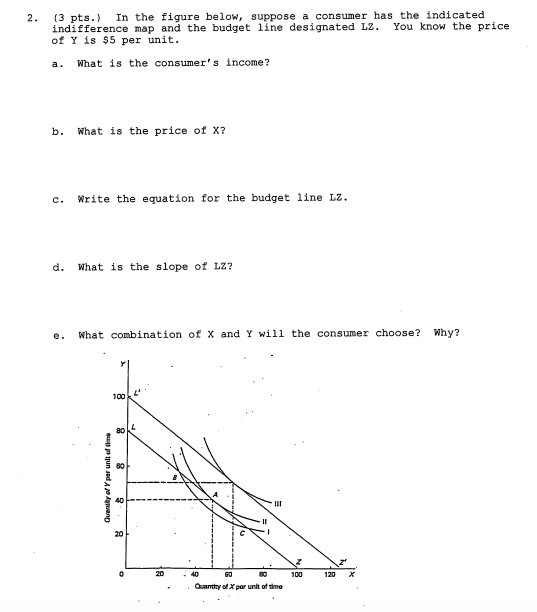
(1) Y- axis intercept of budget line = (Income / Price of good measured on Y-axis)
Budget line is LZ
Y-axis intercept = (income / price of good measured on Y-axis)
80 = (income / $5)
Income = 80 * ($5)
Income = $400
Consumer income is $400.
(2) X- axis intercept of budget line = (Income / Price of good measured on X-axis)
Budget line is LZ
X-axis intercept = (income / price of good measured on X-axis)
100 = ($400 / price of good measured on X-axis)
Price of good measured on X-axis = ($400 /100)
Price of good measured on X-axis = $4
(3) Equation of budget line LZ.
Price of good X * Quantity of good X + Price of good Y * Quantity of good Y = Income
$4 X + $5 Y = $400.
Where, X is the quantity of good X
Y is the quantity of good Y.
(4) Slope of budget line LZ = -(Price of good X / Price of good Y)
Slope of budget line LZ = -($4 / $5)
Slope of budget line LZ = -0.8
(5) Utility is maximized at the tangent point of indifference curve and budget line.
In the given figure, indifference curve II and budget line LZ is tangent at point A.
Hence, the utility maximizing quantities are 50 units of X and 40 units of Y
Add Answer to:
Intermediate Microeconomics Assn 2 #2
2. (3 pts.) In the figure below, suppose a consumer has...
Suppose a consumer has budget of $120 per week to spend on food. Consumer can choose...
 Suppose a consumer has budget of $120 per week to spend on food. Consumer can choose to eat at restaurants (R), in which case he spends about $20 per meal (P $20), or spend his money on All-Other-Food (PAOP $1) 2. a. Ilustrate consumer's budget line. Plot R on the horizontal axis. b. If consumer's utility function is U-R AOF, what will be his optimal bundle? What would be the value of his utility at optimal bundle? How much money...
Consider a consumer in a two commodity world whose indifference map is such that the slope...
Consider a consumer in a two commodity world whose indifference map is such that the slope of the indifference curves is everywhere equal to -(Y?X), where Y is the quantity of good Y measured along the vertical axis, and X is the quantity of good X measured along the horizontal axis. a. what is the value of the optimum Marginal Rate of Substitution for this consumer, given that the price of X is $1, the price of Y is $3...
A Consumer's Demand for Burgers Suppose that the consumer has income, I = $20, and the...
 A Consumer's Demand for Burgers Suppose that the consumer has income, I = $20, and the price of French fries is pe = $2. You are given the following information about the price of burgers and the number of burgers the consumer will buy at that price: Price of Burgers Quantity of Burgers A B C $1.00 $2.00 $5.00 10 5 2 Use an indifference curve and budget line diagram to draw the consumer's three budget lines and three optimal...
2. Suppose that a consumer has income of $12 to spend on and r2. Also suppose...
 2. Suppose that a consumer has income of $12 to spend on and r2. Also suppose that the price of 띠 is $2 per unit and the price of x2 is $1 per unit. You will be asked to draw the three budget line in one diagram. Please label each (as (a), (b) and (c) carefully (a) Draw the consumer's budget line on a diagram where a is on the horizontal axis and r2 is on the vertical axis. the...
If a consumer is spending a small portion of his or her income on a good,...
If a consumer is spending a small portion of his or her income on a good, then the demand for the good is likely to be inelastic. True False A consumer is in equilibrium when the slope of his or her indifference curve is equal to his or her budget constraint. True False The below figure shows the various combinations of the goods X and Y that yield different levels of utility. Figure 7.3 In Figure 7.3, if the price...
Suppose that there two goods X and Y, available in arbitrary non- negative quantities (so the...
 Suppose that there two goods X and Y, available in arbitrary non- negative quantities (so the the consumption set is R2). The consumer has preferences over consumption bundles that are strongly monotone, strictly convex, and represented by the following (differentiable) utility function: u(x, y)-y+2aVT, where z is the quantity of good X, and y is the quantity of good Y, and a 20 is a utility parameter The consumer has strictly positive wealth w > 0. The price of good...
A consumer has the utility function U(X, Y) = (X + 2)(Y + 4). Her income is...
A consumer has the utility function U(X, Y) = (X + 2)(Y + 4). Her income is $100, the price of X is $4, and the price of Y is $5. In order to maximize utility subject to her budget constraint, how many units of X and Y will our consumer choose to purchase? Sketch a budget line – indifference curve diagram illustrating this optimum. Label this optimum A. Suppose the price of X increases to $8, while income and the price...
Consider a consumer with a utility function u(x1, x2) = min{21, 222}. Suppose the prices of...
 Consider a consumer with a utility function u(x1, x2) = min{21, 222}. Suppose the prices of good 1 and good 2 are p1 = P2 = 4. The consumer's income is m = 120. (a) Find the consumer's preferred bundle. (b) Draw the consumer's budget line. (c) On the same graph, indicate the consumer's preferred bundle and draw the indifference curve through it. (d) Now suppose that the consumer gets a discount on good 1: each unit beyond the 4th...
Need help with this practice problem 2. (20 points) Suppose a consumer has $250 to spend...
 Need help with this practice problem
2. (20 points) Suppose a consumer has $250 to spend on two goods, Good X and Good Y. The price of Good X is given by Py = $10. The price of Good Y is given by Py = $25. Graph the consumer's budget constraint. Please put the quantity of Good X on the horizontal axis, and the quantity of Good Y on the vertical axis. Be sure to label your graph carefully and...
Need help with this practice problem
2. (20 points) Suppose a consumer has $250 to spend on two goods, Good X and Good Y. The price of Good X is given by Py = $10. The price of Good Y is given by Py = $25. Graph the consumer's budget constraint. Please put the quantity of Good X on the horizontal axis, and the quantity of Good Y on the vertical axis. Be sure to label your graph carefully and...
Q1. Suppose consumer consumes two goods, X and Y. The price of X is P x...
Q1. Suppose consumer consumes two goods, X and Y. The price of X is P x , price of Y is P Y and the consumer income is m. a. Derive and interpret the budget constraint and its slope. b. If slope is -3, how will you interpret it? c. Suppose a government wants to discourage the excessive consumption of X and decides to impose a tax t 1 if someone consume more than X 1 but less than X...
 Suppose a consumer has budget of $120 per week to spend on food. Consumer can choose to eat at restaurants (R), in which case he spends about $20 per meal (P $20), or spend his money on All-Other-Food (PAOP $1) 2. a. Ilustrate consumer's budget line. Plot R on the horizontal axis. b. If consumer's utility function is U-R AOF, what will be his optimal bundle? What would be the value of his utility at optimal bundle? How much money...
 A Consumer's Demand for Burgers Suppose that the consumer has income, I = $20, and the price of French fries is pe = $2. You are given the following information about the price of burgers and the number of burgers the consumer will buy at that price: Price of Burgers Quantity of Burgers A B C $1.00 $2.00 $5.00 10 5 2 Use an indifference curve and budget line diagram to draw the consumer's three budget lines and three optimal...
 2. Suppose that a consumer has income of $12 to spend on and r2. Also suppose that the price of 띠 is $2 per unit and the price of x2 is $1 per unit. You will be asked to draw the three budget line in one diagram. Please label each (as (a), (b) and (c) carefully (a) Draw the consumer's budget line on a diagram where a is on the horizontal axis and r2 is on the vertical axis. the...
 Suppose that there two goods X and Y, available in arbitrary non- negative quantities (so the the consumption set is R2). The consumer has preferences over consumption bundles that are strongly monotone, strictly convex, and represented by the following (differentiable) utility function: u(x, y)-y+2aVT, where z is the quantity of good X, and y is the quantity of good Y, and a 20 is a utility parameter The consumer has strictly positive wealth w > 0. The price of good...
 Consider a consumer with a utility function u(x1, x2) = min{21, 222}. Suppose the prices of good 1 and good 2 are p1 = P2 = 4. The consumer's income is m = 120. (a) Find the consumer's preferred bundle. (b) Draw the consumer's budget line. (c) On the same graph, indicate the consumer's preferred bundle and draw the indifference curve through it. (d) Now suppose that the consumer gets a discount on good 1: each unit beyond the 4th...
 Need help with this practice problem
2. (20 points) Suppose a consumer has $250 to spend on two goods, Good X and Good Y. The price of Good X is given by Py = $10. The price of Good Y is given by Py = $25. Graph the consumer's budget constraint. Please put the quantity of Good X on the horizontal axis, and the quantity of Good Y on the vertical axis. Be sure to label your graph carefully and...
Need help with this practice problem
2. (20 points) Suppose a consumer has $250 to spend on two goods, Good X and Good Y. The price of Good X is given by Py = $10. The price of Good Y is given by Py = $25. Graph the consumer's budget constraint. Please put the quantity of Good X on the horizontal axis, and the quantity of Good Y on the vertical axis. Be sure to label your graph carefully and...
Most questions answered within 3 hours.
-
Where is the error in this code sequence?
String s1 = "Hello";
String s2 = "ello";...
asked 10 months ago -
Financial data for Joel de Paris, Inc., for last year
follow:
Joel de Paris, Inc.
Balance...
asked 10 months ago -
Consider this reaction:
Al2(SO4)3 (aq)+ BaCl3
(aq) Al2Cl6 (aq)- +
3BaSO4(s) . What is the...
asked 10 months ago -
Suppose that Savneet is considering increasing her
recent random sample from 20 car rentals to 40...
asked 10 months ago -
Trucks arrive at an unloading terminal at an average rate of 120
per hour.
Trucks arrive...
asked 10 months ago -
Why are methanol and ethanol completely soluble in water while
octanol is not very little soluble....
asked 10 months ago -
A facilities manager at a university reads in a research report
that the mean amount of...
asked 10 months ago -
When the CuSO4 is rehydrated by adding water to the anhydrous
compound, is this an endothermic...
asked 10 months ago -
A ray of sunlight is passing from diamond into crown glass; the
angle of incidence is...
asked 10 months ago -
A block of mass 0.249 kg is placed on top of a light, vertical
spring of...
asked 10 months ago -
how do the kidneys compensate in the presences of acidosis
a) trigger hyperventilate
b) reserve acid...
asked 10 months ago -
Question 501 pts
The rental rate of capital to the firm increases. Which of the
following...
asked 10 months ago