
Homework Answers
Add Answer to:
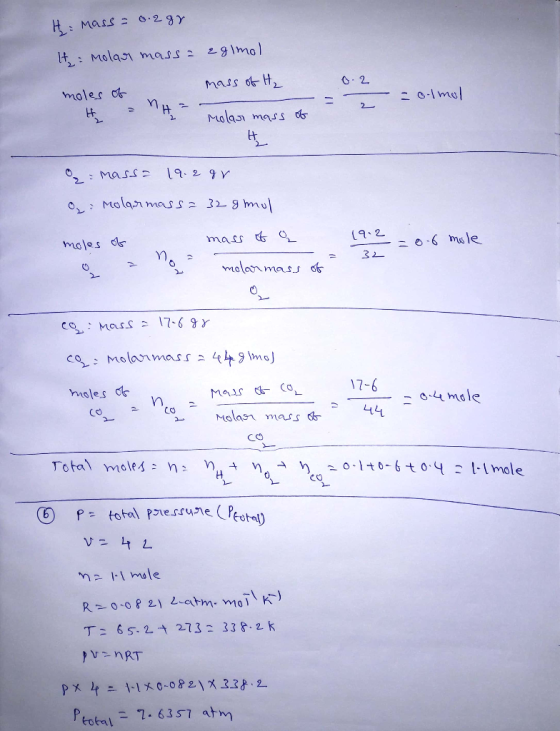
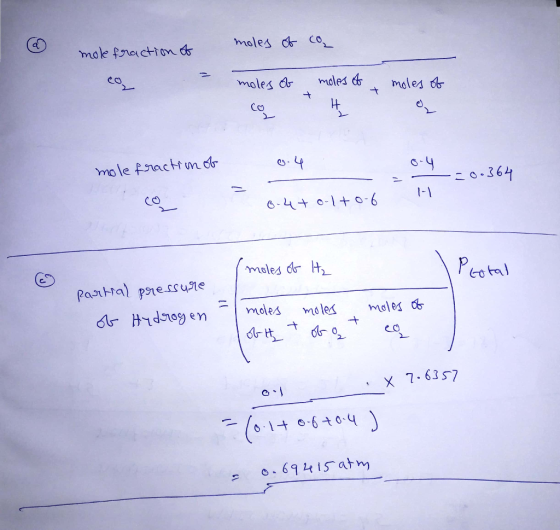
2. Consider a 4.0 L sample of gas contains 0.200 g H2, 19.20 go, and 17.60...
2. Consider a 4.0 L sample of gas contains 0.200 g H, 19.20 g 0, and...
 2. Consider a 4.0 L sample of gas contains 0.200 g H, 19.20 g 0, and 17.60 g Co, at 65.2°C. a. Determine the mol fraction of carbon dioxide. b. Determine the total pressure of the gas sample in atm. c. Determine the partial pressure of hydrogen.
A gas mixture contains 0.650 mol of N2, 0.200 mol of H2, and 0.200 mol of...
 A gas mixture contains 0.650 mol of N2, 0.200 mol of H2, and 0.200 mol of CH4. Calculate the pressure of the gas mixture and the partial pressure of each constituent gas if the mixture is in a 14.0 L vessel at 27.00°C. v 4th attempt Part 1 (1 pt) X Feedback See Periodic Table D See Hint total pressure in the vessel $ 2.70 atm Part 2 (1 pt) *Feedback pressure of H2 0.560 atm Part 3 (1 pt)...
1) A gaseous mixture contains 419.0 Torr H2(g),419.0 Torr H2(g), 359.1 Torr N2(g),359.1 Torr N2(g), and...
1) A gaseous mixture contains 419.0 Torr H2(g),419.0 Torr H2(g), 359.1 Torr N2(g),359.1 Torr N2(g), and 65.7 Torr Ar(g).65.7 Torr Ar(g). Calculate the mole fraction, ?,χ, of each of these gases. 2) Heliox is a helium‑oxygen mixture that may be used in scuba tanks for divers working at great depths. It is also used medically as a breathing treatment. A 7.25 L7.25 L tank holds helium gas at a pressure of 1168 psi.1168 psi. A second 7.25 L7.25 L tank...
A tank contains a mixture of 48.2 g of oxygen gas and 70.0 g of carbon...
 A tank contains a mixture of 48.2 g of oxygen gas and 70.0 g of carbon dioxide gas at 23 °C. The total pressure in the tank is 8.40 atm. Calculate the partial pressure (in atm) of each gas in the mixture. Partial pressure = atm O2 Partial pressure = atm CO2 What mass of neon gas is required to fill a 8.00 L container to a pressure of 1.42 atm at 18 °C? Mass = g Ne How many...
A 5.00 L tank at 24.6 °C is filled with 2.30 g of carbon dioxide gas...
 A 5.00 L tank at 24.6 °C is filled with 2.30 g of carbon dioxide gas and 3.32 g of dinitrogen difluoride gas. You can assume both gases behave as ideal gases under these conditions. Calculate the mole fraction and partial pressure of each gas, and the total pressure in the tank. Be sure your answers have the correct number of significant digits. mole fraction: carbon dioxide partial pressure: atm x 6 ? mole fraction: dinitrogen difluoride partial pressure: atm...
A 8.00 L tank at 10.2 °C is filled with 8.47 g of chlorine pentafluoride gas...
 A 8.00 L tank at 10.2 °C is filled with 8.47 g of chlorine pentafluoride gas and 12.1 g of carbon dioxide gas. You can assume both gases behave as ideal gases under these conditions. Calculate the mole fraction and partial pressure of each gas, and the total pressure in the tank. Be sure your answers have the correct number of significant digits. mole fraction: chlorine pentafluoride partial pressure: | atm x 6 ? mole fraction: carbon dioxide partial pressure:...
1- A mixture of hydrogen and argon gases, in a 8.69 L flask at 77 °C,...
1- A mixture of hydrogen and argon gases, in a 8.69 L flask at 77 °C, contains 0.477 grams of hydrogen and 7.10 grams of argon. The partial pressure of argon in the flask is ____ atm and the total pressure in the flask is ____ atm. 2- A mixture of methane and carbon dioxide gases is maintained in a 7.86 L flask at a pressure of 1.93 atm and a temperature of 39 °C. If the gas mixture contains...
An equilibrium mixture contains 0.550 mol of each of the products (carbon dioxide and hydrogen gas)...
An equilibrium mixture contains 0.550 mol of each of the products (carbon dioxide and hydrogen gas) and 0.200 mol of each of the reactants (carbon monoxide and water vapor) in a 1.00 L container. CO(g)+H2O(g)−⇀↽−CO2(g)+H2(g) How many moles of carbon dioxide would have to be added at constant temperature and volume to increase the amount of carbon monoxide to 0.300 mol once equilibrium has been reestablished?
An equilibrium mixture contains 0.350 mol of each of the products (carbon dioxide and hydrogen gas)...
An equilibrium mixture contains 0.350 mol of each of the products (carbon dioxide and hydrogen gas) and 0.200 mol of each of the reactants (carbon monoxide and water vapor) in a 1.00 L container. CO(g)+H2O(g)−⇀↽−CO2(g)+H2(g) How many moles of carbon dioxide would have to be added at constant temperature and volume to increase the amount of carbon monoxide to 0.300 mol once equilibrium has been reestablished?
A 50.0 L gas mixture at T = 500 K contains 123.0 g H2 and 855.0...
A 50.0 L gas mixture at T = 500 K contains 123.0 g H2 and 855.0 g CO. What is the total pressure of the mixture? Assume ideal-gas behavior. Molar masses: M(H2) = 2.016 g/mol, M(CO) = 28.01 g/mol. (A) 116 atm (B) 75.1 atm (C) 50.1 atm (D) 34.1 atm (E) 25.0 atm
 2. Consider a 4.0 L sample of gas contains 0.200 g H, 19.20 g 0, and 17.60 g Co, at 65.2°C. a. Determine the mol fraction of carbon dioxide. b. Determine the total pressure of the gas sample in atm. c. Determine the partial pressure of hydrogen.
 A gas mixture contains 0.650 mol of N2, 0.200 mol of H2, and 0.200 mol of CH4. Calculate the pressure of the gas mixture and the partial pressure of each constituent gas if the mixture is in a 14.0 L vessel at 27.00°C. v 4th attempt Part 1 (1 pt) X Feedback See Periodic Table D See Hint total pressure in the vessel $ 2.70 atm Part 2 (1 pt) *Feedback pressure of H2 0.560 atm Part 3 (1 pt)...
 A tank contains a mixture of 48.2 g of oxygen gas and 70.0 g of carbon dioxide gas at 23 °C. The total pressure in the tank is 8.40 atm. Calculate the partial pressure (in atm) of each gas in the mixture. Partial pressure = atm O2 Partial pressure = atm CO2 What mass of neon gas is required to fill a 8.00 L container to a pressure of 1.42 atm at 18 °C? Mass = g Ne How many...
 A 5.00 L tank at 24.6 °C is filled with 2.30 g of carbon dioxide gas and 3.32 g of dinitrogen difluoride gas. You can assume both gases behave as ideal gases under these conditions. Calculate the mole fraction and partial pressure of each gas, and the total pressure in the tank. Be sure your answers have the correct number of significant digits. mole fraction: carbon dioxide partial pressure: atm x 6 ? mole fraction: dinitrogen difluoride partial pressure: atm...
 A 8.00 L tank at 10.2 °C is filled with 8.47 g of chlorine pentafluoride gas and 12.1 g of carbon dioxide gas. You can assume both gases behave as ideal gases under these conditions. Calculate the mole fraction and partial pressure of each gas, and the total pressure in the tank. Be sure your answers have the correct number of significant digits. mole fraction: chlorine pentafluoride partial pressure: | atm x 6 ? mole fraction: carbon dioxide partial pressure:...
Most questions answered within 3 hours.
-
Where is the error in this code sequence?
String s1 = "Hello";
String s2 = "ello";...
asked 11 months ago -
Financial data for Joel de Paris, Inc., for last year
follow:
Joel de Paris, Inc.
Balance...
asked 11 months ago -
Consider this reaction:
Al2(SO4)3 (aq)+ BaCl3
(aq) Al2Cl6 (aq)- +
3BaSO4(s) . What is the...
asked 11 months ago -
Suppose that Savneet is considering increasing her
recent random sample from 20 car rentals to 40...
asked 11 months ago -
Trucks arrive at an unloading terminal at an average rate of 120
per hour.
Trucks arrive...
asked 11 months ago -
Why are methanol and ethanol completely soluble in water while
octanol is not very little soluble....
asked 11 months ago -
A facilities manager at a university reads in a research report
that the mean amount of...
asked 11 months ago -
When the CuSO4 is rehydrated by adding water to the anhydrous
compound, is this an endothermic...
asked 11 months ago -
A ray of sunlight is passing from diamond into crown glass; the
angle of incidence is...
asked 11 months ago -
A block of mass 0.249 kg is placed on top of a light, vertical
spring of...
asked 11 months ago -
how do the kidneys compensate in the presences of acidosis
a) trigger hyperventilate
b) reserve acid...
asked 11 months ago -
Question 501 pts
The rental rate of capital to the firm increases. Which of the
following...
asked 11 months ago