


Homework Answers
When price= 32
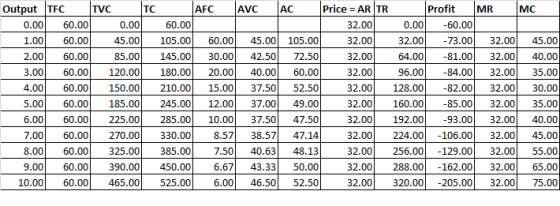
Following is the completed table:
- TC = TFC+TVC,
- TFC remains the same for all units of output. So if TC is given for units 0 10 when there is no TVC, then we know that the TC = TFC = 60
- Using this we calculate the TVC at each level as TC-TFC
- AFC = TFC/output
- AVC = TVC/output,
- AC = TC/output
- TR = Price x output

- Profit = TR-TC
- So at the price of 32, there is no optimal level of output
- The company should stop producing because AVC>AR and loss is lower when the company is not producing at 60 than at any level of output
Price = 41
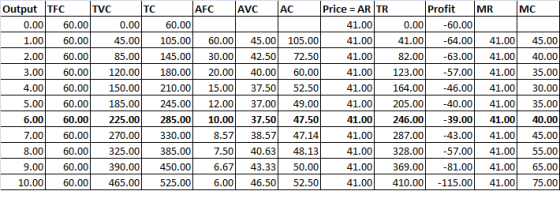
- Optimal level of production is 6 units. Although MR=MC but that happens somewhere in between units 6 and 7 but as units can't be fractional, so 6 units is where the loss is minimum
- Loss = $39
- Firm should produce because loss when it produces 6 units is 39 while that when it shuts down = fixed cost = 60
Price = 56
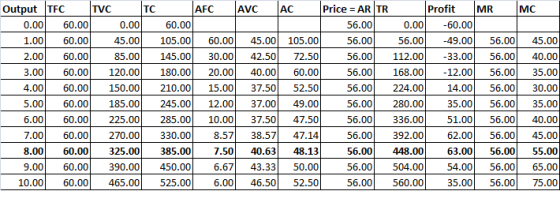
- Optimal level of production is 8 units. Although MR=MC but that happens somewhere in between units 8 and 9 but as units can't be fractional, so 8 units is where the profit is maximum
- Profit = 63
- Firm should produce because it makes a profit
Add Answer to:
Table 3 Again, it's a new price so only the Total Revenue, Marginal Revenue, and Profit/Loss...
I am lost. How would i do these? please show how you got the answer. Perfect...
 I am lost. How would i do these? please show how you got the
answer.
Perfect Competition Waldhet This is a combination of chapter 7 and 8 which includes the free possible market outcomes that were presented in the textbook. Complete the following worksheets and answer the questions Fach sheet Pives you the Price above the table and a complete Total Cost com Given that information you should be able to fill in the rest of the worksheet. You may...
I am lost. How would i do these? please show how you got the
answer.
Perfect Competition Waldhet This is a combination of chapter 7 and 8 which includes the free possible market outcomes that were presented in the textbook. Complete the following worksheets and answer the questions Fach sheet Pives you the Price above the table and a complete Total Cost com Given that information you should be able to fill in the rest of the worksheet. You may...
Fill out the table, answer questions at the end. Avg Total Cost Total Marginal Marginal Revenue Revenue Cost Perfect Co...
 Fill out the table, answer
questions at the end.
Avg Total Cost Total Marginal Marginal Revenue Revenue Cost Perfect Competition Price of output: $10 Fixed costs: $200 Avg Variable Fixed Total Variable Avg Fixed Output Cost Cost Cost Cost Cost $0 10 $50 $250 $20.00 20 $90 $4.50 30 $160 $360 $5.33 $6.67 $225 $300 $500 $6.00 $4.00 $395 70 $510 $710 $7.29 $2.86 80 $640 $8.00 1. What is the profit-maximizing level of output? 2. What are profits at...
Fill out the table, answer
questions at the end.
Avg Total Cost Total Marginal Marginal Revenue Revenue Cost Perfect Competition Price of output: $10 Fixed costs: $200 Avg Variable Fixed Total Variable Avg Fixed Output Cost Cost Cost Cost Cost $0 10 $50 $250 $20.00 20 $90 $4.50 30 $160 $360 $5.33 $6.67 $225 $300 $500 $6.00 $4.00 $395 70 $510 $710 $7.29 $2.86 80 $640 $8.00 1. What is the profit-maximizing level of output? 2. What are profits at...
Total Profit/Loss = Total Revenue - Total Expenses Revenue = Price * Units Discuss the following...
Total Profit/Loss = Total Revenue - Total Expenses Revenue = Price * Units Discuss the following pricing concepts: profit, revenue, pricing objectives (profit maximization vs. sales maximization), market share (in units and revenues), demand & supply, price equilibrium (shortage and surplus), the cost determinants of pricing (fixed cost and variable cost), and the breakeven analysis.
QUESTION 3 Marginal Revenue ($) Marginal Cost (5) Revenue (5) Table: Profit-Maximizing Monopolist Price Quantity Total...
 QUESTION 3 Marginal Revenue ($) Marginal Cost (5) Revenue (5) Table: Profit-Maximizing Monopolist Price Quantity Total Average ($) (Units) Cost ($) Cost ($) 11 6 17 10 7 19 9 8 21 8 9 23 17 10 25 Reference: Ref 13-2 (Table: Profit-Maximizing Monopolist) Refer to the table. The profit-maximizing quantity for this monopolist is units O A7 OB.9 OC. 10 D.8
QUESTION 1 Marginal Revenue ($) Marginal Cost ($) Revenue ($) Table: Profit-Maximizing Monopolist Price Quantity Total...
 QUESTION 1 Marginal Revenue ($) Marginal Cost ($) Revenue ($) Table: Profit-Maximizing Monopolist Price Quantity Total Average ($) (Units) Cost ($) Cost ($) 11 17 10 19 9 8 21 8 9 23 7 10 25 7 Reference: Ref 13-2 to the table. When this monopolist sells 8 units, its average cost and marginal cost levels are: (Table: Profit-Maximizing Monopolist) A. $2.56 and $2 respectively. B. $2.63 and $2 respectively. C. $2.56 and 54 respectively. OD. $2.63 and 54 respectively.
Table 2 Units of Labor Total Product Imperfect Competition Marginal Marginal Product Total Revenue Product Price...
 Table 2 Units of Labor Total Product Imperfect Competition Marginal Marginal Product Total Revenue Product Price Revenue Product IIIIIII ||| 3. How many workers will the firm hire if the market wage rate is $27.95? 4. How many workers will the firm hire if the market wage rate is $19.95? 5. Compare the hiring practices of the firm under Pure Competition and Imperfect Competition. In which situation is the demand for labor more elastic?
The table below shows the costs and demand for the clove oil industry. Total Revenue Marginal...
 The table below shows the costs and demand for the clove oil industry. Total Revenue Marginal Revenue Marginal Cost Total Cost Total Profit/Loss Quantity Price 136 162 190 a. Complete the table above. b. If this industry was perfectly competitive, what would be the output, price, and total industry profit/loss? Output: Price: $0 Profit/loss: $ c. If this industry was a monopoly industry, what would be the output, price, and total industry profit/loss? Output: O Price: $0 Profit/loss: $0
Price Quantity Total Revenue Marginal Revenue Total Cost Marginal Cost RU 91 96 Suppose the local...
 Price Quantity Total Revenue Marginal Revenue Total Cost Marginal Cost RU 91 96 Suppose the local government imposes a $26 per month tax on cable companies. What will Comcast do? (Assume fixed costs equal $15.) A Comcast should produce 6 units in the short run and shut down in the long run O B. Comcast should shut down in the short run and in the long run. OC Comcast should shut down in the short run and produce 6 units...
Please provide your answers and explanations. (No handwriting pls because it is so difficult to read..) Thank you in ad...
 Please provide your answers and explanations. (No handwriting
pls because it is so difficult to read..)
Thank you in advance.
Assignment 6-Q1 SMC ATC Answer the following questions using the cost curves for a firm under perfect competition shown in the figure. 1. How do you draw a marginal revenue curve when the price of good is given at $3.0? 2. How many units should the firm produce? At the production level in 1 above, how much is average total...
Please provide your answers and explanations. (No handwriting
pls because it is so difficult to read..)
Thank you in advance.
Assignment 6-Q1 SMC ATC Answer the following questions using the cost curves for a firm under perfect competition shown in the figure. 1. How do you draw a marginal revenue curve when the price of good is given at $3.0? 2. How many units should the firm produce? At the production level in 1 above, how much is average total...
two price-taking firms compete by setting quantities of output, then Select one: O a marginal revenue...
 two price-taking firms compete by setting quantities of output, then Select one: O a marginal revenue is the same as the market price. b. social surplus will be maximized. O c. the market price will be climater than marginal cost. Od they will produce the same amount of output as in perfect competition. If a firm sells its output on a market that is characterized by many sellers and buyers, a differentiated product, and unlimited long run resource mobility, then...
 I am lost. How would i do these? please show how you got the
answer.
Perfect Competition Waldhet This is a combination of chapter 7 and 8 which includes the free possible market outcomes that were presented in the textbook. Complete the following worksheets and answer the questions Fach sheet Pives you the Price above the table and a complete Total Cost com Given that information you should be able to fill in the rest of the worksheet. You may...
I am lost. How would i do these? please show how you got the
answer.
Perfect Competition Waldhet This is a combination of chapter 7 and 8 which includes the free possible market outcomes that were presented in the textbook. Complete the following worksheets and answer the questions Fach sheet Pives you the Price above the table and a complete Total Cost com Given that information you should be able to fill in the rest of the worksheet. You may...
 Fill out the table, answer
questions at the end.
Avg Total Cost Total Marginal Marginal Revenue Revenue Cost Perfect Competition Price of output: $10 Fixed costs: $200 Avg Variable Fixed Total Variable Avg Fixed Output Cost Cost Cost Cost Cost $0 10 $50 $250 $20.00 20 $90 $4.50 30 $160 $360 $5.33 $6.67 $225 $300 $500 $6.00 $4.00 $395 70 $510 $710 $7.29 $2.86 80 $640 $8.00 1. What is the profit-maximizing level of output? 2. What are profits at...
Fill out the table, answer
questions at the end.
Avg Total Cost Total Marginal Marginal Revenue Revenue Cost Perfect Competition Price of output: $10 Fixed costs: $200 Avg Variable Fixed Total Variable Avg Fixed Output Cost Cost Cost Cost Cost $0 10 $50 $250 $20.00 20 $90 $4.50 30 $160 $360 $5.33 $6.67 $225 $300 $500 $6.00 $4.00 $395 70 $510 $710 $7.29 $2.86 80 $640 $8.00 1. What is the profit-maximizing level of output? 2. What are profits at...
 QUESTION 3 Marginal Revenue ($) Marginal Cost (5) Revenue (5) Table: Profit-Maximizing Monopolist Price Quantity Total Average ($) (Units) Cost ($) Cost ($) 11 6 17 10 7 19 9 8 21 8 9 23 17 10 25 Reference: Ref 13-2 (Table: Profit-Maximizing Monopolist) Refer to the table. The profit-maximizing quantity for this monopolist is units O A7 OB.9 OC. 10 D.8
 QUESTION 1 Marginal Revenue ($) Marginal Cost ($) Revenue ($) Table: Profit-Maximizing Monopolist Price Quantity Total Average ($) (Units) Cost ($) Cost ($) 11 17 10 19 9 8 21 8 9 23 7 10 25 7 Reference: Ref 13-2 to the table. When this monopolist sells 8 units, its average cost and marginal cost levels are: (Table: Profit-Maximizing Monopolist) A. $2.56 and $2 respectively. B. $2.63 and $2 respectively. C. $2.56 and 54 respectively. OD. $2.63 and 54 respectively.
 Table 2 Units of Labor Total Product Imperfect Competition Marginal Marginal Product Total Revenue Product Price Revenue Product IIIIIII ||| 3. How many workers will the firm hire if the market wage rate is $27.95? 4. How many workers will the firm hire if the market wage rate is $19.95? 5. Compare the hiring practices of the firm under Pure Competition and Imperfect Competition. In which situation is the demand for labor more elastic?
 The table below shows the costs and demand for the clove oil industry. Total Revenue Marginal Revenue Marginal Cost Total Cost Total Profit/Loss Quantity Price 136 162 190 a. Complete the table above. b. If this industry was perfectly competitive, what would be the output, price, and total industry profit/loss? Output: Price: $0 Profit/loss: $ c. If this industry was a monopoly industry, what would be the output, price, and total industry profit/loss? Output: O Price: $0 Profit/loss: $0
 Price Quantity Total Revenue Marginal Revenue Total Cost Marginal Cost RU 91 96 Suppose the local government imposes a $26 per month tax on cable companies. What will Comcast do? (Assume fixed costs equal $15.) A Comcast should produce 6 units in the short run and shut down in the long run O B. Comcast should shut down in the short run and in the long run. OC Comcast should shut down in the short run and produce 6 units...
 Please provide your answers and explanations. (No handwriting
pls because it is so difficult to read..)
Thank you in advance.
Assignment 6-Q1 SMC ATC Answer the following questions using the cost curves for a firm under perfect competition shown in the figure. 1. How do you draw a marginal revenue curve when the price of good is given at $3.0? 2. How many units should the firm produce? At the production level in 1 above, how much is average total...
Please provide your answers and explanations. (No handwriting
pls because it is so difficult to read..)
Thank you in advance.
Assignment 6-Q1 SMC ATC Answer the following questions using the cost curves for a firm under perfect competition shown in the figure. 1. How do you draw a marginal revenue curve when the price of good is given at $3.0? 2. How many units should the firm produce? At the production level in 1 above, how much is average total...
 two price-taking firms compete by setting quantities of output, then Select one: O a marginal revenue is the same as the market price. b. social surplus will be maximized. O c. the market price will be climater than marginal cost. Od they will produce the same amount of output as in perfect competition. If a firm sells its output on a market that is characterized by many sellers and buyers, a differentiated product, and unlimited long run resource mobility, then...
Most questions answered within 3 hours.
-
Where is the error in this code sequence?
String s1 = "Hello";
String s2 = "ello";...
asked 10 months ago -
Financial data for Joel de Paris, Inc., for last year
follow:
Joel de Paris, Inc.
Balance...
asked 10 months ago -
Consider this reaction:
Al2(SO4)3 (aq)+ BaCl3
(aq) Al2Cl6 (aq)- +
3BaSO4(s) . What is the...
asked 10 months ago -
Suppose that Savneet is considering increasing her
recent random sample from 20 car rentals to 40...
asked 10 months ago -
Trucks arrive at an unloading terminal at an average rate of 120
per hour.
Trucks arrive...
asked 10 months ago -
Why are methanol and ethanol completely soluble in water while
octanol is not very little soluble....
asked 10 months ago -
A facilities manager at a university reads in a research report
that the mean amount of...
asked 10 months ago -
When the CuSO4 is rehydrated by adding water to the anhydrous
compound, is this an endothermic...
asked 10 months ago -
A ray of sunlight is passing from diamond into crown glass; the
angle of incidence is...
asked 10 months ago -
A block of mass 0.249 kg is placed on top of a light, vertical
spring of...
asked 10 months ago -
how do the kidneys compensate in the presences of acidosis
a) trigger hyperventilate
b) reserve acid...
asked 10 months ago -
Question 501 pts
The rental rate of capital to the firm increases. Which of the
following...
asked 10 months ago