
Homework Answers

Add Answer to:
Please show electron flow. Because the leaving group is attached to
2 carbons and EtOH is...
please hurry medewes the best leaving group? mist the expected for product of the following reaction...
 please hurry
medewes the best leaving group? mist the expected for product of the following reaction sequence? 1. A-BUOK, BUOH Question 23 What type of solvent is ethanol (EtOH)? 4. polar aprotic apolar aprotic polar protic
please hurry
medewes the best leaving group? mist the expected for product of the following reaction sequence? 1. A-BUOK, BUOH Question 23 What type of solvent is ethanol (EtOH)? 4. polar aprotic apolar aprotic polar protic
give the major product of the reaction, and classify leaving group, Substrate, and whether it is...
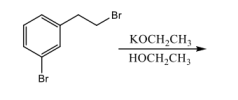 give the major product of the
reaction, and classify leaving group, Substrate, and whether it is
an SN1, SN2, E1, or E2 reaction. (Show arrow pushing).
KOCH.CH HOCH.CH
give the major product of the
reaction, and classify leaving group, Substrate, and whether it is
an SN1, SN2, E1, or E2 reaction. (Show arrow pushing).
KOCH.CH HOCH.CH
Compare and contrast SN1, SN2, E1 and E2 reactions. What are some obvious similarities and differences...
Compare and contrast SN1, SN2, E1 and E2 reactions. What are some obvious similarities and differences between each reaction pathway? What are the requirements for each reaction to work? Discuss why SN2 is in direct competition with E2 while SN1 is in direct competition with the E1 reaction pathway. What is the rate expression for each? Which reactions are concerted? Which reactions are step-wise? Which reactions are stereospecific and what is the stereospecificity of each that are? How do the...
This is a multiple question discussion. Can someone please help and provide insight with definitions and...
This is a multiple question discussion. Can someone please help and provide insight with definitions and examples? Compare and contrast SN1, SN2, E1 and E2 reactions. What are some obvious similarities and differences between each reaction pathway? What are the requirements for each reaction to work? Discuss why SN2 is in direct competition with E2 while SN1 is in direct competition with the E1 reaction pathway. What is the rate expression for each? Which reactions are concerted? Which reactions are...
give the major product and mechanism used. label leaving group, solvent and Nucliphile and also identify what reactio...
 give the major product and
mechanism used. label leaving group, solvent and Nucliphile and
also identify what reaction it is ( Sn1, sn2, e2 or e1)
use
arrow pushing
LOT с онт CH2CO2Na CH2CO2H
give the major product and
mechanism used. label leaving group, solvent and Nucliphile and
also identify what reaction it is ( Sn1, sn2, e2 or e1)
use
arrow pushing
LOT с онт CH2CO2Na CH2CO2H
Please, make the answer clear and reable. BrEtOH a OEt Hace H2C Alkyl halides undergo nucleophilic...
 Please, make the answer clear
and reable.
BrEtOH a OEt Hace H2C Alkyl halides undergo nucleophilic substitution and elimination reactions. When the kinetics of the reaction are measured, if the rate of the reaction is found to be dependent only upon the concentration of the alkyl halide the reaction is first order. The substitution reaction is thus termed ction is termed E1. These reactions are unimolecular and occur in two steps. The first step is rate-limiting and involves the loss...
Please, make the answer clear
and reable.
BrEtOH a OEt Hace H2C Alkyl halides undergo nucleophilic substitution and elimination reactions. When the kinetics of the reaction are measured, if the rate of the reaction is found to be dependent only upon the concentration of the alkyl halide the reaction is first order. The substitution reaction is thus termed ction is termed E1. These reactions are unimolecular and occur in two steps. The first step is rate-limiting and involves the loss...
What is the major product of the following reaction? Please explain why there is not a...
 What is the major product of the following reaction?
Please explain why there is not
a retention of configuration for the ethyl. I get that this is an
E1 elimination. That the NaoMe has to take from the beta carbon
attached to the ethyl because that is the anto-periplanar hydrogen.
What I dont understand is why the ethyl group changes and why
answer C is not the answer. Thank you!
What is the major product of the following reaction? A...
What is the major product of the following reaction?
Please explain why there is not
a retention of configuration for the ethyl. I get that this is an
E1 elimination. That the NaoMe has to take from the beta carbon
attached to the ethyl because that is the anto-periplanar hydrogen.
What I dont understand is why the ethyl group changes and why
answer C is not the answer. Thank you!
What is the major product of the following reaction? A...
With explanation please -- thanks! 9. (30 pts) Predict whether the following conditions would mainly proceed...
 With explanation please --
thanks!
9. (30 pts) Predict whether the following conditions would mainly proceed via an SN2, SN1, E2, or E1 mechanism (write your answer into box on left). Draw the major product (including enatiomer wher appropriate) in each reaction and show stereochemistry (where appropriate). SN2, SN1 E1, or E2 conc.H2SO4 heat SN2, S1 E1, or E2 H2O SN2, SN1 E1, or E2 NaOEt EtOH, heat SN2, SN1 E1, or E2 v O-CF3 H. KOtBu D. H tBuOH...
With explanation please --
thanks!
9. (30 pts) Predict whether the following conditions would mainly proceed via an SN2, SN1, E2, or E1 mechanism (write your answer into box on left). Draw the major product (including enatiomer wher appropriate) in each reaction and show stereochemistry (where appropriate). SN2, SN1 E1, or E2 conc.H2SO4 heat SN2, S1 E1, or E2 H2O SN2, SN1 E1, or E2 NaOEt EtOH, heat SN2, SN1 E1, or E2 v O-CF3 H. KOtBu D. H tBuOH...
For the following reaction, please answer the following questions: A) Which type of substitution reaction would...
 For the following reaction, please answer the following
questions:
A) Which type of substitution reaction would it take place, SN1
or SN2?
B) Does it have a good leaving group? How do you know?
C) What is the intermediate?
D) Show electron move using arrows.
E) Show product structure. Indicate stereochemistry of the
product comparing to the reactant.
OH + I-
For the following reaction, please answer the following
questions:
A) Which type of substitution reaction would it take place, SN1
or SN2?
B) Does it have a good leaving group? How do you know?
C) What is the intermediate?
D) Show electron move using arrows.
E) Show product structure. Indicate stereochemistry of the
product comparing to the reactant.
OH + I-
- For each reaction below, draw all appropriate arrows to indicate the flow of electron starting...
 - For each reaction below, draw all appropriate arrows to indicate the flow of electron starting structures. Fill in the box above the arrows with the reaction mechanism as SNI SNO and/or E1 then draw the product(s). Сн,он * CH,OH CH,SK + Acetone 2. (a) For the following reaction, what solvent would favor SN2 (protic or aprotic)? Provide one example of the appropriate solvent. (b) Please explain why you chose your answer for (a).
 please hurry
medewes the best leaving group? mist the expected for product of the following reaction sequence? 1. A-BUOK, BUOH Question 23 What type of solvent is ethanol (EtOH)? 4. polar aprotic apolar aprotic polar protic
please hurry
medewes the best leaving group? mist the expected for product of the following reaction sequence? 1. A-BUOK, BUOH Question 23 What type of solvent is ethanol (EtOH)? 4. polar aprotic apolar aprotic polar protic
 give the major product of the
reaction, and classify leaving group, Substrate, and whether it is
an SN1, SN2, E1, or E2 reaction. (Show arrow pushing).
KOCH.CH HOCH.CH
give the major product of the
reaction, and classify leaving group, Substrate, and whether it is
an SN1, SN2, E1, or E2 reaction. (Show arrow pushing).
KOCH.CH HOCH.CH
 give the major product and
mechanism used. label leaving group, solvent and Nucliphile and
also identify what reaction it is ( Sn1, sn2, e2 or e1)
use
arrow pushing
LOT с онт CH2CO2Na CH2CO2H
give the major product and
mechanism used. label leaving group, solvent and Nucliphile and
also identify what reaction it is ( Sn1, sn2, e2 or e1)
use
arrow pushing
LOT с онт CH2CO2Na CH2CO2H
 Please, make the answer clear
and reable.
BrEtOH a OEt Hace H2C Alkyl halides undergo nucleophilic substitution and elimination reactions. When the kinetics of the reaction are measured, if the rate of the reaction is found to be dependent only upon the concentration of the alkyl halide the reaction is first order. The substitution reaction is thus termed ction is termed E1. These reactions are unimolecular and occur in two steps. The first step is rate-limiting and involves the loss...
Please, make the answer clear
and reable.
BrEtOH a OEt Hace H2C Alkyl halides undergo nucleophilic substitution and elimination reactions. When the kinetics of the reaction are measured, if the rate of the reaction is found to be dependent only upon the concentration of the alkyl halide the reaction is first order. The substitution reaction is thus termed ction is termed E1. These reactions are unimolecular and occur in two steps. The first step is rate-limiting and involves the loss...
 What is the major product of the following reaction?
Please explain why there is not
a retention of configuration for the ethyl. I get that this is an
E1 elimination. That the NaoMe has to take from the beta carbon
attached to the ethyl because that is the anto-periplanar hydrogen.
What I dont understand is why the ethyl group changes and why
answer C is not the answer. Thank you!
What is the major product of the following reaction? A...
What is the major product of the following reaction?
Please explain why there is not
a retention of configuration for the ethyl. I get that this is an
E1 elimination. That the NaoMe has to take from the beta carbon
attached to the ethyl because that is the anto-periplanar hydrogen.
What I dont understand is why the ethyl group changes and why
answer C is not the answer. Thank you!
What is the major product of the following reaction? A...
 With explanation please --
thanks!
9. (30 pts) Predict whether the following conditions would mainly proceed via an SN2, SN1, E2, or E1 mechanism (write your answer into box on left). Draw the major product (including enatiomer wher appropriate) in each reaction and show stereochemistry (where appropriate). SN2, SN1 E1, or E2 conc.H2SO4 heat SN2, S1 E1, or E2 H2O SN2, SN1 E1, or E2 NaOEt EtOH, heat SN2, SN1 E1, or E2 v O-CF3 H. KOtBu D. H tBuOH...
With explanation please --
thanks!
9. (30 pts) Predict whether the following conditions would mainly proceed via an SN2, SN1, E2, or E1 mechanism (write your answer into box on left). Draw the major product (including enatiomer wher appropriate) in each reaction and show stereochemistry (where appropriate). SN2, SN1 E1, or E2 conc.H2SO4 heat SN2, S1 E1, or E2 H2O SN2, SN1 E1, or E2 NaOEt EtOH, heat SN2, SN1 E1, or E2 v O-CF3 H. KOtBu D. H tBuOH...
 For the following reaction, please answer the following
questions:
A) Which type of substitution reaction would it take place, SN1
or SN2?
B) Does it have a good leaving group? How do you know?
C) What is the intermediate?
D) Show electron move using arrows.
E) Show product structure. Indicate stereochemistry of the
product comparing to the reactant.
OH + I-
For the following reaction, please answer the following
questions:
A) Which type of substitution reaction would it take place, SN1
or SN2?
B) Does it have a good leaving group? How do you know?
C) What is the intermediate?
D) Show electron move using arrows.
E) Show product structure. Indicate stereochemistry of the
product comparing to the reactant.
OH + I-
 - For each reaction below, draw all appropriate arrows to indicate the flow of electron starting structures. Fill in the box above the arrows with the reaction mechanism as SNI SNO and/or E1 then draw the product(s). Сн,он * CH,OH CH,SK + Acetone 2. (a) For the following reaction, what solvent would favor SN2 (protic or aprotic)? Provide one example of the appropriate solvent. (b) Please explain why you chose your answer for (a).
Most questions answered within 3 hours.
-
Where is the error in this code sequence?
String s1 = "Hello";
String s2 = "ello";...
asked 10 months ago -
Financial data for Joel de Paris, Inc., for last year
follow:
Joel de Paris, Inc.
Balance...
asked 10 months ago -
Consider this reaction:
Al2(SO4)3 (aq)+ BaCl3
(aq) Al2Cl6 (aq)- +
3BaSO4(s) . What is the...
asked 10 months ago -
Suppose that Savneet is considering increasing her
recent random sample from 20 car rentals to 40...
asked 10 months ago -
Trucks arrive at an unloading terminal at an average rate of 120
per hour.
Trucks arrive...
asked 10 months ago -
Why are methanol and ethanol completely soluble in water while
octanol is not very little soluble....
asked 10 months ago -
A facilities manager at a university reads in a research report
that the mean amount of...
asked 10 months ago -
When the CuSO4 is rehydrated by adding water to the anhydrous
compound, is this an endothermic...
asked 10 months ago -
A ray of sunlight is passing from diamond into crown glass; the
angle of incidence is...
asked 10 months ago -
A block of mass 0.249 kg is placed on top of a light, vertical
spring of...
asked 10 months ago -
how do the kidneys compensate in the presences of acidosis
a) trigger hyperventilate
b) reserve acid...
asked 10 months ago -
Question 501 pts
The rental rate of capital to the firm increases. Which of the
following...
asked 10 months ago