When ammonia is slowly added to a light blue solution of CuSO4 (aq), at first a...
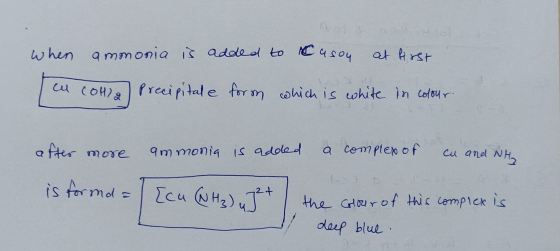
When ammonia is slowly added to a light blue solution of CuSO4 (aq), at first a white precipitate forms. What is the formula of that precipitate?
After more ammonia is added, a dark blue solution forms. What is the formula of the compound or ion responsible for the dark blue color?
Homework Answers
Add Answer to:
When ammonia is slowly added to a light blue solution of CuSO4
(aq), at first a...
In experiment 7, when concentrated ammonia is added to acidic copper solution, the pale-blue precipitate forms,...
In experiment 7, when concentrated ammonia is added to acidic copper solution, the pale-blue precipitate forms, followed by formation of bright blue soluble compound. Write formulas of the precipitate and of colored complex. When potassium iodide is added to copper(II) nitrate solution, a brown precipitate forms. Write and balance the corresponding reaction equation. This brown precipitate is titrated with sodium thiosulfate solution. Write and balance the corresponding equation. After titration, a white precipitate is left in the solution. Write the...
When NH3 is added to a solution that contains Cu2+ ions at first the solution becomes...
When NH3 is added to a solution that contains Cu2+ ions at first the solution becomes cloudy and a white precipitate starts to fall to the bottom of the container. If NH3 continues to be added the solution changes from a light blue color to a dark blue color and the precipitate disappears. Describe what is happening is happening on the molecular level.
FesCN (aq), and LeChâtelier's Explain in terms of the equation, Fe" (aq) + SCN (aq) Principle...
 FesCN (aq), and LeChâtelier's Explain in terms of the equation, Fe" (aq) + SCN (aq) Principle (4 ) Observation after adding KSCN: turned darker more red like original solution brown Explain in terms of the equation, Fe (aq) + SCN (aq) + FeSCN- (aq), and LeChâtelier's Principle. (ps.) Observation after adding AgNO3: Turned milky white + thieverf less transparent Using the ions present in the solution, write a net ionic equation that would explain the precipitate observed Use the above...
When concentrated ammonia is added to acidic copper solution, the pale-blue precipitate forms, followed by formation...
When concentrated ammonia is added to acidic copper solution, the pale-blue precipitate forms, followed by formation of bright blue soluble compound. Write formulas of the precipitate and of colored complex.
When ammonia is added to Zn(NO3)2 solution, a white precipitate forms, which dissolves on the addition...
When ammonia is added to Zn(NO3)2 solution, a white precipitate forms, which dissolves on the addition of excess ammonia; but when ammonia is added to a mixture of Zn(NO3)2 and NH4NO3 no precipitate forms at any time. Suggest an explanation for this difference in behavior.
1. I placed 5 mL of 0.025 M CuSO4 in a test tube, and slowly added...
1. I placed 5 mL of 0.025 M CuSO4 in a test tube, and slowly added 15 M NH3 until my solution turned blue, I then removed reactant by adding (CuSO4, NH3, H20, HCl, NaOH) and my test tube appeared clear, light light blue. That's because as I removed reactant, the Cu2+ concentration (increased, decreased, stayed the same) 2. In a medium test tube, I added 2 drops of 6 M NaOH to 5 mL of 0.05 M MgCl2(aq) to...
1. in the copper cycle experiment when a solution of NaOH(aq) is added to a solution...
1. in the copper cycle experiment when a solution of NaOH(aq) is added to a solution of Cu(NO3)2, what happens? a. no reaction occurs b. a blue copper (II) hydroxide precipitate forms along with a solution of NaNO3(aq) c. a reddish copper solid forms and the solutions bubbles because the presence of H2 gas d. a black copper (II) oxide solid forms and H2O molecules are released in a decomposition 2. Put these in order in how to safely light...
why bail blue of [Cu(H2O)6]^2+ can turn dark blue when ammonia solution is added?
why bail blue of [Cu(H2O)6]^2+ can turn dark blue when ammonia solution is added?
The deep blue compound Cu(NH3)4SO4 is made by the reaction of copper(II) sulfate and ammonia. CuSO4(aq)...
The deep blue compound Cu(NH3)4SO4 is made by the reaction of copper(II) sulfate and ammonia. CuSO4(aq) + 4NH3(aq) → Cu(NH3)4SO4(aq) If you use 47.0 g of CuSO4 and excess NH3, what is the theoretical yield of Cu(NH3)4SO4? If you isolate 38.2 g of Cu(NH3)4SO4, what is the percent yield of Cu(NH3)4SO4? ______ g Cu(NH3)4SO4 _______ %
An aqueous solution of sodium fluoride is slowly added to a water sample that contains barium...
An aqueous solution of sodium fluoride is slowly added to a water sample that contains barium ion (2.75×10⁻²M ) and calcium ion (7.30×10⁻²M ). What is the remaining concentration of the first ion to precipitate when the second ion begins to precipitate?
 FesCN (aq), and LeChâtelier's Explain in terms of the equation, Fe" (aq) + SCN (aq) Principle (4 ) Observation after adding KSCN: turned darker more red like original solution brown Explain in terms of the equation, Fe (aq) + SCN (aq) + FeSCN- (aq), and LeChâtelier's Principle. (ps.) Observation after adding AgNO3: Turned milky white + thieverf less transparent Using the ions present in the solution, write a net ionic equation that would explain the precipitate observed Use the above...
Most questions answered within 3 hours.
-
Where is the error in this code sequence?
String s1 = "Hello";
String s2 = "ello";...
asked 10 months ago -
Financial data for Joel de Paris, Inc., for last year
follow:
Joel de Paris, Inc.
Balance...
asked 10 months ago -
Consider this reaction:
Al2(SO4)3 (aq)+ BaCl3
(aq) Al2Cl6 (aq)- +
3BaSO4(s) . What is the...
asked 10 months ago -
Suppose that Savneet is considering increasing her
recent random sample from 20 car rentals to 40...
asked 10 months ago -
Trucks arrive at an unloading terminal at an average rate of 120
per hour.
Trucks arrive...
asked 10 months ago -
Why are methanol and ethanol completely soluble in water while
octanol is not very little soluble....
asked 10 months ago -
A facilities manager at a university reads in a research report
that the mean amount of...
asked 10 months ago -
When the CuSO4 is rehydrated by adding water to the anhydrous
compound, is this an endothermic...
asked 10 months ago -
A ray of sunlight is passing from diamond into crown glass; the
angle of incidence is...
asked 10 months ago -
A block of mass 0.249 kg is placed on top of a light, vertical
spring of...
asked 10 months ago -
how do the kidneys compensate in the presences of acidosis
a) trigger hyperventilate
b) reserve acid...
asked 10 months ago -
Question 501 pts
The rental rate of capital to the firm increases. Which of the
following...
asked 10 months ago