FINC 3380 Homework 4
Seungho Baek
Due: Wednesday, April 1 2020, 6:29 P.M.
For this homework assignment, you need to use Excel. Once you done, upload your excel file to Blackboard. Do not submit HW4 via email.
Part 1 Reading Assignments Read LN6.
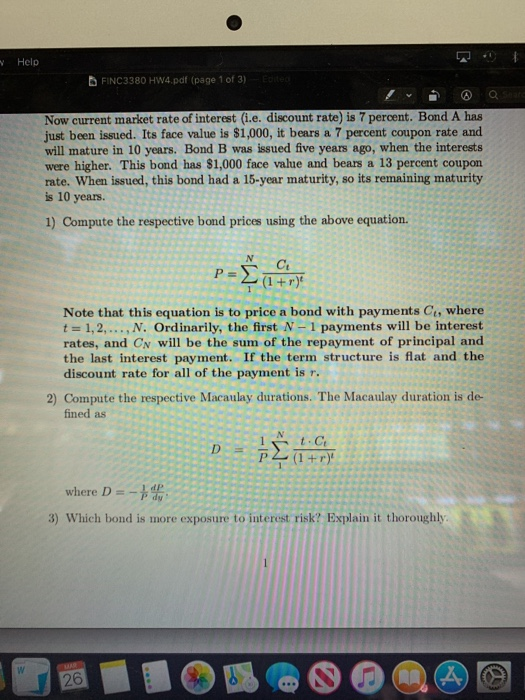
Part 2 Practical Assignments using Excel Consider two annual coupon bonds. Now current market rate of interest (i.e. discount rate) is 7 percent. Bond A has just been issued. Its face value is $1,000, it bears a 7 percent coupon rate and will mature in 10 years. Bond B was issued five years ago, when the interests were higher. This bond has $1,000 face value and bears a 13 percent coupon rate. When issued, this bond had a 15-year maturity, so its remaining maturity is 10 years.
1) Compute the respective bond prices using the above equation.
P=?N Ct
(1+r)t
1
Note that this equation is to price a bond with payments Ct, where t=1,2,...,N. Ordinarily,thefirstN−1paymentswillbeinterest rates, and CN will be the sum of the repayment of principal and the last interest payment. If the term structure is flat and the discount rate for all of the payment is r.
-
2) Compute the respective Macaulay durations. The Macaulay duration is de- fined as
whereD=−1 dP. P dy
-
3) Which bond is more exposure to interest risk? Explain it thoroughly. 1
D=
1
1?N t·Ct P (1+r)t
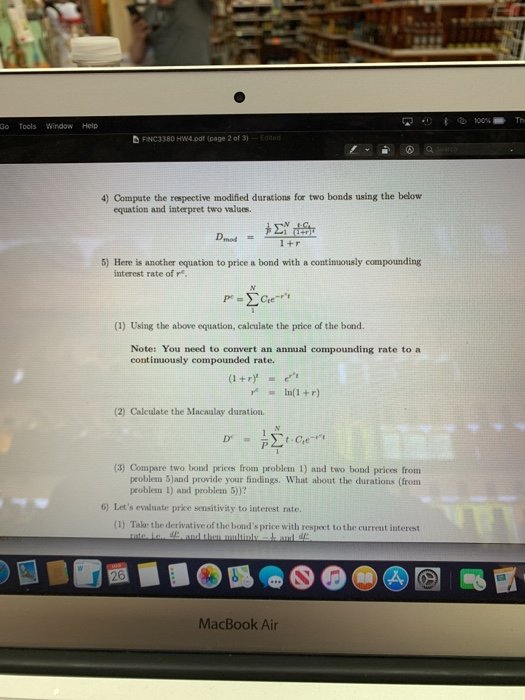
4) Compute the respective modified durations for two bonds using the below equation and interpret two values.
1 ?N t·Ct P 1 (1+r)t
Dmod =
5) Here is another equation to price a bond with a continuously
compounding
interest rate of rc.
1+r
N
Pc =?Cte−rct
1
-
(1) Using the above equation, calculate the price of the bond.
Note: You need to convert an annual compounding rate to a continuously compounded rate.
(1+r)t = erct
rc = ln(1+r) -
(2) Calculate the Macaulay duration.
Dc = 1 ?t·Cte−rct
P
1
(3) Compare two bond prices from problem 1) and two bond prices from problem 5)and provide your findings. What about the durations (from problem 1) and problem 5))?
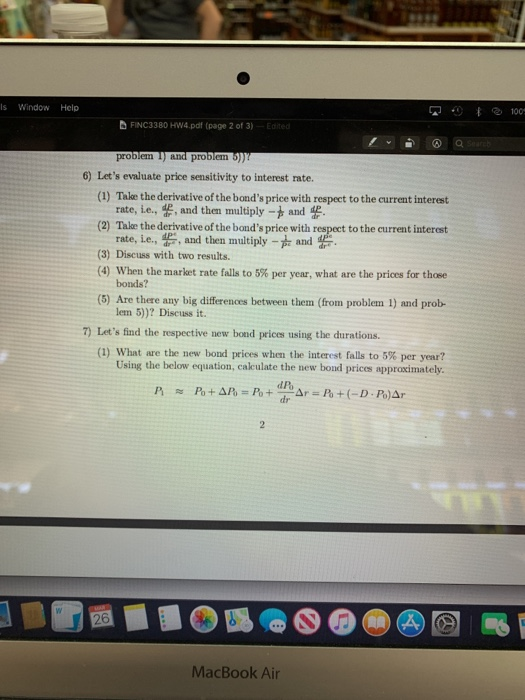
6) Let’s evaluate price sensitivity to interest rate.
(1)
Takethederivativeofthebond’spricewithrespecttothecurrentinterest
rate, i.e., dP , and then multiply − 1 and dP . dr Pdr
N
(2) Takethederivativeofthebond’spricewithrespecttothecurrentinterest rate, i.e., dPc , and then multiply − 1 and dPc .
drc Pc drc (3) Discuss with two results.
-
(4) When the market rate falls to 5% per year, what are the prices for those bonds?
-
(5) Are there any big differences between them (from problem 1) and prob- lem 5))? Discuss it.
7) Let’s find the respective new bond prices using the durations.
(1) What are the new bond prices when the interest falls to 5% per year? Using the below equation, calculate the new bond prices approximately.
P1 ≈ P0+∆P0 =P0+dP0∆r=P0+(−D·P0)∆r dr
2
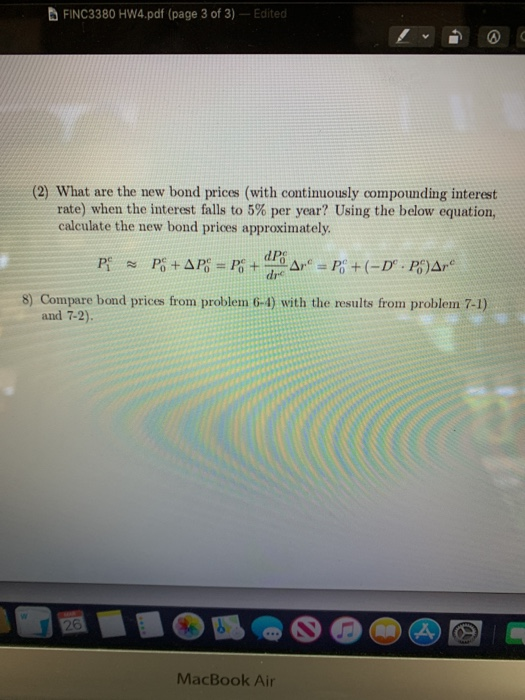
(2) What are the new bond prices (with continuously compounding interest rate) when the interest falls to 5% per year? Using the below equation, calculate the new bond prices approximately.
dPc
P1c ≈ P0c +∆P0c = P0c + 0 ∆rc = P0c +(−Dc ·P0c)∆rc drc
8) Compare bond prices from problem 6-4) with the results from problem 7-1) and 7-2).
3

Homework Answers
As per HOMEWORKLIB RULES, I'm only supposed to answer the first 4
sub-parts of any question. I have answered.
Details given:
|
Bond A |
Bond B |
|
|
Interest rate |
7% |
7% |
|
Face Value |
$1000 |
$1000 |
|
Coupon rate |
7% |
13% |
|
Time to maturity |
10 |
10 |
The given formulae have been used. The results are presented in a tabular format.
1. Bond A Price:
|
Time |
Bond A Cash Flows |
Discounting Factor = 1/(1+r)^t |
Present Value = Cash Flows * 1/(1+r)^t |
|
0 |
70 |
1 |
70 |
|
1 |
70 |
0.934579439 |
65.42056075 |
|
2 |
70 |
0.873438728 |
61.14071098 |
|
3 |
70 |
0.816297877 |
57.14085138 |
|
4 |
70 |
0.762895212 |
53.40266484 |
|
5 |
70 |
0.712986179 |
49.90903256 |
|
6 |
70 |
0.666342224 |
46.64395567 |
|
7 |
70 |
0.622749742 |
43.59248193 |
|
8 |
70 |
0.582009105 |
40.74063732 |
|
9 |
70 |
0.543933743 |
38.07536198 |
|
10 |
1070 |
0.508349292 |
543.9337426 |
|
Bond price = Sum of Present values of cash flows |
1070 |
Bond B Price:
|
Time |
Bond A Cash Flows |
Discounting Factor = 1/(1+r)^t |
Present Value = Cash Flows * 1/(1+r)^t |
|
0 |
130 |
1 |
130 |
|
1 |
130 |
0.934579439 |
121.4953271 |
|
2 |
130 |
0.873438728 |
113.5470347 |
|
3 |
130 |
0.816297877 |
106.118724 |
|
4 |
130 |
0.762895212 |
99.17637757 |
|
5 |
130 |
0.712986179 |
92.68820333 |
|
6 |
130 |
0.666342224 |
86.6244891 |
|
7 |
130 |
0.622749742 |
80.95746644 |
|
8 |
130 |
0.582009105 |
75.66118359 |
|
9 |
130 |
0.543933743 |
70.71138654 |
|
10 |
1130 |
0.508349292 |
574.4347001 |
|
Bond price = Sum of Present values of cash flows |
1551.414892 |
2. Bond A Macaulay Duration:
|
Present Value = Cash Flows * 1/(1+r)^t |
Fraction of Price |
Fraction of price * Time |
|
|
0 |
70 |
0.065420561 |
0 |
|
1 |
65.42056075 |
0.061140711 |
0.061140711 |
|
2 |
61.14071098 |
0.057140851 |
0.114281703 |
|
3 |
57.14085138 |
0.053402665 |
0.160207995 |
|
4 |
53.40266484 |
0.049909033 |
0.19963613 |
|
5 |
49.90903256 |
0.046643956 |
0.233219778 |
|
6 |
46.64395567 |
0.043592482 |
0.261554892 |
|
7 |
43.59248193 |
0.040740637 |
0.285184461 |
|
8 |
40.74063732 |
0.038075362 |
0.304602896 |
|
9 |
38.07536198 |
0.03558445 |
0.320260054 |
|
10 |
543.9337426 |
0.508349292 |
5.083492921 |
|
1070 |
Macaulay Duration |
7.023581541 |
Bond B Macaulay duration:
|
Time |
Present Value = Cash Flows * 1/(1+r)^t |
Fraction of Price |
Fraction of price * Time |
|
0 |
130 |
0.083794477 |
0 |
|
1 |
121.4953271 |
0.078312596 |
0.078312596 |
|
2 |
113.5470347 |
0.073189342 |
0.146378683 |
|
3 |
106.118724 |
0.068401254 |
0.205203762 |
|
4 |
99.17637757 |
0.063926406 |
0.255705622 |
|
5 |
92.68820333 |
0.059744304 |
0.298721521 |
|
6 |
86.6244891 |
0.055835798 |
0.33501479 |
|
7 |
80.95746644 |
0.052182989 |
0.365280924 |
|
8 |
75.66118359 |
0.048769149 |
0.39015319 |
|
9 |
70.71138654 |
0.045578644 |
0.410207793 |
|
10 |
574.4347001 |
0.370265042 |
3.702650419 |
|
1551.414892 |
Macaulay Duration |
6.187629299 |
3. Since the Macaulay duration of Bond A is greater than that of Bond B, the interest rate risk of Bond A is more. This is because the price of a bond with greater maturity is more sensitive to changes in interest rates.
4. Bond A Modified Duration:
|
Modified Duration = Macaulay Duration / (1+r) |
6.564094898 |
Interpretation: When the interest rate increases by 1 percentage point, the price of the bond shall fall by 6.564094898
Bond B Modified Duration:
|
Modified Duration = Macaulay Duration / (1+r) |
5.782831121 |
Interpretation: When the interest rates increase by 1 percentage point, the price of the bond B will fall by 5.782831121
Add Answer to:
FINC 3380 Homework 4
Seungho Baek
Due: Wednesday, April 1 2020, 6:29 P.M.
For this homework...
please answer the questions according to the marks appointed per question and sub question. this is...
 please answer the questions according to the marks appointed per
question and sub question. this is a banking and finance question
so please answer it accordingly.
8. (a) Explain the concept of Macaulay duration and explain the relationship between Macaulay duration and: (i) bond maturity (ii) interest rates (iii) bond coupon rate (7 marks) (b) Calculate the price and Macaulay duration of a five-year 5% coupon bond where the market interest rate is 5%. Assume the par value of the...
please answer the questions according to the marks appointed per
question and sub question. this is a banking and finance question
so please answer it accordingly.
8. (a) Explain the concept of Macaulay duration and explain the relationship between Macaulay duration and: (i) bond maturity (ii) interest rates (iii) bond coupon rate (7 marks) (b) Calculate the price and Macaulay duration of a five-year 5% coupon bond where the market interest rate is 5%. Assume the par value of the...
Use the following information for problems 1, 2, 3, and 4: A non-callable $1,000 par- value...
 Use the following information for problems 1, 2, 3, and 4: A non-callable $1,000 par- value bond matures in thirty years at par. The annual coupon rate is 5% with coupons payable annually. The bond was purchased at a price to yield an annual effective rate of 4%. 1. (1 point) Find the bond purchase price. 2. (1 point) Calculate the Macaulay duration and the modified duration for this bond. 3. (2 points) Suppose that the market interest rate increases...
bond X and bond Y. Bond X has a face value of $1,000 and 10 years...
bond X and bond Y. Bond X has a face value of $1,000 and 10 years to maturity and has just been issued at par. It bears the current market interest rate of 7% (i.e. this is the yield to maturity for this bond). Bond Y was issued 5 years ago when interest rates were much higher. Bond Y has face value of $1,000 and pays a 13% coupon rate. When issued, this bond had a 15-year, so today its...
1. An investor purchases an annual coupon bond with a 6% coupon rate and exactly 20...
1. An investor purchases an annual coupon bond with a 6% coupon rate and exactly 20 years remaining until maturity at a price equal to par value. The investor’s investment horizon is eight years. The approximate modified duration of the bond is 11.470 years. What is the duration gap at the time of purchase? (Hint: use approximate Macaulay duration to calculate the duration gap) 2. An investor plans to retire in 10 years. As part of the retirement portfolio, the...
Consider two bonds: bond XY and bond ZW . Bond XY has a face value of $1,000 and 10 years to maturity and has just been...
Consider two bonds: bond XY and bond ZW . Bond XY has a face value of $1,000 and 10 years to maturity and has just been issued at par. It bears the current market interest rate of 7% (i.e. this is the yield to maturity for this bond). Bond ZW was issued 5 years ago when interest rates were much higher. Bond ZW has face value of $1,000 and pays a 13% coupon rate. When issued, this bond had a...
REQUIRED Let the continuously compounded zero interest rates for 6, 12 and 18 months be: r05-4%,...
 REQUIRED Let the continuously compounded zero interest rates for 6, 12 and 18 months be: r05-4%, ri -5%, and r1.5-5.9%, p.a. respectively. Calculate the prices of a 6-month zero-coupon note a 1-year bond with 7% annual coupon rate (semi-annual payment), and a 15-year coupon bond with 3% annual coupon rate (semi-annual payment). Assume a bond face value of £100 a) (7 marks) b) Calculate the annualised yield to maturity for each security from question (a) and express it both in...
Below is some useful material. A portfolio manager wants to estimate the interest rate risk of...
 Below is some useful material.
A portfolio manager wants to estimate the interest rate risk of a bond using duration. The current price of the bond is 82. A valuation model found that if interest rates decline 30 basis points, the price will increase to 83.50 and if interest rates increase by 30 basis points, the price will decline to 80.75. What is the duration of this bond? [Read Attachment #1 before attempting.) Macaulay, Modified and Approximate Modified Durations Macaulay...
Below is some useful material.
A portfolio manager wants to estimate the interest rate risk of a bond using duration. The current price of the bond is 82. A valuation model found that if interest rates decline 30 basis points, the price will increase to 83.50 and if interest rates increase by 30 basis points, the price will decline to 80.75. What is the duration of this bond? [Read Attachment #1 before attempting.) Macaulay, Modified and Approximate Modified Durations Macaulay...
Now suppose market interest rates have risen over the course of the year. Specifically, the bonds...
 Now suppose market interest rates have risen over the course of the year. Specifically, the bonds in your portfolio experienced the following changes. Interest Rate a Year Ago (96) Interest Rate Now (96) 12 10 5.5 3. Calculate the approximate change in the price of each bond in your portfolio. (Hint) You may want to use the Equation (2) in the Web Appendix to Cho4. %A in P Portfolio Weight %) Suppose you are holding a portfolio of bonds that...
Hi! Would you be able to solve #6 problem using only a financial calculator ? Thanks in advance for your time. p...
 Hi!
Would you be able to solve #6 problem using only a
financial calculator ?
Thanks in advance for your time.
pay SPUL VUV Wuvos this price, the bonds yield 5.9 percent. What must the coupon rate be on the bonds? 6. Bond Prices [LO2] Sqeekers Co. issued 15-year bonds a year ago at a coupon rate of 4.1 percent. The bonds make semiannual payments and have a par value of $1,000. If the YTM on these bonds is 4.5...
Hi!
Would you be able to solve #6 problem using only a
financial calculator ?
Thanks in advance for your time.
pay SPUL VUV Wuvos this price, the bonds yield 5.9 percent. What must the coupon rate be on the bonds? 6. Bond Prices [LO2] Sqeekers Co. issued 15-year bonds a year ago at a coupon rate of 4.1 percent. The bonds make semiannual payments and have a par value of $1,000. If the YTM on these bonds is 4.5...
2. The following questions are based on a $1,000 face value coupon bond with a coupon...
 2. The following questions are based on a $1,000 face value coupon bond with a coupon rate of 10% a. Suppose the bond has one year to maturity and you buy it for $1,018.52. What is the yield to maturity on the bond? Is the yield to maturity above or below the coupon rate of 10%? Why? b. Since the equation is often considered too difficult to solve, simply write down the equation that one would have to solve to...
 please answer the questions according to the marks appointed per
question and sub question. this is a banking and finance question
so please answer it accordingly.
8. (a) Explain the concept of Macaulay duration and explain the relationship between Macaulay duration and: (i) bond maturity (ii) interest rates (iii) bond coupon rate (7 marks) (b) Calculate the price and Macaulay duration of a five-year 5% coupon bond where the market interest rate is 5%. Assume the par value of the...
please answer the questions according to the marks appointed per
question and sub question. this is a banking and finance question
so please answer it accordingly.
8. (a) Explain the concept of Macaulay duration and explain the relationship between Macaulay duration and: (i) bond maturity (ii) interest rates (iii) bond coupon rate (7 marks) (b) Calculate the price and Macaulay duration of a five-year 5% coupon bond where the market interest rate is 5%. Assume the par value of the...
 Use the following information for problems 1, 2, 3, and 4: A non-callable $1,000 par- value bond matures in thirty years at par. The annual coupon rate is 5% with coupons payable annually. The bond was purchased at a price to yield an annual effective rate of 4%. 1. (1 point) Find the bond purchase price. 2. (1 point) Calculate the Macaulay duration and the modified duration for this bond. 3. (2 points) Suppose that the market interest rate increases...
 REQUIRED Let the continuously compounded zero interest rates for 6, 12 and 18 months be: r05-4%, ri -5%, and r1.5-5.9%, p.a. respectively. Calculate the prices of a 6-month zero-coupon note a 1-year bond with 7% annual coupon rate (semi-annual payment), and a 15-year coupon bond with 3% annual coupon rate (semi-annual payment). Assume a bond face value of £100 a) (7 marks) b) Calculate the annualised yield to maturity for each security from question (a) and express it both in...
 Below is some useful material.
A portfolio manager wants to estimate the interest rate risk of a bond using duration. The current price of the bond is 82. A valuation model found that if interest rates decline 30 basis points, the price will increase to 83.50 and if interest rates increase by 30 basis points, the price will decline to 80.75. What is the duration of this bond? [Read Attachment #1 before attempting.) Macaulay, Modified and Approximate Modified Durations Macaulay...
Below is some useful material.
A portfolio manager wants to estimate the interest rate risk of a bond using duration. The current price of the bond is 82. A valuation model found that if interest rates decline 30 basis points, the price will increase to 83.50 and if interest rates increase by 30 basis points, the price will decline to 80.75. What is the duration of this bond? [Read Attachment #1 before attempting.) Macaulay, Modified and Approximate Modified Durations Macaulay...
 Now suppose market interest rates have risen over the course of the year. Specifically, the bonds in your portfolio experienced the following changes. Interest Rate a Year Ago (96) Interest Rate Now (96) 12 10 5.5 3. Calculate the approximate change in the price of each bond in your portfolio. (Hint) You may want to use the Equation (2) in the Web Appendix to Cho4. %A in P Portfolio Weight %) Suppose you are holding a portfolio of bonds that...
 Hi!
Would you be able to solve #6 problem using only a
financial calculator ?
Thanks in advance for your time.
pay SPUL VUV Wuvos this price, the bonds yield 5.9 percent. What must the coupon rate be on the bonds? 6. Bond Prices [LO2] Sqeekers Co. issued 15-year bonds a year ago at a coupon rate of 4.1 percent. The bonds make semiannual payments and have a par value of $1,000. If the YTM on these bonds is 4.5...
Hi!
Would you be able to solve #6 problem using only a
financial calculator ?
Thanks in advance for your time.
pay SPUL VUV Wuvos this price, the bonds yield 5.9 percent. What must the coupon rate be on the bonds? 6. Bond Prices [LO2] Sqeekers Co. issued 15-year bonds a year ago at a coupon rate of 4.1 percent. The bonds make semiannual payments and have a par value of $1,000. If the YTM on these bonds is 4.5...
 2. The following questions are based on a $1,000 face value coupon bond with a coupon rate of 10% a. Suppose the bond has one year to maturity and you buy it for $1,018.52. What is the yield to maturity on the bond? Is the yield to maturity above or below the coupon rate of 10%? Why? b. Since the equation is often considered too difficult to solve, simply write down the equation that one would have to solve to...
Most questions answered within 3 hours.
-
Where is the error in this code sequence?
String s1 = "Hello";
String s2 = "ello";...
asked 10 months ago -
Financial data for Joel de Paris, Inc., for last year
follow:
Joel de Paris, Inc.
Balance...
asked 10 months ago -
Consider this reaction:
Al2(SO4)3 (aq)+ BaCl3
(aq) Al2Cl6 (aq)- +
3BaSO4(s) . What is the...
asked 10 months ago -
Suppose that Savneet is considering increasing her
recent random sample from 20 car rentals to 40...
asked 10 months ago -
Trucks arrive at an unloading terminal at an average rate of 120
per hour.
Trucks arrive...
asked 10 months ago -
Why are methanol and ethanol completely soluble in water while
octanol is not very little soluble....
asked 10 months ago -
A facilities manager at a university reads in a research report
that the mean amount of...
asked 10 months ago -
When the CuSO4 is rehydrated by adding water to the anhydrous
compound, is this an endothermic...
asked 10 months ago -
A ray of sunlight is passing from diamond into crown glass; the
angle of incidence is...
asked 10 months ago -
A block of mass 0.249 kg is placed on top of a light, vertical
spring of...
asked 10 months ago -
how do the kidneys compensate in the presences of acidosis
a) trigger hyperventilate
b) reserve acid...
asked 10 months ago -
Question 501 pts
The rental rate of capital to the firm increases. Which of the
following...
asked 10 months ago