
Homework Answers

Add Answer to:
1. Using aggregate supply and demand analysis, discuss how the following will affect the aggregate level...
Using aggregate supply and demand analysis, discuss how the following will affect the aggregate level of...
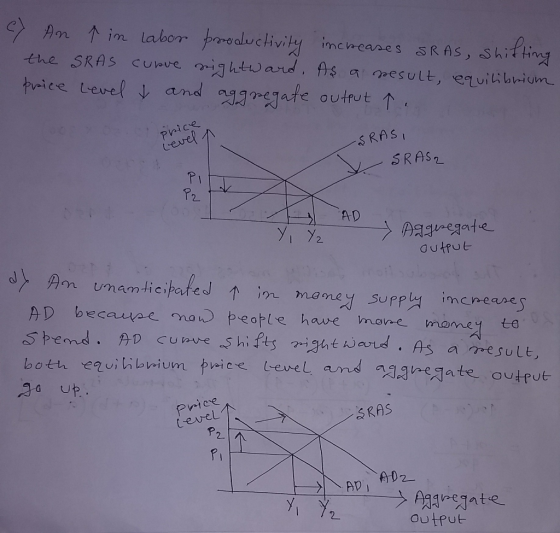
Using aggregate supply and demand analysis, discuss how the following will affect the aggregate level of output and the price level in the economy. Use a SRAS curve. You need to determine whether the AD or SRAS curve will shift, in which direction it will shift, and how this will affect aggregate output and the price level. a. Price of standardized inputs such as oil decrease. b. A fall in the stock market.
1. . (Figure: Determining SRAS Shifts) If there are advances in technology, the short-run aggregate supply...
 1.
.
(Figure: Determining SRAS Shifts) If there are advances in
technology, the short-run aggregate supply curve will shift from
SRAS0 to _____ and the price level will shift to
_____.
SRAS1; P0
SRAS2; P2
SRAS2; P1
SRAS1; P1
2.
Simultaneous recession and deflation can be explained by:
a decrease in aggregate supply.
an increase in aggregate supply.
a decrease in aggregate demand.
an increase in aggregate demand.
3.
Which is a determinant of aggregate supply?
household expectations
prices of...
1.
.
(Figure: Determining SRAS Shifts) If there are advances in
technology, the short-run aggregate supply curve will shift from
SRAS0 to _____ and the price level will shift to
_____.
SRAS1; P0
SRAS2; P2
SRAS2; P1
SRAS1; P1
2.
Simultaneous recession and deflation can be explained by:
a decrease in aggregate supply.
an increase in aggregate supply.
a decrease in aggregate demand.
an increase in aggregate demand.
3.
Which is a determinant of aggregate supply?
household expectations
prices of...
Figure: The Money Supply and Aggregate Demand Panel (b) Panel (a) SRAS Price level Price level...
 Figure: The Money Supply and Aggregate Demand Panel (b) Panel (a) SRAS Price level Price level SRAS P P2 P2 AD P AD AD2 AD YReal GDP (per year) Real GDP Y (per year) Y2 Y Refer to Figure: The Money Supply and Aggregate Demand. If the Federal Reserve intended to encourage investment and interest rates. This is shown in the money supply, and Treasury bills, expand the economy, it would panel buy; increase; lower; (a) buy; decrease; lower; (a)...
Using the aggregate demand (AD), the short-run aggregate supply (SRAS), and the long-run aggregate supply (LRAS)...
Using the aggregate demand (AD), the short-run aggregate supply (SRAS), and the long-run aggregate supply (LRAS) curves, briefly explain how an open market purchase will affect the equilibrium price level (P) and real output (Y) in the short run. Assume the economy is initially in a recession?
Using aggregate demand (AD), short-run aggregate supply (SRAS) and long-run aggregate supply (LRAS) curves
Question 1: AD-SRAS-LRAS Model Using aggregate demand (AD), short-run aggregate supply (SRAS) and long-run aggregate supply (LRAS) curves, graphically illustrate the effect of an increase in the money supply on output and prices in the short and long run. Assume that the economy is initially in long run equilibrium at the potential output level and prices are fixed in the short-run. In your graph, label "A" for the initial equilibrium, "B' for the short-run equilibrium, and "C" for the long-run equilibrium.
Given a downward-sloping aggregate demand (AD) curve and an upward-sloping short-run aggregate supply curve (SRAS), equilibrium...
Given a downward-sloping aggregate demand (AD) curve and an upward-sloping short-run aggregate supply curve (SRAS), equilibrium occurs where the two intersect. The value on the vertical axis is the equilibrium price level and the value on the horizontal axis is the equilibrium value of real GDP or output. What happens to the economy when AD shifts? It is useful to sketch a graph and show the shift. Suppose, for example, interest rates fall or wealth increases due to a stock...
What would cause the price level to decrease and employment to increase? a shift to the...
What would cause the price level to decrease and employment to increase? a shift to the left of the SRAS curve a shift to the left of the AD curve a shift to the right of the SRAS curve a shift to the right of the AD curve High taxes and/or heavy regulation: raise costs of production so that the aggregate supply curve shifts to the left. are likely to shift aggregate supply to the right. are not likely to...
The following figure depicts the aggregate demand (AD), theshort-run aggregate supply (SRAS), and the long-run...
 The following figure depicts the aggregate demand (AD), the
short-run aggregate supply (SRAS), and the long-run aggregate
supply (LRAS) curves for an economy. The economy is initially at
long-run equilibrium, at point A. Suppose that there is an increase
in the amount of investment in the economy due to a reduction in
the real interest rate. This increase in investment shifts the AD
curve to the right, depicted below in the movement of the economy
from point A to point...
The following figure depicts the aggregate demand (AD), the
short-run aggregate supply (SRAS), and the long-run aggregate
supply (LRAS) curves for an economy. The economy is initially at
long-run equilibrium, at point A. Suppose that there is an increase
in the amount of investment in the economy due to a reduction in
the real interest rate. This increase in investment shifts the AD
curve to the right, depicted below in the movement of the economy
from point A to point...
Which of the following will most likely cause a decrease in short-run aggregate supply (leftward shift) in the goods and services market?
35. Which of the following will most likely cause a decrease in short-run aggregate supply (leftward shift) in the goods and services market? a. An increase in the productivity of labor b. A reduction in the price of crude oil, a major imported commodity c. An increase in resource prices d. Favorable weather conditions in agricultural areas. 36. The vertical long-run aggregate supply curve reflects the fact that in the long run, an increase in the price level. a. Will not alter the economy's maximum...
Figure: The Money Supply and Aggregate Demand Panel (a) Panel (b) SRAS Price level Price level...
 Figure: The Money Supply and Aggregate Demand Panel (a) Panel (b) SRAS Price level Price level SRAS Y Real GDP (per year) Y Y Real GDP (per year) Refer to Figure: The Money Supply and Aggregate Demand. If the Federal Reserve intended to encourage investment and expand the economy, it would T reasury bills, the money supply, and interest rates. This is shown in panel O buy; increase; lower; (a) buy; decrease; lower; (a) buy; increase; raise: (a) O sell;...
 1.
.
(Figure: Determining SRAS Shifts) If there are advances in
technology, the short-run aggregate supply curve will shift from
SRAS0 to _____ and the price level will shift to
_____.
SRAS1; P0
SRAS2; P2
SRAS2; P1
SRAS1; P1
2.
Simultaneous recession and deflation can be explained by:
a decrease in aggregate supply.
an increase in aggregate supply.
a decrease in aggregate demand.
an increase in aggregate demand.
3.
Which is a determinant of aggregate supply?
household expectations
prices of...
1.
.
(Figure: Determining SRAS Shifts) If there are advances in
technology, the short-run aggregate supply curve will shift from
SRAS0 to _____ and the price level will shift to
_____.
SRAS1; P0
SRAS2; P2
SRAS2; P1
SRAS1; P1
2.
Simultaneous recession and deflation can be explained by:
a decrease in aggregate supply.
an increase in aggregate supply.
a decrease in aggregate demand.
an increase in aggregate demand.
3.
Which is a determinant of aggregate supply?
household expectations
prices of...
 Figure: The Money Supply and Aggregate Demand Panel (b) Panel (a) SRAS Price level Price level SRAS P P2 P2 AD P AD AD2 AD YReal GDP (per year) Real GDP Y (per year) Y2 Y Refer to Figure: The Money Supply and Aggregate Demand. If the Federal Reserve intended to encourage investment and interest rates. This is shown in the money supply, and Treasury bills, expand the economy, it would panel buy; increase; lower; (a) buy; decrease; lower; (a)...
 The following figure depicts the aggregate demand (AD), the
short-run aggregate supply (SRAS), and the long-run aggregate
supply (LRAS) curves for an economy. The economy is initially at
long-run equilibrium, at point A. Suppose that there is an increase
in the amount of investment in the economy due to a reduction in
the real interest rate. This increase in investment shifts the AD
curve to the right, depicted below in the movement of the economy
from point A to point...
The following figure depicts the aggregate demand (AD), the
short-run aggregate supply (SRAS), and the long-run aggregate
supply (LRAS) curves for an economy. The economy is initially at
long-run equilibrium, at point A. Suppose that there is an increase
in the amount of investment in the economy due to a reduction in
the real interest rate. This increase in investment shifts the AD
curve to the right, depicted below in the movement of the economy
from point A to point...
 Figure: The Money Supply and Aggregate Demand Panel (a) Panel (b) SRAS Price level Price level SRAS Y Real GDP (per year) Y Y Real GDP (per year) Refer to Figure: The Money Supply and Aggregate Demand. If the Federal Reserve intended to encourage investment and expand the economy, it would T reasury bills, the money supply, and interest rates. This is shown in panel O buy; increase; lower; (a) buy; decrease; lower; (a) buy; increase; raise: (a) O sell;...
Most questions answered within 3 hours.
-
Where is the error in this code sequence?
String s1 = "Hello";
String s2 = "ello";...
asked 10 months ago -
Financial data for Joel de Paris, Inc., for last year
follow:
Joel de Paris, Inc.
Balance...
asked 10 months ago -
Consider this reaction:
Al2(SO4)3 (aq)+ BaCl3
(aq) Al2Cl6 (aq)- +
3BaSO4(s) . What is the...
asked 10 months ago -
Suppose that Savneet is considering increasing her
recent random sample from 20 car rentals to 40...
asked 10 months ago -
Trucks arrive at an unloading terminal at an average rate of 120
per hour.
Trucks arrive...
asked 10 months ago -
Why are methanol and ethanol completely soluble in water while
octanol is not very little soluble....
asked 10 months ago -
A facilities manager at a university reads in a research report
that the mean amount of...
asked 10 months ago -
When the CuSO4 is rehydrated by adding water to the anhydrous
compound, is this an endothermic...
asked 10 months ago -
A ray of sunlight is passing from diamond into crown glass; the
angle of incidence is...
asked 10 months ago -
A block of mass 0.249 kg is placed on top of a light, vertical
spring of...
asked 10 months ago -
how do the kidneys compensate in the presences of acidosis
a) trigger hyperventilate
b) reserve acid...
asked 10 months ago -
Question 501 pts
The rental rate of capital to the firm increases. Which of the
following...
asked 10 months ago