
Homework Answers
2) budget constraints,
Let x is egg quantity and y is other good quantity,
I=px*X+py*Y
Px*X=I-Py*y
X={I-py*y)/px
Px=1
X={I-py*y)
Px=2
X=(I-py*y)/2=0.5(I-py*y)
So
(I-py*y)-0.5(I-py*y)=6
0.5 (I-py*y)=6
(I-py*y)=12
So initially ( before price increase ) ben was consuming 12 eggs.
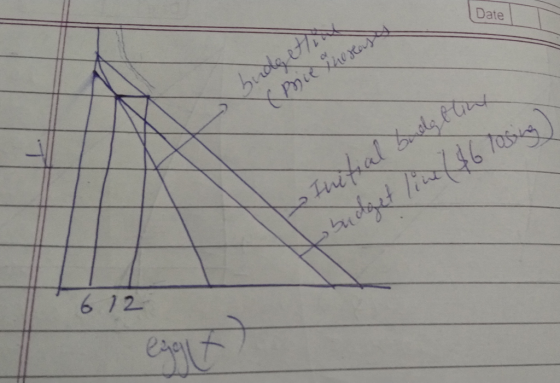
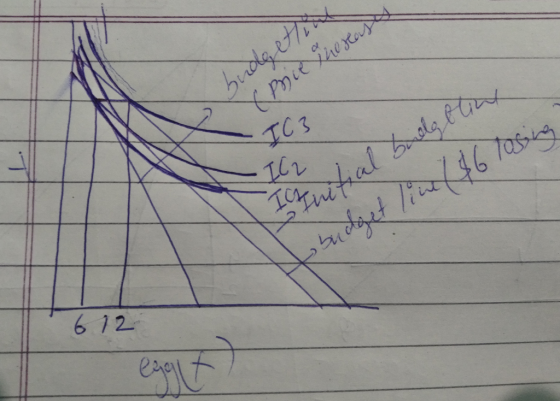
If ben lose 6$ and still spend same amount on other good then he will still get only 6 egg with same price of x=1$.
New budget line ( with price increase) is tangent with IC1 But new budget line( with 6$ loss) is tangent with a higher level of indifference curve( IC2).,so ben ben prefer loss of 6$ instead of price rise.to MAXIMIZE his utility
Add Answer to:
just number 2 please.
S pose you can work anywhere from 0 to 24 hours a...
3. Suppose you have 24 hours to allocate between leisure and working at $10 an hour....
 3. Suppose you have 24 hours to allocate between leisure and working at $10 an hour. One day the government simultaneously institutes a new program consisting of two policies: a 50% income tax and a plan whereby everybody in the country receives a gift from the government of $60 a day. (a) Draw the two budget lines (you may draw a total of three budget lines since the program contains two separate parts.) (b) Suppose that the government chose the...
The distribution of the number of hours people spend at work per day is unimodal and...
 The distribution of the number of hours people spend at work per day is unimodal and symmetric with a mean of 8 hours and a standard deviation of 0.5 hours. If Tom's z-score for his work hours was -1.3, explain what this value means in terms of the number of hours he works. Select one: a. The number of hours Tom works is 1.3 standard deviations below the mean. O b. Tom works 1.3 hours less than the average person....
Suppose an employee works 42 hours a week for a salary of SEK 8 per hour...
 Suppose an employee works 42 hours a week for a salary of SEK 8 per hour and that he is taxed at a proportional tax of ten percent. Thus, in a week, this worker earns SEK 336 before and SEK 302.40 after tax. The employee decides for himself how many hours he wants to work per week (no law regulates working hours). Now the income tax is abolished for people who earn less than SEK 1000 per week. In the...
O Courses The distribution of the number of hours people spend at work per day is...
 O Courses The distribution of the number of hours people spend at work per day is unimodal and symmetric with a mean of 8 hours and a standard deviation of 0.5 hours. If Anthony's Z-score for his work hours was -1.3, explain what this value means in terms of the number of hours he works, arse Hon mework O A. Anthony works 1.3 hours more than the average person. B. The number of hours Anthony works is 1.3 standard devations...
Sam and Kim live in Coquitlam but work in Vancouver. They must commute to their place...
Sam and Kim live in Coquitlam but work in Vancouver. They must commute to their place of work and back home during rush hours. Assume that there are 14 available hours in the day, that their wage rate is $25 per hour, and that they each have nonlabour income of $200 per day. The commute takes 2 hours each way (4 hours a day total), and it costs $80 in expenses for the round trip. 1. Let us say his...
(Problem 1d). Leandro has 16 hours per day that he can allocate to work or leisure....
(Problem 1d). Leandro has 16 hours per day that he can allocate to work or leisure. His job pays a wage rate of $20. Leandro decides to consume 8 hours of leisure. His indifference curves have the usual shape: they slope downward, they do not cross, and they have the characteristic convex shape. Draw Leandro's time allocation budget line for a typical day, with income on the vertical axis and hours of leisure on the horizontal axis. Leandro's decision to...
Please show work and explain EXERCISE 2 A consumer consumes one consumption good x and hours...
 Please show work and explain
EXERCISE 2 A consumer consumes one consumption good x and hours of leisure h. The price of the consumption good is 1. The consumer earns wage rate s per hour for the first eight hours of work, and s' > s for additional overtime hours. He also faces a tax rate per dollar on labor income earned above amount M. Draw the budget set. Assume M < 8s, which means that the consumer does not...
Please show work and explain
EXERCISE 2 A consumer consumes one consumption good x and hours of leisure h. The price of the consumption good is 1. The consumer earns wage rate s per hour for the first eight hours of work, and s' > s for additional overtime hours. He also faces a tax rate per dollar on labor income earned above amount M. Draw the budget set. Assume M < 8s, which means that the consumer does not...
Suppose you have 24 hours per day that you can allocate between leisure and working (i)...
Suppose you have 24 hours per day that you can allocate between leisure and working (i) Draw the budget constraint between “leisure hours” on the horizontal axis and “wage income” on the vertical when the wage rate is $40 per hour. Mark an optimum point A that is meaningful. Draw a new budget constraint when the wage rate falls to $30 per hour. Show a new optimum point B. (ii) On your indifference curve diagram, decompose the effect of the...
a) With free time on the horizontal axis and consumption on the vertical axis, draw the...
a) With free time on the horizontal axis and consumption on the vertical axis, draw the feasible set of an individual who receives a lump sum grant of £100 per day and then can work for a wage of £10 per hour. After earning £50 in his job he is subject to an income tax rate of 10%. b) Suppose now that his wage increased to £15 per hour. Draw the new feasible set on your diagram. c) Draw the...
1a. Assume that you are single and have just graduated college and are thinking of taking...
 1a. Assume that you are single and have just graduated college and are thinking of taking a job at a wage of W1. How many hours of market work per day would you choose? Theoretically, how do you determine this? Explain based on your choice of hours worked. b. What would happen to your decision of how many hours a day to devote to market work if your wage increased to W2? c. Now assume that you get married and...
 3. Suppose you have 24 hours to allocate between leisure and working at $10 an hour. One day the government simultaneously institutes a new program consisting of two policies: a 50% income tax and a plan whereby everybody in the country receives a gift from the government of $60 a day. (a) Draw the two budget lines (you may draw a total of three budget lines since the program contains two separate parts.) (b) Suppose that the government chose the...
 The distribution of the number of hours people spend at work per day is unimodal and symmetric with a mean of 8 hours and a standard deviation of 0.5 hours. If Tom's z-score for his work hours was -1.3, explain what this value means in terms of the number of hours he works. Select one: a. The number of hours Tom works is 1.3 standard deviations below the mean. O b. Tom works 1.3 hours less than the average person....
 Suppose an employee works 42 hours a week for a salary of SEK 8 per hour and that he is taxed at a proportional tax of ten percent. Thus, in a week, this worker earns SEK 336 before and SEK 302.40 after tax. The employee decides for himself how many hours he wants to work per week (no law regulates working hours). Now the income tax is abolished for people who earn less than SEK 1000 per week. In the...
 O Courses The distribution of the number of hours people spend at work per day is unimodal and symmetric with a mean of 8 hours and a standard deviation of 0.5 hours. If Anthony's Z-score for his work hours was -1.3, explain what this value means in terms of the number of hours he works, arse Hon mework O A. Anthony works 1.3 hours more than the average person. B. The number of hours Anthony works is 1.3 standard devations...
 Please show work and explain
EXERCISE 2 A consumer consumes one consumption good x and hours of leisure h. The price of the consumption good is 1. The consumer earns wage rate s per hour for the first eight hours of work, and s' > s for additional overtime hours. He also faces a tax rate per dollar on labor income earned above amount M. Draw the budget set. Assume M < 8s, which means that the consumer does not...
Please show work and explain
EXERCISE 2 A consumer consumes one consumption good x and hours of leisure h. The price of the consumption good is 1. The consumer earns wage rate s per hour for the first eight hours of work, and s' > s for additional overtime hours. He also faces a tax rate per dollar on labor income earned above amount M. Draw the budget set. Assume M < 8s, which means that the consumer does not...
 1a. Assume that you are single and have just graduated college and are thinking of taking a job at a wage of W1. How many hours of market work per day would you choose? Theoretically, how do you determine this? Explain based on your choice of hours worked. b. What would happen to your decision of how many hours a day to devote to market work if your wage increased to W2? c. Now assume that you get married and...
Most questions answered within 3 hours.
-
Where is the error in this code sequence?
String s1 = "Hello";
String s2 = "ello";...
asked 10 months ago -
Financial data for Joel de Paris, Inc., for last year
follow:
Joel de Paris, Inc.
Balance...
asked 10 months ago -
Consider this reaction:
Al2(SO4)3 (aq)+ BaCl3
(aq) Al2Cl6 (aq)- +
3BaSO4(s) . What is the...
asked 10 months ago -
Suppose that Savneet is considering increasing her
recent random sample from 20 car rentals to 40...
asked 10 months ago -
Trucks arrive at an unloading terminal at an average rate of 120
per hour.
Trucks arrive...
asked 10 months ago -
Why are methanol and ethanol completely soluble in water while
octanol is not very little soluble....
asked 10 months ago -
A facilities manager at a university reads in a research report
that the mean amount of...
asked 10 months ago -
When the CuSO4 is rehydrated by adding water to the anhydrous
compound, is this an endothermic...
asked 10 months ago -
A ray of sunlight is passing from diamond into crown glass; the
angle of incidence is...
asked 10 months ago -
A block of mass 0.249 kg is placed on top of a light, vertical
spring of...
asked 10 months ago -
how do the kidneys compensate in the presences of acidosis
a) trigger hyperventilate
b) reserve acid...
asked 10 months ago -
Question 501 pts
The rental rate of capital to the firm increases. Which of the
following...
asked 10 months ago