(Problem 1d). Leandro has 16 hours per day that he can allocate to work or leisure....
| (Problem 1d). Leandro has 16 hours per day that he can allocate
to work or leisure. His job pays a wage rate of $20. Leandro
decides to consume 8 hours of leisure. His indifference curves have
the usual shape: they slope downward, they do not cross, and they
have the characteristic convex shape. Draw Leandro's time
allocation budget line for a typical day, with income on the
vertical axis and hours of leisure on the horizontal axis. Leandro's decision to work less as the wage rate falls is the result of a substitution effect and an income effect. In your diagram, show the income effect and the substitution effect from this reduced wage rate. Which effect is stronger? |
|||||||||
|
Homework Answers
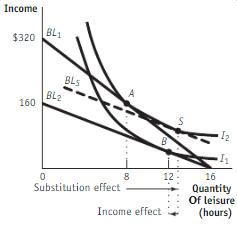
The substitution effect is Leandro's change in leisure consumption from point A to Point S In the diagram: we constructed it by holding Leandro's utility constant—by Keeping him on the same indifference curve he was on originally, I2—but allow the opportunity cost of leisure to change from 20 to 10. This is illustrated by the dashed budget line labeled BLS. The opportunity cost has fallen, pushing Leandro towards consuming more by the substitution effect. The income effect is Leandro's change in leisure consumption from point STo point B: the reduced wage rate has made Leandro poorer, so he should consume less leisure since it is a normal good.Since his overall leisure consumption has increased (from 8 hours to 12 hours).
The substitution effect is stronger than the income effect.
Add Answer to:
(Problem 1d). Leandro has 16 hours per day that he can allocate
to work or leisure....
(Problem 1a). Leandro has 16 hours per day that he can allocate to work or leisure....
(Problem 1a). Leandro has 16 hours per day that he can allocate to work or leisure. His job pays a wage rate of $20. Leandro decides to consume 8 hours of leisure. His indifference curves have the usual shape: they slope downward, they do not cross, and they have the characteristic convex shape. Draw Leandro's time allocation budget line for a typical day, with income on the vertical axis and hours of leisure on the horizontal axis. Then illustrate the...
Suppose you have 24 hours per day that you can allocate between leisure and working (i)...
Suppose you have 24 hours per day that you can allocate between leisure and working (i) Draw the budget constraint between “leisure hours” on the horizontal axis and “wage income” on the vertical when the wage rate is $40 per hour. Mark an optimum point A that is meaningful. Draw a new budget constraint when the wage rate falls to $30 per hour. Show a new optimum point B. (ii) On your indifference curve diagram, decompose the effect of the...
(6) Geo's utility function is described as LeY, where Le is hours of leisure per day,...
 (6) Geo's utility function is described as LeY, where Le is hours of leisure per day, and Y is disposable income per day. Geo is employed in a job with a wage of $20 per hour and has 10 hours per day that he can spend in either working or leisure. His income from working is his only source of disposable income. He does not receive any non-wage income Geo can work as many hours as he chooses, up to...
Leisure-labour choice 1. Mr. Cog works in a machine factory. He can work as many hours per day as he wishes at a wa...
 Leisure-labour choice 1. Mr. Cog works in a machine factory. He can work as many hours per day as he wishes at a wage rate of w. Let C be the number of dollars he spends on consumer goods and let R be the number of hours of leisure that he chooses. (a) Mr. Cog earns $8 an hour and has 18 hours per day to devote to labor or leisure, and he has $16 of nonlabor income per day....
Draw the budget constraint between “leisure hours” on the horizontal axis and “wage income” on the...
Draw the budget constraint between “leisure hours” on the horizontal axis and “wage income” on the vertical when the wage rate is $40 per hour. Mark an optimum point A that is meaningful. Draw a new budget constraint when the wage rate falls to $30 per hour. Show a new optimum point B. On your indifference curve diagram, decompose the effect of the wage decrease into a “substitution effect” and an “income effect” (What is the direction of the substitution...
Need as much details as possible. Microeconomics. Peter can work 24 hours a day if he...
Need as much details as possible. Microeconomics. Peter can work 24 hours a day if he wants to and gets wage w per hour worked. His utility from leisure (work-free time) and consumption is U(C,L)=CL. If the wage of Peter goes up, which of the following statements is always correct? a. The substitution effect on consumption means that consumption goes up. b. The total effect on leisure means that leisure goes down. c. The income effect on leisure means that...
Emma’s wage rate is $10 per hour and she has a maximum of 100 hours per...
Emma’s wage rate is $10 per hour and she has a maximum of 100 hours per week to allocate between leisure and work. In the absence of any tax on wage earnings, Emma optimally chooses to work 40 hours per week. The following tax is imposed. Emma is not taxed on the first $240 earnings per week, but each dollar earned beyond that is taxed at 10%. Does the tax cause Emma to work more, work less, or have no...
Individual X and Y work 10 and 6 hours a day, respectively. Their hourly wage is...
Individual X and Y work 10 and 6 hours a day, respectively. Their hourly wage is $8 per hour. If their wage goes up to $10 per hour, individual X and Y adjust their hours of work as 12 and 5 hours a day, respectively. (Assume that both individuals faces the same 16 hours constraint in a day) (a) (5 points) What can you tell about their indifference curves? (e.g flat or steep) Explain briefly what your answer implies about...
(10) A person earns a wage $10 per hour and has 100 hours per week to...
(10) A person earns a wage $10 per hour and has 100 hours per week to allocate between leisure and work. At the $10 wage, the person chooses to consume 65 hours of leisure per week. a. Draw the labor-leisure graph showing the situation described above. Make sure to label all intercepts, axis, and relevant slopes in your graph. b.The wage increases to $15 per hour. Assume the substitution effect exceeds the income effect. Show on your graph whether the person works more...
6. On a standard income-leisure diagram, Tony has flatter indifference curves than Bruce, but both are...
6. On a standard income-leisure diagram, Tony has flatter indifference curves than Bruce, but both are negatively sloped. It is probably true that: a. Both like leisure and income, but Bruce values leisure relatively more than Tony does. b. Bruce likes leisure but dislikes income while Tony likes both c. Bruce likes income but dislikes leisure while Tony likes both d. Tony values leisure more highly compared to income than Bruce does 7. As an individual’s wage rate gets higher,...
 (6) Geo's utility function is described as LeY, where Le is hours of leisure per day, and Y is disposable income per day. Geo is employed in a job with a wage of $20 per hour and has 10 hours per day that he can spend in either working or leisure. His income from working is his only source of disposable income. He does not receive any non-wage income Geo can work as many hours as he chooses, up to...
 Leisure-labour choice 1. Mr. Cog works in a machine factory. He can work as many hours per day as he wishes at a wage rate of w. Let C be the number of dollars he spends on consumer goods and let R be the number of hours of leisure that he chooses. (a) Mr. Cog earns $8 an hour and has 18 hours per day to devote to labor or leisure, and he has $16 of nonlabor income per day....
Most questions answered within 3 hours.
-
Where is the error in this code sequence?
String s1 = "Hello";
String s2 = "ello";...
asked 10 months ago -
Financial data for Joel de Paris, Inc., for last year
follow:
Joel de Paris, Inc.
Balance...
asked 10 months ago -
Consider this reaction:
Al2(SO4)3 (aq)+ BaCl3
(aq) Al2Cl6 (aq)- +
3BaSO4(s) . What is the...
asked 10 months ago -
Suppose that Savneet is considering increasing her
recent random sample from 20 car rentals to 40...
asked 10 months ago -
Trucks arrive at an unloading terminal at an average rate of 120
per hour.
Trucks arrive...
asked 10 months ago -
Why are methanol and ethanol completely soluble in water while
octanol is not very little soluble....
asked 10 months ago -
A facilities manager at a university reads in a research report
that the mean amount of...
asked 10 months ago -
When the CuSO4 is rehydrated by adding water to the anhydrous
compound, is this an endothermic...
asked 10 months ago -
A ray of sunlight is passing from diamond into crown glass; the
angle of incidence is...
asked 10 months ago -
A block of mass 0.249 kg is placed on top of a light, vertical
spring of...
asked 10 months ago -
how do the kidneys compensate in the presences of acidosis
a) trigger hyperventilate
b) reserve acid...
asked 10 months ago -
Question 501 pts
The rental rate of capital to the firm increases. Which of the
following...
asked 10 months ago