Question 1: For this question, ignore any externalities that might be associated with the production of...
Question 1:
For this question, ignore any externalities that might be associated with the production of honey.
- Graphically indicate the demand (D0) and Supply (S0) and the equilibrium in the market for honey. Show the equilibrium price and quantity, Q0 and P0. Indicate on your graph the areas of consumer surplus and producer surplus.
- What is the output level the Benevolent Dictator would like to see in this market? Why?
Question 2:
Now suppose that scientists have discovered that the production of honey has a very significant positive externality. The main input into honey production, honey bees, are most effective when there are orchards nearby. The bees gather nectar from the orchards and simultaneously pollinate the orchard. This pollination is very valuable to the orchard.
However, honey firms (beekeepers) are not compensated for this positive impact on orchards. This positive externality means that the true marginal social value of producing honey is different than the marginal private value of the consumption of honey. Indeed, the Marginal Social Value for the industry would be the sum of the marginal private value (the demand curve) plus the positive impact each unit of honey production has on orchards. That is, in the eyes of the benevolent dictator, the production of honey has Marginal Social Value per unit higher than the marginal private value (the demand curve).
- Construct another graph. Show the original demand and supply (labeled correctly as D0and S0) and equilibrium price (P0) and quantity (Q0).
- Now add another curve that reflects the Marginal Social Value given the existence of the positive externality, and label it appropriately.
- What, if anything, happens to price and quantity of honey established in the marketplace, given the presence of this positive externality?
- What is the output QSO6the Benevolent Dictator would choose (where SO6 stands for Socially Optimal output here in question 6, which may or may not be different than the socially optimal output you found in question 5)?
- Indicate graphically and explain in a narrative the area of deadweight loss (DWL), if any, given the existence of this positive externality. What does deadweight loss mean in this context?
Homework Answers
Answer:
1. The graph of the equilibrium in the market for honey:
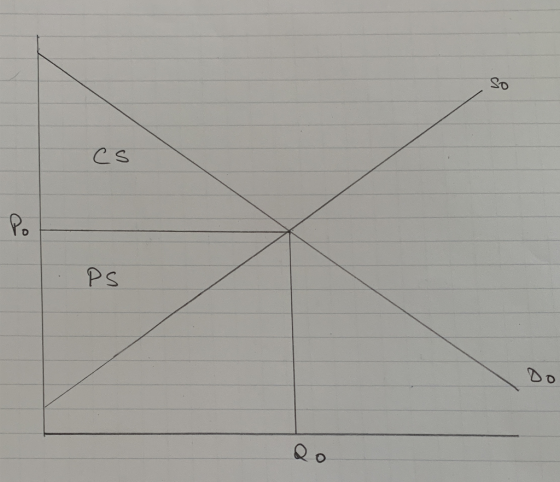
Here, D0 is the demand for honey and S0 is the supply of honey. Output is at Q0 and price at P0.
Consumer surplus is the area of the triangle labelled CS which is above P0 and below D0.
Producer surplus is the area of the triangle labelled PS which is below P0 and above S0.
The benevolent dictator would like to see Q0 according to this graph because demand and supply are in equilibrium. There is no wastage of welfare as it is shared by sellers and buyers (no deadweight loss)
2. In this graph, D0 is the original demand curve and S0 is the original supply curve. Q0 is the original equilibrium quantity and P0 is the original equilibrium price.
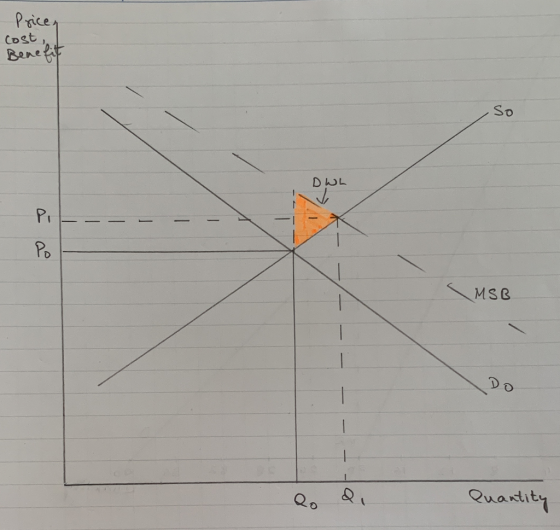
When honey bees give out positive externalities, MSB (marginal social benefit) is the new curve. Now the benevolent dictator would desire output at Q1 which is greater than Q0. P1 greater than P0 will be the new price.
The orange triangle at the center, between Q0 and Q1 above P0 is the deadweight loss.
DWL indicates the opportunity cost to the society. It is the difference between what is produced and what should have been produced.This is because, at Q0, marginal social benefit (benefit received by the society) is greater than individual private cost (the demand curve of the individual making the decision). So, less is produced than is socially optimum. Consumers pay P0 and consume Q0. As seen in the graph, this is below the socially optimum quantity of Q1 at price P1. That is why the situation results in dedweight loss, indicating loss of economic welfare.
Add Answer to:
Question 1:
For this question,
ignore any externalities that might be associated with the
production of...
Phoebe keeps a bee farm next door to an apple orchard. She chooses her optimal number...
Phoebe keeps a bee farm next door to an apple orchard. She chooses her optimal number of beehives by selecting the honey output level at which her private marginal benefit from beekeeping equals her private marginal cost. Use the following graph to answer the questions below. a. Assuming that Phoebe’s private marginal benefit and marginal cost curves from beekeeping are normally shaped, identify which curve is the private marginal benefit curve and which one is the private marginal cost curve....
Which of the following statements are true regarding externalities? (Check all thot apply.) OA. In the...
 Which of the following statements are true regarding externalities? (Check all thot apply.) OA. In the case of an extemality, the free market wil maximize social surplus. occurs when an economic activity has a spillover cost to a bystander. C. Deadweight loss can be either a foregone benefit or the total cost of the externality to society. D. For compuing efficient outcomes, economic agente adjust the demand curve to account for negative extenalities In the case of the negative extemality,the...
3. The effect of negative externalities on the optimal quantity of consumption Consider the market for...
 3. The effect of negative externalities on the optimal quantity of consumption Consider the market for steel. Suppose that a steel manufacturing plant dumps toxic waste into a nearby river, creating a negative externality for those living downstream from the plant. Producing an additional ton of steel imposes a constant external cost of $385 per ton. The following graph shows the demand (private value) curve and the supply (private cost) curve for steel, Use the purple points (diamond symbol) to...
3. The effect of negative externalities on the optimal quantity of consumption Consider the market for...
 3. The effect of negative externalities on the optimal quantity of consumption Consider the market for paper. Suppose that a paper factory dumps toxic waste into a nearby river, creating a negative externality for those living downstream from the factory. Producing an additional ton of paper imposes a constant external cost of $150 per ton. The following graph shows the demand (private value) curve and the supply (private cost) curve for paper. Use the purple points (diamond symbol) to plot...
3. The effect of negative externalities on the optimal quantity of consumption Consider the market for...
 3. The effect of negative externalities on the optimal quantity of consumption Consider the market for steel. Suppose that a steel manufacturing plant dumps toxic waste into a nearby river, creating a negative externality for those living downstream from the plant. Producing an additional ton of steel imposes a constant external cost of $315 per ton. The following graph shows the demand (private value) curve and the supply (private cost) curve for steel. Use the purple points (diamond symbol) to...
3. The effect of negative externalities on the optimal quantityof consumption Consider the market for bolts....
 3. The effect of negative externalities on the optimal quantityof consumption Consider the market for bolts. Suppose that a hardware factory dumps toxic waste into a nearby river, creating a negative externality for those living downstream from the factory. Producing an additional ton of bolts imposes a constant external cost of $330 per ton. The following graph shows the demand (private value) curve and the supply (private cost) curve for bolts. Use the purple points (diamond symbol) to plot the...
2. The effect of negative externalities on the optimal quantityof consumption Consider the market for steel....
 2. The effect of negative externalities on the optimal quantityof consumption Consider the market for steel. Suppose that a steel manufacturing plant dumps toxic waste into a nearby river, creating a negative externality for those living downstream from the plant. Producing an additional tonne of steel imposes a constant external cost of $165 per tonne. The following graph shows the demand (private value) curve and the supply (private cost) curve for steel. Use the purple points (diamond symbol) to plot...
We are considering a market with marginal cost of P=100+2Q and a demand of P=500-2Q. Use...
We are considering a market with marginal cost of P=100+2Q and a demand of P=500-2Q. Use that information to answer the following questions. a. Find the market equilibrium (price and quantity in the market). b. Find producer and consumer surplus. c. Now imagine production of this good created a negative externality of 1$ per unit of output. Find the socially optimal outcome (price and quantity) taking this externality into account. d. Find consumer and producer surplus at the socially efficient...
Homework (Ch 10) 3. The effect of negative externalities on the optimal quantity of consumption Consider the market...
 Homework (Ch 10) 3. The effect of negative externalities on the optimal quantity of consumption Consider the market for bolts. Suppose that a hardware factory dumps toxic waste into a nearby river, creating a negative externality for those living downstream from the factory Producing an additional ton of bolts imposes a constant external cost of $140 per ton. The following graph shows the demand (private value) curve and the supply (private cost) curve for bolts. Use the purple points (diamond...
3. The effect of negative externalities on the optimal quantity of consumption Consider the market for...
 3. The effect of negative externalities on the optimal quantity of consumption Consider the market for bolts. Suppose that a hardware factory dumps toxic waste into a nearby river, creating a negative externality for those living downstream from the factory. Producing an additional ton of bolts imposes a constant external cost of $225 per ton. The following graph shows the demand (private value) curve and the supply (private cost) curve for bolts Use the purple points (diamond symbol) to plot...
 Which of the following statements are true regarding externalities? (Check all thot apply.) OA. In the case of an extemality, the free market wil maximize social surplus. occurs when an economic activity has a spillover cost to a bystander. C. Deadweight loss can be either a foregone benefit or the total cost of the externality to society. D. For compuing efficient outcomes, economic agente adjust the demand curve to account for negative extenalities In the case of the negative extemality,the...
 3. The effect of negative externalities on the optimal quantity of consumption Consider the market for steel. Suppose that a steel manufacturing plant dumps toxic waste into a nearby river, creating a negative externality for those living downstream from the plant. Producing an additional ton of steel imposes a constant external cost of $385 per ton. The following graph shows the demand (private value) curve and the supply (private cost) curve for steel, Use the purple points (diamond symbol) to...
 3. The effect of negative externalities on the optimal quantity of consumption Consider the market for paper. Suppose that a paper factory dumps toxic waste into a nearby river, creating a negative externality for those living downstream from the factory. Producing an additional ton of paper imposes a constant external cost of $150 per ton. The following graph shows the demand (private value) curve and the supply (private cost) curve for paper. Use the purple points (diamond symbol) to plot...
 3. The effect of negative externalities on the optimal quantity of consumption Consider the market for steel. Suppose that a steel manufacturing plant dumps toxic waste into a nearby river, creating a negative externality for those living downstream from the plant. Producing an additional ton of steel imposes a constant external cost of $315 per ton. The following graph shows the demand (private value) curve and the supply (private cost) curve for steel. Use the purple points (diamond symbol) to...
 3. The effect of negative externalities on the optimal quantityof consumption Consider the market for bolts. Suppose that a hardware factory dumps toxic waste into a nearby river, creating a negative externality for those living downstream from the factory. Producing an additional ton of bolts imposes a constant external cost of $330 per ton. The following graph shows the demand (private value) curve and the supply (private cost) curve for bolts. Use the purple points (diamond symbol) to plot the...
 2. The effect of negative externalities on the optimal quantityof consumption Consider the market for steel. Suppose that a steel manufacturing plant dumps toxic waste into a nearby river, creating a negative externality for those living downstream from the plant. Producing an additional tonne of steel imposes a constant external cost of $165 per tonne. The following graph shows the demand (private value) curve and the supply (private cost) curve for steel. Use the purple points (diamond symbol) to plot...
 Homework (Ch 10) 3. The effect of negative externalities on the optimal quantity of consumption Consider the market for bolts. Suppose that a hardware factory dumps toxic waste into a nearby river, creating a negative externality for those living downstream from the factory Producing an additional ton of bolts imposes a constant external cost of $140 per ton. The following graph shows the demand (private value) curve and the supply (private cost) curve for bolts. Use the purple points (diamond...
 3. The effect of negative externalities on the optimal quantity of consumption Consider the market for bolts. Suppose that a hardware factory dumps toxic waste into a nearby river, creating a negative externality for those living downstream from the factory. Producing an additional ton of bolts imposes a constant external cost of $225 per ton. The following graph shows the demand (private value) curve and the supply (private cost) curve for bolts Use the purple points (diamond symbol) to plot...
Most questions answered within 3 hours.
-
Where is the error in this code sequence?
String s1 = "Hello";
String s2 = "ello";...
asked 10 months ago -
Financial data for Joel de Paris, Inc., for last year
follow:
Joel de Paris, Inc.
Balance...
asked 10 months ago -
Consider this reaction:
Al2(SO4)3 (aq)+ BaCl3
(aq) Al2Cl6 (aq)- +
3BaSO4(s) . What is the...
asked 10 months ago -
Suppose that Savneet is considering increasing her
recent random sample from 20 car rentals to 40...
asked 10 months ago -
Trucks arrive at an unloading terminal at an average rate of 120
per hour.
Trucks arrive...
asked 10 months ago -
Why are methanol and ethanol completely soluble in water while
octanol is not very little soluble....
asked 10 months ago -
A facilities manager at a university reads in a research report
that the mean amount of...
asked 10 months ago -
When the CuSO4 is rehydrated by adding water to the anhydrous
compound, is this an endothermic...
asked 10 months ago -
A ray of sunlight is passing from diamond into crown glass; the
angle of incidence is...
asked 10 months ago -
A block of mass 0.249 kg is placed on top of a light, vertical
spring of...
asked 10 months ago -
how do the kidneys compensate in the presences of acidosis
a) trigger hyperventilate
b) reserve acid...
asked 10 months ago -
Question 501 pts
The rental rate of capital to the firm increases. Which of the
following...
asked 10 months ago