
Homework Answers
![DUA Total Revenue (TR) = P.laIl 2200-cm] Un at Boulla-Gla? ] me (Marinel revenue).= dtr t [2200 - 204] At optimal & M.R=mc =>](http://img.homeworklib.com/questions/3d04cf60-79ab-11ea-8252-d93050f2cde9.png?x-oss-process=image/resize,w_560)
Add Answer to:
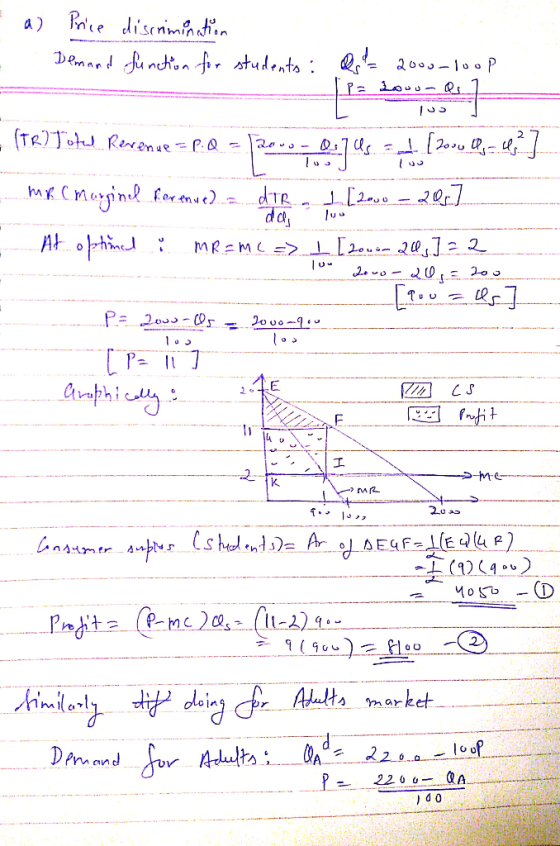
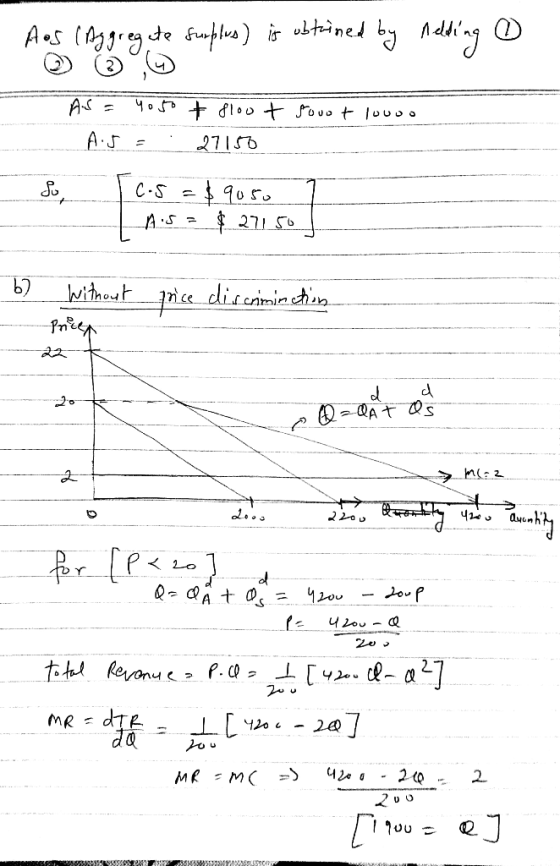
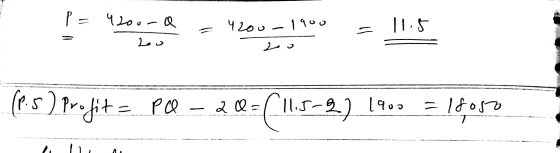
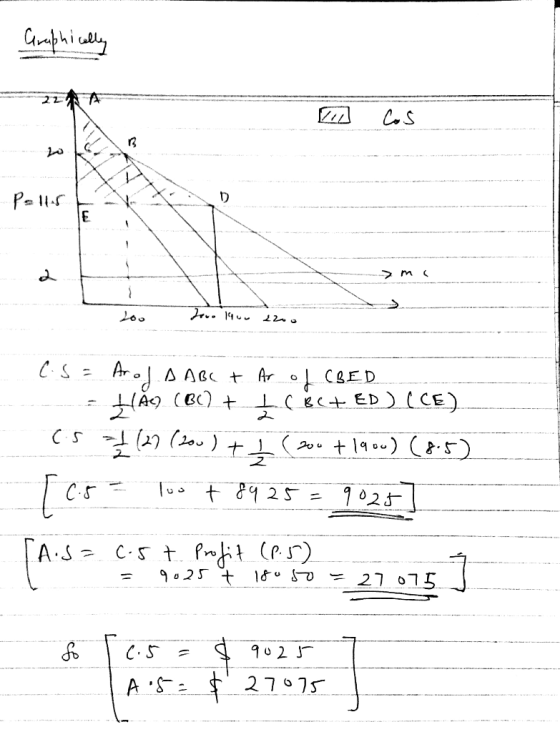
A movie monopolist sells to college students and other adults. The demand function for students is...
A monopolist who sells toys faces the following demand: P(y)=100-2y. The total cost function of the...
A monopolist who sells toys faces the following demand: P(y)=100-2y. The total cost function of the monopolist is given by: c(y)=20y+10y2 . a) Find the price and quantity that maximizes the monopolist’s profit. Also calculate the profit. [3+3] b) If the monopolist can do a perfect price discrimination, then find the consumer and producer surplus.
A monopolist sells to two consumer groups, students and non-students. Demand for students: Q =...
A monopolist sells to two consumer groups, students and non-students. Demand for students: Q = 500 - 1/2P Demand for non-students: Q = 750 - 2P MC = 20 Find the profit-maximizing price/quantity combination in each market if the groups can be separated.
A movie theater faces the following inverse demand curves: Seniors: Ps = 14 - 0.5Q Adults:...
A movie theater faces the following inverse demand curves: Seniors: Ps = 14 - 0.5Q Adults: Pa = 34 - 2Q The marginal cost is constant at $2. a. If the movie theater uses segmenting, calculate the ticket prices charged to adults and seniors. b. How much producer surplus does the movie theater earn from segmenting? c. Now suppose the movie theater is legally prevented from using segmenting. What price will the movie theater charge per ticket? How much producer...
A monopolist has a total cost function TC = 8Q2 + 100. The inverse demand function...
A monopolist has a total cost function TC = 8Q2 + 100. The inverse demand function for the monopolist is P = 18- Q. What is the optimal price for the monopolist and what is consumer surplus
1. Suppose that a single-price monopolist faces the demand function P 100 Q where I is...
 1. Suppose that a single-price monopolist faces the demand function P 100 Q where I is average weekly household income, and that the firm's marginal cost function is given by MC(Q) 2Q. The firm has no fixed costs. = (a) If the average weekly household income is $600, find the firm's marginal revenue function. (b) What is the firm's profit-maximizing quantity of output? At what price will the firm sell that output? What will the firm's marginal cost be? (c)...
A monopolist has discovered that the inverse demand function of a person with income M for...
A monopolist has discovered that the inverse demand function of a person with income M for the monopolists product is p = 2M −q. The monopolist has a total cost function, c(q) = 100q. The monopolist is able to observe the incomes of its consumers and to practice price discrimination according to income (second-degree price discrimination). (a) Draw the demand function of consumers with income ML and those with income MH, with ML < MH. [20%] (b) Determine the price...
2. A monopolist serves a market with an aggregate demand function given by Q = 36...
2. A monopolist serves a market with an aggregate demand function given by Q = 36 – 3P. The monopolist’s cost function is given by C(Q) = 2Q. a. How much profit can the monopolist generate with first-degree price discrimination if resale can be prevented? What is the associated deadweight loss relative to the competitive level of output? b. Suppose that the monopolist can partition its market into two separate submarkets. The demand function for submarket 1 is given by...
6. A monopolist has discovered that the inverse demand function of a person with income M...
6. A monopolist has discovered that the inverse demand function of a person with income M for the monopolists product is p = 2M − q. The monopolist has a total cost function, c(q) = 100q. The monopolist is able to observe the incomes of its consumers and to practice price discrimination according to income (second-degree price discrimination). (a) Draw the demand function of consumers with income ML and those with income MH , with ML < MH . [20%]...
1. A monopolist with marginal cost of production of 40 sells to two distinct consumers. For...
 1. A monopolist with marginal cost of production of 40 sells to two distinct consumers. For consumer 1, demand is given by Q1 = 300 - P1. For consumer 2, it is given by Q2 = 180 - P2. a. Determine the optimal uniform price and output when discrimination is impossible. b. Assume third-degree discrimination between the two consumers is possible. What price will be set for each consumer? What quantity will be sold for each consumer? c. How does...
D Question 15 1 pts Consider a monopolist that has two types of consumers. The first, students have a demand curve give...
 D Question 15 1 pts Consider a monopolist that has two types of consumers. The first, students have a demand curve given by the following: QA-120-2P. The second type of consumer is non-students who have the following demand curve: QB-200-4P. If the monopolist has constant marginal and average cost equal to 10, which of the following is truef the monopolist practices third degree price discrimination? The price charged to student equals 35 and non-students equals 60 The price charged to...
 1. Suppose that a single-price monopolist faces the demand function P 100 Q where I is average weekly household income, and that the firm's marginal cost function is given by MC(Q) 2Q. The firm has no fixed costs. = (a) If the average weekly household income is $600, find the firm's marginal revenue function. (b) What is the firm's profit-maximizing quantity of output? At what price will the firm sell that output? What will the firm's marginal cost be? (c)...
 1. A monopolist with marginal cost of production of 40 sells to two distinct consumers. For consumer 1, demand is given by Q1 = 300 - P1. For consumer 2, it is given by Q2 = 180 - P2. a. Determine the optimal uniform price and output when discrimination is impossible. b. Assume third-degree discrimination between the two consumers is possible. What price will be set for each consumer? What quantity will be sold for each consumer? c. How does...
 D Question 15 1 pts Consider a monopolist that has two types of consumers. The first, students have a demand curve given by the following: QA-120-2P. The second type of consumer is non-students who have the following demand curve: QB-200-4P. If the monopolist has constant marginal and average cost equal to 10, which of the following is truef the monopolist practices third degree price discrimination? The price charged to student equals 35 and non-students equals 60 The price charged to...
Most questions answered within 3 hours.
-
Where is the error in this code sequence?
String s1 = "Hello";
String s2 = "ello";...
asked 11 months ago -
Financial data for Joel de Paris, Inc., for last year
follow:
Joel de Paris, Inc.
Balance...
asked 11 months ago -
Consider this reaction:
Al2(SO4)3 (aq)+ BaCl3
(aq) Al2Cl6 (aq)- +
3BaSO4(s) . What is the...
asked 11 months ago -
Suppose that Savneet is considering increasing her
recent random sample from 20 car rentals to 40...
asked 11 months ago -
Trucks arrive at an unloading terminal at an average rate of 120
per hour.
Trucks arrive...
asked 11 months ago -
Why are methanol and ethanol completely soluble in water while
octanol is not very little soluble....
asked 11 months ago -
A facilities manager at a university reads in a research report
that the mean amount of...
asked 11 months ago -
When the CuSO4 is rehydrated by adding water to the anhydrous
compound, is this an endothermic...
asked 11 months ago -
A ray of sunlight is passing from diamond into crown glass; the
angle of incidence is...
asked 11 months ago -
A block of mass 0.249 kg is placed on top of a light, vertical
spring of...
asked 11 months ago -
how do the kidneys compensate in the presences of acidosis
a) trigger hyperventilate
b) reserve acid...
asked 11 months ago -
Question 501 pts
The rental rate of capital to the firm increases. Which of the
following...
asked 11 months ago