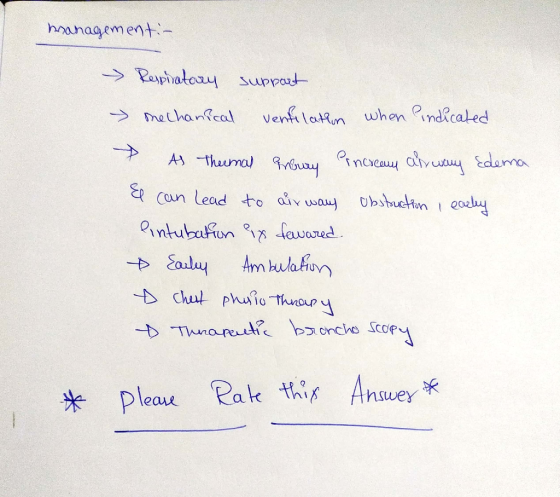
1 sentence. Brief history on inhalation injury including possible risk factor patient has
Homework Answers

Add Answer to:
1
sentence. Brief history on inhalation injury including possible
risk factor patient has
Traumatic brain injury a brief review of pathophysiology/etiology epidemiology / risk factors signs and symptoms diagnostic...
Traumatic brain injury a brief review of pathophysiology/etiology epidemiology / risk factors signs and symptoms diagnostic testing / common lab findings diagnosis (including 3 differential diagnoses) evidence-based treatment (pharmacologic and non-pharmacologic) patient education needs / tips for management / follow-up
Brief Patient History Ms. J is a 40-year-old victim of a car crash. She was found...
Brief Patient History Ms. J is a 40-year-old victim of a car crash. She was found conscious at the scene and pulled out of a burning car to safety by a passerby. The paramedics at the scene reported her as awake but disoriented and anxious. She is otherwise healthy and is the mother of a 5-year-old child, who was also rescued at the scene with no injuries. Clinical Assessment Ms. J is sent from the emergency department to the trauma...
iscussion Questions 1. Relate the patient history and circumstances of the injury and the signs and...
 iscussion Questions 1. Relate the patient history and circumstances of the injury and the signs and symptoms related 2. Discuss the treatments available for the patient. (See Detached Retina in your text and any 3. Relate the symptoms and signs to those of macular degeneration. (See Macular Degeneration.) to the pathophysiology of this condition. (See Detached Retina in your text.) new procedures that are being used clinically in the literature) 4. Discuss the treatment available and the prognosis for recovering...
If a patient has a significant scalp wound laceration, but a closed head injury, what factors...
If a patient has a significant scalp wound laceration, but a closed head injury, what factors may predispose his case for an SSI? What would be the setup for the patient if there is a history of CJD? If the setup was a regular setup what impact could this have on the next patient?
9. Which of the following is a modifiable risk factor of osteoporosis? Answer: a) Female gender...
 9. Which of the following is a modifiable risk factor of osteoporosis? Answer: a) Female gender b) Family history c) Sedentary lifestyle d) Advanced age 10. The nurse is teaching the patient about the difference between rheumatoid arthritis (RA) and osteoarthritis (OA). Which statement by the patient indicates a need for further teaching? Answer: a) "RA is inflammatory. OA is degenerative." b) "The risk factors or causes of RA are probably autoimmune, whereas OA may be caused by age, obesity,...
Patient with Hematologic Disorders and Oncologic Emergencies Brief Patient History Mr. L is an otherwise healthy,...
Patient with Hematologic Disorders and Oncologic Emergencies Brief Patient History Mr. L is an otherwise healthy, 23-year-old African American man who presents with a week-long history of diarrhea, nausea, and vomiting after attending a barbecue last weekend. Clinical Assessment Mr. L is admitted to the critical care unit from the emergency department with hypotension, fever, and leukocytosis. Diagnostic Procedures His vital signs are as follows: blood pressure of 65/42 mm Hg, heart rate of 145 beats/min (sinus tachycardia), respiratory rate...
5. An infant patient presents with stridor and profound inhalation. He has signs of a viral infection...
5. An infant patient presents with stridor and profound inhalation. He has signs of a viral infection (e.g. fever and general malaise). What upper respiratory obstructive disorder is most likely occurring in this patient? 1. A patient presents with signs of combative behavior, hypotension and bradycardia. You suspect he has a disorder of ventilation. A) What would you detect is aberrant in terms of blood gas concentration if he has hypoxemia? B) What would you detect is aberrant in terms of blood...
Brief Patient History Mrs. G is a 54-year-old African American woman who has been having intermittent...
Brief Patient History Mrs. G is a 54-year-old African American woman who has been having intermittent indigestion for the past month. She has a history of hypertension and hyperlipidemia. She was admitted as an inpatient on a medical floor for management of her blood pressure and is scheduled to undergo endoscopy tomorrow. Mrs. G suddenly becomes diaphoretic and complains of nausea and epigastric pain. Clinical Assessment The rapid response team is called to evaluate Mrs. G. When the team arrives...
Brief Patient History Mr. K is a 58-year-old white man admitted to the cardiac unit from...
Brief Patient History Mr. K is a 58-year-old white man admitted to the cardiac unit from the medical unit after cardiac arrest (VF). He was successfully defibrillated after one shock (biphasic at 200 joules). He has a history of hypertension, myocardial infarction, mitral valve regurgitation, atrial fibrillation, and hyperlipidemia. Mr. K was scheduled for mitral valve replacement and the maze procedure. Mr. K is a school administrator, is married, and has two daughters who live out of state. Clinical Assessment...
Brief Patient History Mr. P is a 24-year-old man who was water-skiing when he was hit...
Brief Patient History Mr. P is a 24-year-old man who was water-skiing when he was hit by a boat. He was rescued from the water by friends. He was immobilized and transported to the hospital by paramedics called to the scene. Clinical Assessment Mr. P is admitted to the emergency department with abrasions and bruising to his head and shoulders. He is having difficulty breathing and is unable to move his extremities. He is complaining of neck pain and has...
 iscussion Questions 1. Relate the patient history and circumstances of the injury and the signs and symptoms related 2. Discuss the treatments available for the patient. (See Detached Retina in your text and any 3. Relate the symptoms and signs to those of macular degeneration. (See Macular Degeneration.) to the pathophysiology of this condition. (See Detached Retina in your text.) new procedures that are being used clinically in the literature) 4. Discuss the treatment available and the prognosis for recovering...
 9. Which of the following is a modifiable risk factor of osteoporosis? Answer: a) Female gender b) Family history c) Sedentary lifestyle d) Advanced age 10. The nurse is teaching the patient about the difference between rheumatoid arthritis (RA) and osteoarthritis (OA). Which statement by the patient indicates a need for further teaching? Answer: a) "RA is inflammatory. OA is degenerative." b) "The risk factors or causes of RA are probably autoimmune, whereas OA may be caused by age, obesity,...
Most questions answered within 3 hours.
-
Where is the error in this code sequence?
String s1 = "Hello";
String s2 = "ello";...
asked 11 months ago -
Financial data for Joel de Paris, Inc., for last year
follow:
Joel de Paris, Inc.
Balance...
asked 11 months ago -
Consider this reaction:
Al2(SO4)3 (aq)+ BaCl3
(aq) Al2Cl6 (aq)- +
3BaSO4(s) . What is the...
asked 11 months ago -
Suppose that Savneet is considering increasing her
recent random sample from 20 car rentals to 40...
asked 11 months ago -
Trucks arrive at an unloading terminal at an average rate of 120
per hour.
Trucks arrive...
asked 11 months ago -
Why are methanol and ethanol completely soluble in water while
octanol is not very little soluble....
asked 11 months ago -
A facilities manager at a university reads in a research report
that the mean amount of...
asked 11 months ago -
When the CuSO4 is rehydrated by adding water to the anhydrous
compound, is this an endothermic...
asked 11 months ago -
A ray of sunlight is passing from diamond into crown glass; the
angle of incidence is...
asked 11 months ago -
A block of mass 0.249 kg is placed on top of a light, vertical
spring of...
asked 11 months ago -
how do the kidneys compensate in the presences of acidosis
a) trigger hyperventilate
b) reserve acid...
asked 11 months ago -
Question 501 pts
The rental rate of capital to the firm increases. Which of the
following...
asked 11 months ago