chebysshev's theorem
Homework Answers
Chebyshev’s Theorem:
at least  of the data lie within
  standard deviations of the mean, that is, in the
interval with endpoints
standard deviations of the mean, that is, in the
interval with endpoints  for samples and with endpoints
  for populations, where k is any positive whole number
that is greater than 1.
for populations, where k is any positive whole number
that is greater than 1.
For any numerical data set,
1.
- at least
 of the data lie within two standard deviations of the mean, that
is, in the interval with endpoints
of the data lie within two standard deviations of the mean, that
is, in the interval with endpoints
 of the data lie within two standard deviations of the mean, that
is, in the interval with endpoints
of the data lie within two standard deviations of the mean, that
is, in the interval with endpoints and
and
 for samples and with endpoints
  and
and  for population
2.
at least  of the data lie within three standard deviations of the mean, that
is, in the interval with endpoints
of the data lie within three standard deviations of the mean, that
is, in the interval with endpoints  and
and  for samples and with endpoints
  and
and  for populations;
Stokes' Theorem Verify Stokes' Theorem by evaluating each side of the equation in the theorem Here,...
 Stokes' Theorem Verify Stokes' Theorem by evaluating each side of the equation in the theorem Here, F (x2 y, y2 - z2,z2 -x2) S is the plane x + y z 1 in the first octant, oriented with upward pointing normal vector, and y is the boundary of S oriented counterclockwise when seen from above. State Stokes' Theorem in its entirety Sketch the surface S and curve, y Explain in detail how all the conditions of the hypothesis of the...
Superposition Theorem
 Use the superposition theorem to solve the given circuitUse the superposition theorem to solve the given circuitUse the superposition theorem to solve the given circuitUse the superposition theorem to solve the given circuitUse the superposition theorem to solve the given circuitUse the superposition theorem to solve the given circuit
State the Karatsuba algorithm as a Theorem , and prove that theorem.
State the Karatsuba algorithm as a Theorem , and prove that theorem.
Prove these 2 formulas of the weibull distribution THEOREM THEOREM
 Prove these 2 formulas of the weibull distribution
THEOREM
THEOREM
Prove these 2 formulas of the weibull distribution
THEOREM
THEOREM
2.) Show that the fundamental theorem of divergences (aka Gauss's theorem, aka Green's theorem), shown below,...
 2.) Show that the fundamental theorem of divergences (aka Gauss's theorem, aka Green's theorem), shown below, holds for the (vector) function v from the previous problem. (Use the cube shown below as the basis for your work; the cube has sides of length 3.) fundamental theorem of divergences (V.v)dr v-da 24 A(v) (ii) 47 (iv) (ii) (vi) 1.) Calculate the divergence of the following (vector) function: v (xy)x +(2yz)y+ (3xz)z (NOTE: x, y, and z are Cartesian unit vectors.) 2.)...
Using the theorem of equivalences and the substitution theorem prove that: A ⊕ B ≡ ¬(A...
Using the theorem of equivalences and the substitution theorem prove that: A ⊕ B ≡ ¬(A ↔ B)
Use the Heine-Borel Theorem to prove the Bolzano-Weierstrass Theorem.
Use the Heine-Borel Theorem to prove the Bolzano-Weierstrass Theorem.
Clearly explain the "Coase theorem." What is the implication of ridership on the theorem?
Clearly explain the "Coase theorem." What is the implication of ridership on the theorem?
Prove the theorem: 12.5 Theorem If α and β are transformations, then βα is a transformation.
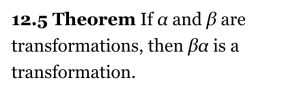 Prove the theorem:
12.5 Theorem If α and β are transformations, then βα is a transformation.
Prove the theorem:
12.5 Theorem If α and β are transformations, then βα is a transformation.
1. Both Lagrange's theorem and Cauchy's theorem deal with the relationship between the size of a ...
 1. Both Lagrange's theorem and Cauchy's theorem deal with the relationship between the size of a group and the order of its elements. (a) Explain the difference between the theorems in general terms and by using S7 as an example. Your explanation should include what we can and cannot conclude from each theorem about S7 (b) Which theorem would allow you to prove that if a group contained only elements that had order some power of 2, then the order...
 Stokes' Theorem Verify Stokes' Theorem by evaluating each side of the equation in the theorem Here, F (x2 y, y2 - z2,z2 -x2) S is the plane x + y z 1 in the first octant, oriented with upward pointing normal vector, and y is the boundary of S oriented counterclockwise when seen from above. State Stokes' Theorem in its entirety Sketch the surface S and curve, y Explain in detail how all the conditions of the hypothesis of the...
 Prove these 2 formulas of the weibull distribution
THEOREM
THEOREM
Prove these 2 formulas of the weibull distribution
THEOREM
THEOREM
 2.) Show that the fundamental theorem of divergences (aka Gauss's theorem, aka Green's theorem), shown below, holds for the (vector) function v from the previous problem. (Use the cube shown below as the basis for your work; the cube has sides of length 3.) fundamental theorem of divergences (V.v)dr v-da 24 A(v) (ii) 47 (iv) (ii) (vi) 1.) Calculate the divergence of the following (vector) function: v (xy)x +(2yz)y+ (3xz)z (NOTE: x, y, and z are Cartesian unit vectors.) 2.)...
 Prove the theorem:
12.5 Theorem If α and β are transformations, then βα is a transformation.
Prove the theorem:
12.5 Theorem If α and β are transformations, then βα is a transformation.
 1. Both Lagrange's theorem and Cauchy's theorem deal with the relationship between the size of a group and the order of its elements. (a) Explain the difference between the theorems in general terms and by using S7 as an example. Your explanation should include what we can and cannot conclude from each theorem about S7 (b) Which theorem would allow you to prove that if a group contained only elements that had order some power of 2, then the order...
Most questions answered within 3 hours.
-
Where is the error in this code sequence?
String s1 = "Hello";
String s2 = "ello";...
asked 10 months ago -
Financial data for Joel de Paris, Inc., for last year
follow:
Joel de Paris, Inc.
Balance...
asked 10 months ago -
Consider this reaction:
Al2(SO4)3 (aq)+ BaCl3
(aq) Al2Cl6 (aq)- +
3BaSO4(s) . What is the...
asked 10 months ago -
Suppose that Savneet is considering increasing her
recent random sample from 20 car rentals to 40...
asked 10 months ago -
Trucks arrive at an unloading terminal at an average rate of 120
per hour.
Trucks arrive...
asked 10 months ago -
Why are methanol and ethanol completely soluble in water while
octanol is not very little soluble....
asked 10 months ago -
A facilities manager at a university reads in a research report
that the mean amount of...
asked 10 months ago -
When the CuSO4 is rehydrated by adding water to the anhydrous
compound, is this an endothermic...
asked 10 months ago -
A ray of sunlight is passing from diamond into crown glass; the
angle of incidence is...
asked 10 months ago -
A block of mass 0.249 kg is placed on top of a light, vertical
spring of...
asked 10 months ago -
how do the kidneys compensate in the presences of acidosis
a) trigger hyperventilate
b) reserve acid...
asked 10 months ago -
Question 501 pts
The rental rate of capital to the firm increases. Which of the
following...
asked 10 months ago