Current situation: 60-year-old adult man, begins to present diarrhea (> 3 days), dizziness, drowsiness, headache (strong),...
Current situation: 60-year-old adult man, begins to present diarrhea (> 3 days), dizziness, drowsiness, headache (strong), movement problems, vomiting (bloody), numbness and tingling of the extremities. He is taken by his wife to the hospital, in the triage consultation, he states that, due to chronic back pain, he self-medicated (for more than 3 months) with high doses (500mg / day) of a supposedly natural over-the-counter pain reliever . Unfortunately, this medication was found to contain diclofenac sodium.
1. what is Toxicokinetics. In this case, identify the phases of toxicokinetics in NSAID poisoning, explain step by step the mechanism of action and toxicity of diclofenac sodium by means of a diagram
2. What does Triage consist of? What is the assessment and general examination performed on the patient in this case of diclofenac sodium poisoning?
3.Consult the symptoms of sodium diclofenac poisoning, according to the time elapsed since ingesting the drug in poisoning by this drug. Please explain briefly what are its uses and its pharmacodynamics.
4. What are the complementary tests to identify diclofenac sodium poisoning? Consult and explain the clinical utility of a toxicological study, in which cases should a toxicological analysis be performed?
Homework Answers
1. Toxicokinetics
Toxicokinetics is the changes in concentrations of a toxicant over time due to the uptake, biotransformation, distribution and elimination of toxicants in the body.
Phases of toxicokinetics in NSAID poisoning
- Ulcer FORMATION IN STOMACH
- Bleeding in the stomach
- Injury to the kidneys
- Seizures and coma.
Mechanism of action
IT works by reducing substances in the body that cause pain and inflammation. It works by inhibition of prostaglandin synthesis by inhibition of the transiently expressed prostaglandin-endoperoxide synthase-2 (PGES-2) also known as cycloxygenase-2 (COX-2).
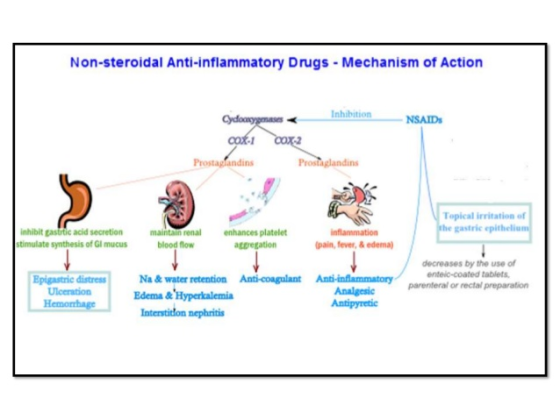
2.Triage
It is the assignment of illnesses to decide the order of treatment of a large number of patients or casualties.
Assessment and general examination
- Observe the respiration
- Monitor hydration level
- Asses the neuro status
- Asses the characters of stool and vomitus for the signs of GI bleed.
Uses
To relieve pain, swelling (inflammation), and joint stiffness caused by arthritis.
Pharmacodynamics
Diclofenac reduces inflammation and by extension reduces
nociceptive pain and combats fever. It also increases the risk of
developing a gastrointestinal ulcer by inhibiting the production of
protective mucus in the stomach.
3.Tests to identify diclofenac sodium poisoning
- Liver function test
- Renal function test
- Respiratory assessment
- GI endoscopy
Clinical interventions
Manage patients with symptomatic and supportive care following an NSAID overdosage. There are no specific antidotes. Consider emesis and/or activated charcoal (60 to 100 grams in adults, 1 to 2 grams per kg of body weight in child) and/or osmotic cathartic in symptomatic patients seen within four hours of ingestion or in patients with a large overdose (5 to 10 times the recommended dosage). Forced diuresis, alkalinization of urine, hemodialysis, or hemoperfusion may not be useful due to high protein binding.
Add Answer to:
Current situation: 60-year-old adult man, begins to present
diarrhea (> 3 days), dizziness, drowsiness, headache (strong),...
Most questions answered within 3 hours.
-
Where is the error in this code sequence?
String s1 = "Hello";
String s2 = "ello";...
asked 11 months ago -
Financial data for Joel de Paris, Inc., for last year
follow:
Joel de Paris, Inc.
Balance...
asked 11 months ago -
Consider this reaction:
Al2(SO4)3 (aq)+ BaCl3
(aq) Al2Cl6 (aq)- +
3BaSO4(s) . What is the...
asked 11 months ago -
Suppose that Savneet is considering increasing her
recent random sample from 20 car rentals to 40...
asked 11 months ago -
Trucks arrive at an unloading terminal at an average rate of 120
per hour.
Trucks arrive...
asked 11 months ago -
Why are methanol and ethanol completely soluble in water while
octanol is not very little soluble....
asked 11 months ago -
A facilities manager at a university reads in a research report
that the mean amount of...
asked 11 months ago -
When the CuSO4 is rehydrated by adding water to the anhydrous
compound, is this an endothermic...
asked 11 months ago -
A ray of sunlight is passing from diamond into crown glass; the
angle of incidence is...
asked 11 months ago -
A block of mass 0.249 kg is placed on top of a light, vertical
spring of...
asked 11 months ago -
how do the kidneys compensate in the presences of acidosis
a) trigger hyperventilate
b) reserve acid...
asked 11 months ago -
Question 501 pts
The rental rate of capital to the firm increases. Which of the
following...
asked 11 months ago