
Homework Answers
Answer c. the monopoly price will rise by less than $1.
Reason- Demand curve faced by monopolist is downward sloping. So, P>MR for all units for a monopolist.
The profit maximising condition for monopoly is MC =MR.
So, When MC rises by $1, the rise in price is less than $1.
Add Answer to:
148. If a monopolist's marginal costs shift up by $1.00, then a. the monopoly price will...
. Chapter 15/Monopoly > 647 Ans X10* Table 15-3 George has the following demand curve for...
 . Chapter 15/Monopoly > 647 Ans X10* Table 15-3 George has the following demand curve for selling vegemite: TR MR Price Quantity $10.00 S8.00 S6.00 3 $4.00 $2.00 MRE ME LP a proke In addition, George has a marginal cost of $3.00 per unit 146. Refer to Table 15-3. What is George's profit-maximizing level of output? a. 1 b. 2 What is Georges Pois minimizing level of operating H Q 41 MRT 1861 MR="MR Y TR d. 4 ANS: B...
ts product at different price), it is engaging in ing. quality-adjusted pricing c. price differentiation. d....
 ts product at different price), it is engaging in ing. quality-adjusted pricing c. price differentiation. d. price discrimination ANS: D PTS: I Prige discrimination TOP: DIF: I MSC: Definitional REF: 15-5 Sceyario 15-3 Black Box Cable TV is able to purchase an exclusive right to sell a premium movie channel (PMC) in its market arca. V Let's assume that Black Box Cable pays $150.000 a vear for the exclusive marketing rights to PMC. Since Black Box has already installed cable...
= 6oooo-20.0 4000 PTS: 1 TOP: Price discrimination TOUT DIF: 2 REF: 15-5 MSC: Analytical 67....
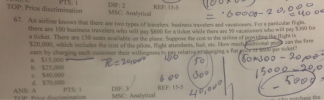 = 6oooo-20.0 4000 PTS: 1 TOP: Price discrimination TOUT DIF: 2 REF: 15-5 MSC: Analytical 67. An airline knows that there are two types of traveler knows that there are two types of travelers: business travelers and vacationers. For a particular flight, there are 100 business travelers who will pay $600 for a ticket while there are 50 vacationers who will pay a ticket. There are 150 seats available on the plane. Suppose the cost to the airline of providing...
1. An increase in the supply of labor, the variable factor of production, will cause a monopsonist's: a. marginal revenue product curve to shift up b. marginal revenue product curve to shift...
 1. An increase in the supply of labor, the variable factor of production, will cause a monopsonist's: a. marginal revenue product curve to shift up b. marginal revenue product curve to shift down arginal factor cost curve to shift up marginal factor cost curve to shift down ARP e. both "a" and "c" are correct answers f. both "b" and "c" are correct answers g. both "a" and "d" are correct answers h. both "b" and "d" are correct answers...
1.) What is the main difference between a competitive firm and a monopoly? a. A competitive...
1.) What is the main difference between a competitive firm and a monopoly? a. A competitive firm owns a key resource, but a monopoly firm does not. b. A competitive firm is a price taker, and a monopoly is a price maker. c. A competitive firm produces output at a lower cost than a monopoly firm. d. A competitive firm is subject to government regulations, but a monopoly firm is not. 2.) What is the main social problem caused by...
36) When a monopolist sells the same product at different prices and the prices are not related to cost differences, we have B) price differentiation. D) monopoly pricing A) price discrimination...
 36) When a monopolist sells the same product at different prices and the prices are not related to cost differences, we have B) price differentiation. D) monopoly pricing A) price discrimination C) marginal cost pricing. 37) 37) Monopolies misallocate resources because A) price does not equal marginal cost B) profits are usually positive. C) marginal cost does not equal average total cost. D) price does not equal average total cost. 38) 38) Which of the following assumptions is true about...
6) Monopoly (6 points) The following table shows output and pricing options for a monopoly. Price...
 6) Monopoly (6 points) The following table shows output and pricing options for a monopoly. Price $10 $9 $8 $7 $6 $5 $4 $3 $2 $1 $0 Quantity Demanded 0 1 2 3 4 5 6 7 8 9 10 Total Revenue $0 Marginal Revenue a. Complete the table by calculating total revenue and marginal revenue at each output level. b. At what rate of output does marginal revenue turn negative? What is the price effect and the quantity effect...
1. What do you think best describes each of the following markets: perfect competition, monopoly, oligopoly...
 1. What do you think best describes each of the following markets: perfect competition, monopoly, oligopoly or monopolistic competition? Explain. a. The market for cars. b. The market for soy beans. c. The market for cellphones. d. The market for dining out in a large city. 2. Why is price equal to marginal revenue for a perfectly competitive firm but not for a monopolist? e) What is the opportunity cost of one more slurpee? O A. $0.75 OB. 0.5 candy...
Question 1 1 pts A natural monopoly is characterised by: large marginal costs relative to fixed...
 Question 1 1 pts A natural monopoly is characterised by: large marginal costs relative to fixed costs. large fixed costs relative to variable costs. small fixed costs relative to variable costs. fixed costs that are equal to variable costs. Question 2 1 pts In the market equilibrium, a single-price monopolist generally O generates lower total surplus than in perfect competition O produces at an inefficient scale causes deadweight loss all of the above none of the above
An industry currently has 100 firms, all of which have fixed costs of $16 and avg
An industry currently has 100 firms, all of which have fixed costs of $16 and avg. variable cost as follows: Q Avg. Variable Cost ($) 1 1 2 2 3 3 4 4 5 5 6 6 a. Compute marginal cost and avg. total cost. b. the price is $10. what is the total quantity supplied in the market? c. as this market makes the transition to its long-run equilibrium, will the price rise or fall? will the quantity demanded...
 . Chapter 15/Monopoly > 647 Ans X10* Table 15-3 George has the following demand curve for selling vegemite: TR MR Price Quantity $10.00 S8.00 S6.00 3 $4.00 $2.00 MRE ME LP a proke In addition, George has a marginal cost of $3.00 per unit 146. Refer to Table 15-3. What is George's profit-maximizing level of output? a. 1 b. 2 What is Georges Pois minimizing level of operating H Q 41 MRT 1861 MR="MR Y TR d. 4 ANS: B...
 ts product at different price), it is engaging in ing. quality-adjusted pricing c. price differentiation. d. price discrimination ANS: D PTS: I Prige discrimination TOP: DIF: I MSC: Definitional REF: 15-5 Sceyario 15-3 Black Box Cable TV is able to purchase an exclusive right to sell a premium movie channel (PMC) in its market arca. V Let's assume that Black Box Cable pays $150.000 a vear for the exclusive marketing rights to PMC. Since Black Box has already installed cable...
 = 6oooo-20.0 4000 PTS: 1 TOP: Price discrimination TOUT DIF: 2 REF: 15-5 MSC: Analytical 67. An airline knows that there are two types of traveler knows that there are two types of travelers: business travelers and vacationers. For a particular flight, there are 100 business travelers who will pay $600 for a ticket while there are 50 vacationers who will pay a ticket. There are 150 seats available on the plane. Suppose the cost to the airline of providing...
 1. An increase in the supply of labor, the variable factor of production, will cause a monopsonist's: a. marginal revenue product curve to shift up b. marginal revenue product curve to shift down arginal factor cost curve to shift up marginal factor cost curve to shift down ARP e. both "a" and "c" are correct answers f. both "b" and "c" are correct answers g. both "a" and "d" are correct answers h. both "b" and "d" are correct answers...
 36) When a monopolist sells the same product at different prices and the prices are not related to cost differences, we have B) price differentiation. D) monopoly pricing A) price discrimination C) marginal cost pricing. 37) 37) Monopolies misallocate resources because A) price does not equal marginal cost B) profits are usually positive. C) marginal cost does not equal average total cost. D) price does not equal average total cost. 38) 38) Which of the following assumptions is true about...
 6) Monopoly (6 points) The following table shows output and pricing options for a monopoly. Price $10 $9 $8 $7 $6 $5 $4 $3 $2 $1 $0 Quantity Demanded 0 1 2 3 4 5 6 7 8 9 10 Total Revenue $0 Marginal Revenue a. Complete the table by calculating total revenue and marginal revenue at each output level. b. At what rate of output does marginal revenue turn negative? What is the price effect and the quantity effect...
 1. What do you think best describes each of the following markets: perfect competition, monopoly, oligopoly or monopolistic competition? Explain. a. The market for cars. b. The market for soy beans. c. The market for cellphones. d. The market for dining out in a large city. 2. Why is price equal to marginal revenue for a perfectly competitive firm but not for a monopolist? e) What is the opportunity cost of one more slurpee? O A. $0.75 OB. 0.5 candy...
 Question 1 1 pts A natural monopoly is characterised by: large marginal costs relative to fixed costs. large fixed costs relative to variable costs. small fixed costs relative to variable costs. fixed costs that are equal to variable costs. Question 2 1 pts In the market equilibrium, a single-price monopolist generally O generates lower total surplus than in perfect competition O produces at an inefficient scale causes deadweight loss all of the above none of the above
Most questions answered within 3 hours.
-
Where is the error in this code sequence?
String s1 = "Hello";
String s2 = "ello";...
asked 10 months ago -
Financial data for Joel de Paris, Inc., for last year
follow:
Joel de Paris, Inc.
Balance...
asked 10 months ago -
Consider this reaction:
Al2(SO4)3 (aq)+ BaCl3
(aq) Al2Cl6 (aq)- +
3BaSO4(s) . What is the...
asked 10 months ago -
Suppose that Savneet is considering increasing her
recent random sample from 20 car rentals to 40...
asked 10 months ago -
Trucks arrive at an unloading terminal at an average rate of 120
per hour.
Trucks arrive...
asked 10 months ago -
Why are methanol and ethanol completely soluble in water while
octanol is not very little soluble....
asked 10 months ago -
A facilities manager at a university reads in a research report
that the mean amount of...
asked 10 months ago -
When the CuSO4 is rehydrated by adding water to the anhydrous
compound, is this an endothermic...
asked 10 months ago -
A ray of sunlight is passing from diamond into crown glass; the
angle of incidence is...
asked 10 months ago -
A block of mass 0.249 kg is placed on top of a light, vertical
spring of...
asked 10 months ago -
how do the kidneys compensate in the presences of acidosis
a) trigger hyperventilate
b) reserve acid...
asked 10 months ago -
Question 501 pts
The rental rate of capital to the firm increases. Which of the
following...
asked 10 months ago