
Homework Answers
Add Answer to:
(a) Consider a two-product firm that is operating under pure competition - I.e. the the prices...
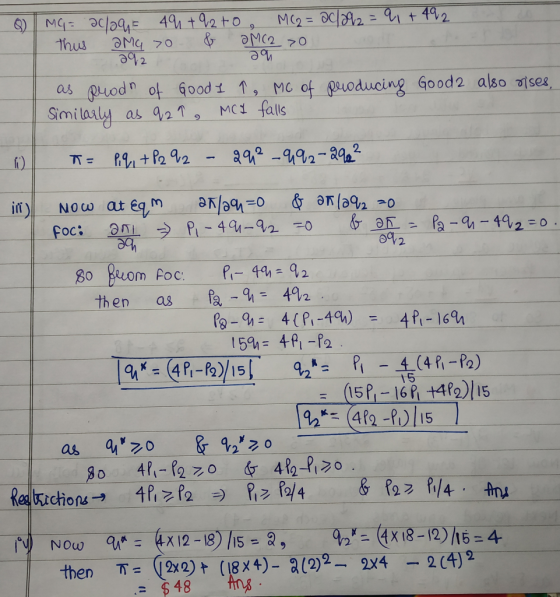
3. A firm produces two goods in pure competition and has the following total revenue and total cost function. TR(X1,X2) = 18x1 + 15x2 (a) Maximize profits for the firm, using matrix inversion to...
 3. A firm produces two goods in pure competition and has the following total revenue and total cost function. TR(X1,X2) = 18x1 + 15x2 (a) Maximize profits for the firm, using matrix inversion to solve the first-order conditions. 13) Answer: 3 (. Refar to the fim in Question 3(0) use the Hessian to check the second conditions for profit maximization. 13] Answer:
3. A firm produces two goods in pure competition and has the following total revenue and total cost...
3. A firm produces two goods in pure competition and has the following total revenue and total cost function. TR(X1,X2) = 18x1 + 15x2 (a) Maximize profits for the firm, using matrix inversion to solve the first-order conditions. 13) Answer: 3 (. Refar to the fim in Question 3(0) use the Hessian to check the second conditions for profit maximization. 13] Answer:
3. A firm produces two goods in pure competition and has the following total revenue and total cost...
Mathematical Question 3 (30pts) 3. Consider two firms are performing Cournot price competition in two differentiated...
 Mathematical Question 3 (30pts) 3. Consider two firms are performing Cournot price competition in two differentiated goods markets. Firm 1 produces goods 1, and firm 2 produces goods 2, and two market demand functions are given by 91 (P1,P2) = 12-2p1 + P2 and 921,P2) = 12-2p2 + P 1. Furthermore, assume that the two firms have the same cost function such that fixed cost is $20 and variable cost is zero. a. (10pts) Calculate the equilibrium prices, quantities and...
Question 2 (60 points) Consider two following Cournot competition between two firms, Firm 1 and Firm...
 Question 2 (60 points) Consider two following Cournot competition between two firms, Firm 1 and Firm 2. The firms face an inverse demand function P = 600-Q where Q = 91 + 92 is the total output. Each unit produced costs c-$60. Therefore the profit of each farmer is given by π1 (J1.qz) = (600-91-J2)a1-6091 712 (41,42) (600 q1 q2)42-6092 Each firm. i simultaneusly chooses own qi to maximize own profits πί. a) (15 points) Find the Cournot NE quantities...
10 POINTS. Consider the two-period firm optimization problem. Suppose that the only factor of production is...
 10 POINTS. Consider the two-period firm optimization problem. Suppose that the only factor of production is capital (no labor is used in production). The production function is y-zK" in the current period and y'-z'K'? in the future period, where z, z, and K are given exogenously and the parameter ? < 1. Real profits are ?-y-1 in the current period and ?-y, + (1- d)K'in the future period. The firm seeks to maximize the present value of lifetime discounted profits,...
Each firm produces both goods, i.e., good 1 and good 2. Each firm takes the market prices p 0 and p2 2 0 as firm produc...
 Each firm produces both goods, i.e., good 1 and good 2. Each firm takes the market prices p 0 and p2 2 0 as firm produces T units of good 1 and x2 units of good 2, with (xi, x2) the total costs of C(x.x) = 2i+0.5«% given and chooses output to maximize profits.1 If a R2, it has 1200 (a) (1 point ) For given prices p1 and p2, find the revenue, R(x1, x2), of a single firm (b)...
There are two firms. Firm 1 (or, a small firm) produces a single product, product A,...
There are two firms. Firm 1 (or, a small firm) produces a single product, product A, at zero cost. Firm 2 (or, a big firm) is a multi-product firm that sells both products A and B. Firm 2 is less efficient in producing A. It incurs a constant marginal cost c > 0 for producing A. However, firm 2 is a monopolist of the market of product B and its cost of producing product B is zero. A unit mass...
The market for widgets consists of two firms that produce identical products. Competition in the market...
The market for widgets consists of two firms that produce identical products. Competition in the market is such that each of the firms independently produces a quantity of output, and these quantities are then sold in the market at a price that is determined by the total amount produced by the two firms. Firm 2 is known to have a cost advantage over firm 1. A recent study found that the (inverse) market demand curve faced by the two firms...
1. Consider two firms engaging in Bertrand Competition. Each firm picks a price at which to...
1. Consider two firms engaging in Bertrand Competition. Each firm picks a price at which to charge for their good. All of the demand for the good goes to the firm with the lowest price, where the quantity demanded = 1000-P. If the firms’ prices are the same, firm 1 gets all of the demand. The cost-per-product produced by firm 1 is MC=2, and the costper-product produced by firm 2 is MC=5. Suppose that the firms can charge any continuous...
3. There are two firms that compete according to Cournot competition. Firm 1 has a cost...
 3. There are two firms that compete according to Cournot competition. Firm 1 has a cost function G(91) = 5.59+12. Firm 2 has a cost function C(q2) = 2.5q3 + 18. These firms cannot discriminate, so there is just one price that is determined by the aggregate demand. The inverse demand equation is P(Q) = 600 – 0 Where total supply Q-q1+92. (e) Use your best response equations to mathematically solve for the equilibrium quantities qi 9, Q". equilibrium price...
PROBLEM #1 Consider a market with two firms that sell products that are identical. Su market dema...
 PROBLEM #1 Consider a market with two firms that sell products that are identical. Su market demand is as follows: P-56-Q , where Q measures the total output produced by both firms (that is, Q=q +q.) and qi and q, are the quantities produced by firm 1 and firm 2, respectively. The per-unit cost of production is $6 for each firm, and so the firm's cost functions are 6q, and 6q, respectively. Each firm seeks to maximize profits. The firms...
 3. A firm produces two goods in pure competition and has the following total revenue and total cost function. TR(X1,X2) = 18x1 + 15x2 (a) Maximize profits for the firm, using matrix inversion to solve the first-order conditions. 13) Answer: 3 (. Refar to the fim in Question 3(0) use the Hessian to check the second conditions for profit maximization. 13] Answer:
3. A firm produces two goods in pure competition and has the following total revenue and total cost...
3. A firm produces two goods in pure competition and has the following total revenue and total cost function. TR(X1,X2) = 18x1 + 15x2 (a) Maximize profits for the firm, using matrix inversion to solve the first-order conditions. 13) Answer: 3 (. Refar to the fim in Question 3(0) use the Hessian to check the second conditions for profit maximization. 13] Answer:
3. A firm produces two goods in pure competition and has the following total revenue and total cost...
 Mathematical Question 3 (30pts) 3. Consider two firms are performing Cournot price competition in two differentiated goods markets. Firm 1 produces goods 1, and firm 2 produces goods 2, and two market demand functions are given by 91 (P1,P2) = 12-2p1 + P2 and 921,P2) = 12-2p2 + P 1. Furthermore, assume that the two firms have the same cost function such that fixed cost is $20 and variable cost is zero. a. (10pts) Calculate the equilibrium prices, quantities and...
 Question 2 (60 points) Consider two following Cournot competition between two firms, Firm 1 and Firm 2. The firms face an inverse demand function P = 600-Q where Q = 91 + 92 is the total output. Each unit produced costs c-$60. Therefore the profit of each farmer is given by π1 (J1.qz) = (600-91-J2)a1-6091 712 (41,42) (600 q1 q2)42-6092 Each firm. i simultaneusly chooses own qi to maximize own profits πί. a) (15 points) Find the Cournot NE quantities...
 10 POINTS. Consider the two-period firm optimization problem. Suppose that the only factor of production is capital (no labor is used in production). The production function is y-zK" in the current period and y'-z'K'? in the future period, where z, z, and K are given exogenously and the parameter ? < 1. Real profits are ?-y-1 in the current period and ?-y, + (1- d)K'in the future period. The firm seeks to maximize the present value of lifetime discounted profits,...
 Each firm produces both goods, i.e., good 1 and good 2. Each firm takes the market prices p 0 and p2 2 0 as firm produces T units of good 1 and x2 units of good 2, with (xi, x2) the total costs of C(x.x) = 2i+0.5«% given and chooses output to maximize profits.1 If a R2, it has 1200 (a) (1 point ) For given prices p1 and p2, find the revenue, R(x1, x2), of a single firm (b)...
 3. There are two firms that compete according to Cournot competition. Firm 1 has a cost function G(91) = 5.59+12. Firm 2 has a cost function C(q2) = 2.5q3 + 18. These firms cannot discriminate, so there is just one price that is determined by the aggregate demand. The inverse demand equation is P(Q) = 600 – 0 Where total supply Q-q1+92. (e) Use your best response equations to mathematically solve for the equilibrium quantities qi 9, Q". equilibrium price...
 PROBLEM #1 Consider a market with two firms that sell products that are identical. Su market demand is as follows: P-56-Q , where Q measures the total output produced by both firms (that is, Q=q +q.) and qi and q, are the quantities produced by firm 1 and firm 2, respectively. The per-unit cost of production is $6 for each firm, and so the firm's cost functions are 6q, and 6q, respectively. Each firm seeks to maximize profits. The firms...
Most questions answered within 3 hours.
-
Where is the error in this code sequence?
String s1 = "Hello";
String s2 = "ello";...
asked 10 months ago -
Financial data for Joel de Paris, Inc., for last year
follow:
Joel de Paris, Inc.
Balance...
asked 10 months ago -
Consider this reaction:
Al2(SO4)3 (aq)+ BaCl3
(aq) Al2Cl6 (aq)- +
3BaSO4(s) . What is the...
asked 10 months ago -
Suppose that Savneet is considering increasing her
recent random sample from 20 car rentals to 40...
asked 10 months ago -
Trucks arrive at an unloading terminal at an average rate of 120
per hour.
Trucks arrive...
asked 10 months ago -
Why are methanol and ethanol completely soluble in water while
octanol is not very little soluble....
asked 10 months ago -
A facilities manager at a university reads in a research report
that the mean amount of...
asked 10 months ago -
When the CuSO4 is rehydrated by adding water to the anhydrous
compound, is this an endothermic...
asked 10 months ago -
A ray of sunlight is passing from diamond into crown glass; the
angle of incidence is...
asked 10 months ago -
A block of mass 0.249 kg is placed on top of a light, vertical
spring of...
asked 10 months ago -
how do the kidneys compensate in the presences of acidosis
a) trigger hyperventilate
b) reserve acid...
asked 10 months ago -
Question 501 pts
The rental rate of capital to the firm increases. Which of the
following...
asked 10 months ago