Mrs. V, a healthy 45-year-old woman, gives birth to a child. There are no outward complications...
Mrs. V, a healthy 45-year-old woman, gives birth to a child. There are no outward complications associated with the birth but, when examined by the pediatrician, the child exhibits abnormal facies, a single palmar crease, hypotonic muscles, and loose pelvic joints. Following chromosomal analysis, a diagnosis of Down syndrome is made.
Discuss the cause of Down syndrome. (See Chromosomal Disorders—Trisomy 21.)
What risks factors exist in the family history? Why are these thought to be risk factors? (See Down Syndrome.)
What other manifestations are typically associated with Down syndrome?
Upon auscultation of her heart, the nurse hears a murmur. What is the significance of this finding based on her history?
Discuss further characteristics that the child may show as he gets older.
Homework Answers
Down Syndrome
Down syndrome is a genetic disorder and the most common autosomal chromosome abnormality in humans, where extra genetic material from chromosome 21 is transferred to a newly formed embryo. These extra genes and DNA cause changes in development of the embryo and fetus resulting in physical and mental abnormalities. Each patient is unique and there can be great variability in the severity of symptoms.
Causes of Down Syndrome
Normally, the human body has 23 pairs of chromosomes (called autosomes) and two sex chromosomes (allosomes). At conception, a new cell is formed that receives one copy of each chromosome from the sperm and one copy from the egg. The new cell divides and multiplies to form an embryo and ultimately a fetus and new human. Each cell contains the exact same genetic material as the original 46 chromosomes, carrying the same genes and DNA.
In patients with Down syndrome, an error occurs in the coming together of chromosome 21. The extra genetic material is responsible for the developmental abnormalities that occur. Instead of 46 chromosomes plus two sex chromosomes, there are 47.
The most common error in chromosome replication is trisomy 21, where the new cell gets three copies of chromosome 21, instead of two. This accounts for about 95% of those patients with Down syndrome. Translocation describes a less common event where an extra piece of chromosome 21 gets attached to another chromosome, again delivering more genetic material to the new cell than is needed.
Mosaic Down syndrome occurs when there is a combination of cells with the normal number of chromosomes (46+2) mixed together with those containing a third chromosome 21 (47+2). The cells with normal chromosomes can moderate the effect of the trisomy 21 cells and modify the effect on the patient's physical and mental development.
Genotype is the term used to describe the genetic makeup of a person and for most Down syndrome patients, it is 47+2. Phenotype describes the physical and functional capabilities of a patient. In patients with Down syndrome there is great variability in phenotype.
Risk Factors in Family History
Family History
There are three types of Down Syndrome: trisomy 21, mosaicism, and translocation. Trisomy 21 is the most common type and occurs when three, rather than two, copies of chromosome 21 are inherited by the fetus from the parents. The second type, mosaicism, happens when some of the fetus’ cells get three copies of chromosome 21, while others get the standard two copies. There is only one type of Down Syndrome that is passed down genetically: the third type, called translocation. With translocation Down syndrome, a piece of one chromosome 21 breaks off and attaches itself to another chromosome. Four percent of people with Down Syndrome have this type.
There is a higher probability of being a carrier (someone who inherited the genetic trait of a disease but does not suffer from it) of the translocation type of Down Syndrome if there is a family history of Down Syndrome or if a mother has had other children with translocation Down Syndrome. If you believe you may be a carrier, an obstetrician can recommend a genetic carrier screening.
Family history of down syndrome can say a risk factor because due to a case of down syndrome in the family like in father, mother, brother sister etc. increase the chances of occurence of down syndrome in the next children.
Clinical Manifestations
The baby with Down syndrome has a hallmark appearance. However, every aspect of the appearance does not need to be present as the phenotype, the way the genes make the child look, can be markedly different for each patient.
Common Down syndrome symptoms are:
- there are a small head and short neck,
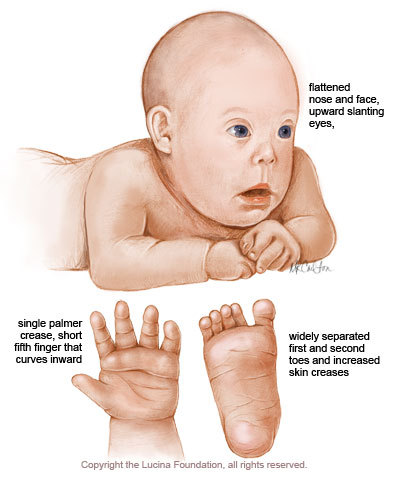
- a flat face, and upward slanting eyes,
- ears are flat and positioned lower than “normal,”
- the tongue protrudes and seems to be too large for the mouth,
- hands tend to be wide, with short fingers and there is just a single flexion crease in the palm, and
- joints tend to be more flexible and muscles may lack tone.
The patient may have growth retardation and though as a baby may be normal size, will not grow as tall. Average height for an adult male with Down syndrome is 5 ft 1 in and for a female it is 4 ft 9 in. Bowleggedness is common. Obesity occurs with aging.
There is decreased mental function and the IQ may range from mild disability (50 to 70) to moderate (35 to 50). For patients with Mosaic Down syndrome, the IQ can be 10 to 30 points higher. There can be language development delay both from hearing impairment and speech delay. Gross motor skills like crawling and walking can be slow to mature and fine motor skills may take time to develop.
| Characteristics | Percentage | Characteristics | Percentage |
|---|---|---|---|
| Mental impairment | 99% | Abnormal teeth | 60% |
| Stunted growth | 90% | Slanted eyes | 60%[12] |
| Umbilical hernia | 90% | Shortened hands | 60% |
| Increased skin on back of neck | 80% | Short neck | 60% |
| Low muscle tone | 80% | Obstructive sleep apnea | 60% |
| Narrow roof of mouth | 76% | Bent fifth finger tip | 57% |
| Flat head | 75% | Brushfield spots in the iris | 56% |
| Flexible ligaments | 75% | Single transverse palmar crease | 53% |
| Proportionally large tongue | 75% | Protruding tongue | 47% |
| Abnormal outer ears | 70% | Congenital heart disease | 40% |
| Flattened nose | 68% | Strabismus | ~35% |
| Separation of first and second toes | 68% | Undescended testicles | 20% |
Cardiac Murmur In this condition
The rate of congenital heart disease in newborns with Down syndrome is around 40%. Of those with heart disease, about 80% have an atrioventricular septal defect or ventricular septal defect with the former being more common. Mitral valve problems become common as people age, even in those without heart problems at birth. Other problems that may occur include tetralogy of Fallot and patent ductus arteriosus. People with Down syndrome have a lower risk of hardening of the arteries.
Characteristics that the child may show as he gets older
Down syndrome is associated with an increased risk of many chronic diseases that are typically associated with older age such as Alzheimer's disease. The accelerated aging suggest that trisomy 21 increases the biological age of tissues, but molecular evidence for this hypothesis is sparse. According to a biomarker of tissue age known as epigenetic clock, trisomy 21 increases the age of blood and brain tissue (on average by 6.6 years)
Adults with DS are at age-related increased risk for dementia, skin and hair changes, early onset menopause, visual and hearing impairments, adult onset seizure disorder, thyroid dysfunction, diabetes, obesity, sleep apnea and musculoskeletal problems
Add Answer to:
Mrs. V, a healthy 45-year-old woman, gives birth to a child.
There are no outward complications...
need help with correct answers. A 21-year-old soldier disappeared in Vietnam. Forty years later, bones are di...
 need help with correct answers.
A 21-year-old soldier disappeared in Vietnam. Forty years later, bones are discovered that may include his remains. Which available living relative's mitochondrial DNA would be the most accurate sample to obtain for comparison to determine whether the bones belong to the soldier? Sister's son O Brother's son O Daughter O Father Question 55 1 pts Which of the following is a hereditary disease characterized by excessive intestinal absorption of a dietary iron resulting in a...
need help with correct answers.
A 21-year-old soldier disappeared in Vietnam. Forty years later, bones are discovered that may include his remains. Which available living relative's mitochondrial DNA would be the most accurate sample to obtain for comparison to determine whether the bones belong to the soldier? Sister's son O Brother's son O Daughter O Father Question 55 1 pts Which of the following is a hereditary disease characterized by excessive intestinal absorption of a dietary iron resulting in a...
 need help with correct answers.
A 21-year-old soldier disappeared in Vietnam. Forty years later, bones are discovered that may include his remains. Which available living relative's mitochondrial DNA would be the most accurate sample to obtain for comparison to determine whether the bones belong to the soldier? Sister's son O Brother's son O Daughter O Father Question 55 1 pts Which of the following is a hereditary disease characterized by excessive intestinal absorption of a dietary iron resulting in a...
need help with correct answers.
A 21-year-old soldier disappeared in Vietnam. Forty years later, bones are discovered that may include his remains. Which available living relative's mitochondrial DNA would be the most accurate sample to obtain for comparison to determine whether the bones belong to the soldier? Sister's son O Brother's son O Daughter O Father Question 55 1 pts Which of the following is a hereditary disease characterized by excessive intestinal absorption of a dietary iron resulting in a...
Most questions answered within 3 hours.
-
Where is the error in this code sequence?
String s1 = "Hello";
String s2 = "ello";...
asked 11 months ago -
Financial data for Joel de Paris, Inc., for last year
follow:
Joel de Paris, Inc.
Balance...
asked 11 months ago -
Consider this reaction:
Al2(SO4)3 (aq)+ BaCl3
(aq) Al2Cl6 (aq)- +
3BaSO4(s) . What is the...
asked 11 months ago -
Suppose that Savneet is considering increasing her
recent random sample from 20 car rentals to 40...
asked 11 months ago -
Trucks arrive at an unloading terminal at an average rate of 120
per hour.
Trucks arrive...
asked 11 months ago -
Why are methanol and ethanol completely soluble in water while
octanol is not very little soluble....
asked 11 months ago -
A facilities manager at a university reads in a research report
that the mean amount of...
asked 11 months ago -
When the CuSO4 is rehydrated by adding water to the anhydrous
compound, is this an endothermic...
asked 11 months ago -
A ray of sunlight is passing from diamond into crown glass; the
angle of incidence is...
asked 11 months ago -
A block of mass 0.249 kg is placed on top of a light, vertical
spring of...
asked 11 months ago -
how do the kidneys compensate in the presences of acidosis
a) trigger hyperventilate
b) reserve acid...
asked 11 months ago -
Question 501 pts
The rental rate of capital to the firm increases. Which of the
following...
asked 11 months ago