Refer to Figure 8-6. If the tax is imposed on the buyer, what price would the buyers pay for the good?
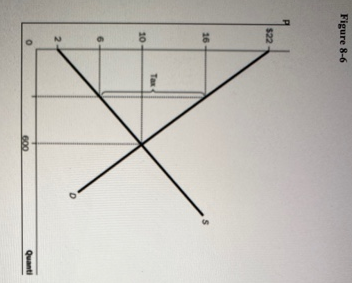
Refer to Figure 8-6. If the tax is imposed on the buyer, what price would the buyers pay for the good?
Homework Answers
The answer is $16.
the after-tax equilibrium at the demand curve where tax is the
difference between demand and supply curve and that is the $16 as
the tax shifts the supply curve up by the tax amount and the new
supply =demand is at P=16 for buyer and P=6 for sellers.
Add Answer to:
Refer to Figure 8-6. If the tax is imposed on the buyer, what price would the buyers pay for the good?
Refer to Figure 6-8. The effective price that buyers ay after the tax is imposed is
 6. Refer to Figure 6-8. The effective price that buyers ay after the tax is imposed is 7. Refer to Figure 6-8. The price that sellers receive after the tax is imposed is8. Refer to Figure 6-8. The amount of the tax per unit is 9. Refer to Figure 6-8. The burden of the tax on sellers is 10. Refer to Figure 6-8. Suppose the same Sand D curves apply, and a tax of the same amount per unit as shown here is...
Refer to Figure 1. Suppose a $3 per-unit tax is imposed on the sellers of this good. How much is the burden of this tax on the buyers in this market
 QUESTION #1 Refer to Figure 1. Suppose a $3 per-unit tax is
imposed on the sellers of this good. How much is the burden of this
tax on the buyers in this market? What price will buyers pay for
the good after the tax is imposed? Explain clearly.QUESTION #2 Refer to Figure 1. Suppose a $3 per-unit tax is
imposed on the sellers of this good. How much is the burden of this
tax on the sellers in this market? What is...
QUESTION #1 Refer to Figure 1. Suppose a $3 per-unit tax is
imposed on the sellers of this good. How much is the burden of this
tax on the buyers in this market? What price will buyers pay for
the good after the tax is imposed? Explain clearly.QUESTION #2 Refer to Figure 1. Suppose a $3 per-unit tax is
imposed on the sellers of this good. How much is the burden of this
tax on the sellers in this market? What is...
Refer to Figure 7. The price paid by buyers after the tax is imposed is a. $8. b. $16. C. $14. d. $12.
 Refer to Figure 7. The price paid by buyers after the tax is imposed is a. $8. b. $16. C. $14. d. $12.Refer to Figure 7. The effective price received by sellers after the tax is imposed is a. $8. b. $16. c. $14. d. $12.Refer to Figure 7. The amount of the tax per unit is a. $4. b. $8. C. $14. d. $10.Refer to Figure 7. The per-unit burden of the tax is a. $2 for buyers and...
A tax imposed on the sellers of a good will a. raise both the price buyers...
A tax imposed on the sellers of a good will a. raise both the price buyers pay and the effective price sellers receive. b. raise the price buyers pay and lower the effective price sellers receive. c. lower the price buyers pay and raise the effective price sellers receive. d. lower both the price buyers pay and the effective price sellers receive. Part B. When studying how some event or policy affects a market, elasticity provides information on the a....
Suppose a $3 per-unit tax is imposed on the sellers of this good. 1) What is...
 Suppose a $3 per-unit tax is imposed on the sellers of this
good.
1) What is the effective price that sellers will receive for the
good after the tax is imposed?
2) What price will buyers pay for the good after the tax is
imposed?
3)How much is the burden of this tax on the buyers/sellers in
this market?
How do you calculate it? Please explain.
Price 20 18 16 14 12 10 8 6 4 D 10 12 14...
Suppose a $3 per-unit tax is imposed on the sellers of this
good.
1) What is the effective price that sellers will receive for the
good after the tax is imposed?
2) What price will buyers pay for the good after the tax is
imposed?
3)How much is the burden of this tax on the buyers/sellers in
this market?
How do you calculate it? Please explain.
Price 20 18 16 14 12 10 8 6 4 D 10 12 14...
Refer to Figure 6-26. The effective price received by sellers after the tax is imposed is
 Refer to Figure 6-26. The effective price received by sellers after the tax is imposed is a. $8 b. $16 c. $14 d. $12
ts) Suppose a tax is imposed on a good. This will A. increase the price paid by the buyer and decrease the price receiv...
 ts) Suppose a tax is imposed on a good. This will A. increase the price paid by the buyer and decrease the price received by the seller B. increase the price paid by the buyer but leave the price received by the seller unchanged C. decrease the price received by the seller but leave the price received by the buyer unchanged D. increase the price received by the seller and decrease the price paid by the buyer
Question 32 (1 point) Figure 8-5 Price Quantity Refer to Figure 8-5. What is the price...
 Question 32 (1 point) Figure 8-5 Price Quantity Refer to Figure 8-5. What is the price buyers pay after the tax and the quantity buyers receive? OP1 and 1 OP2 and Q2 OP3 and Q2 OP3 and Q1
How much will the buyer pay for the product after the tax is imposed? How much will the seller receive after the tax i...
 How much will the buyer pay for the product after the
tax is imposed?
How much will the seller receive after the tax is
imposed?
As a result of the tax, what has happened to the level
of output?
Calculate the economic welfare after government imposes
a tax of $5 per unit on buyers.
Total Surplus
Government Revenue
DWL
Producer Surplus
Supply Demand 10 20 30 40 50 60 70 80 Quantity
How much will the buyer pay for the product after the
tax is imposed?
How much will the seller receive after the tax is
imposed?
As a result of the tax, what has happened to the level
of output?
Calculate the economic welfare after government imposes
a tax of $5 per unit on buyers.
Total Surplus
Government Revenue
DWL
Producer Surplus
Supply Demand 10 20 30 40 50 60 70 80 Quantity
Figure 8-3 The vertical distance between points A and C represents a tax in the market....
 Figure 8-3
The vertical distance between points A and C represents a tax in
the market.
Refer to Figure 8-3. The price that buyers
effectively pay after the tax is imposed is
Group of answer choices
P3.
P1.
P4.
P2.
We were unable to transcribe this imagehome / study / business/ economics / economics questions and answers/ figure 8-3 the w Question: Figure 8-3 The vertical distance beti Figure 8-3 The vertical distance between points A and represents a...
Figure 8-3
The vertical distance between points A and C represents a tax in
the market.
Refer to Figure 8-3. The price that buyers
effectively pay after the tax is imposed is
Group of answer choices
P3.
P1.
P4.
P2.
We were unable to transcribe this imagehome / study / business/ economics / economics questions and answers/ figure 8-3 the w Question: Figure 8-3 The vertical distance beti Figure 8-3 The vertical distance between points A and represents a...
 QUESTION #1 Refer to Figure 1. Suppose a $3 per-unit tax is
imposed on the sellers of this good. How much is the burden of this
tax on the buyers in this market? What price will buyers pay for
the good after the tax is imposed? Explain clearly.QUESTION #2 Refer to Figure 1. Suppose a $3 per-unit tax is
imposed on the sellers of this good. How much is the burden of this
tax on the sellers in this market? What is...
QUESTION #1 Refer to Figure 1. Suppose a $3 per-unit tax is
imposed on the sellers of this good. How much is the burden of this
tax on the buyers in this market? What price will buyers pay for
the good after the tax is imposed? Explain clearly.QUESTION #2 Refer to Figure 1. Suppose a $3 per-unit tax is
imposed on the sellers of this good. How much is the burden of this
tax on the sellers in this market? What is...
 Suppose a $3 per-unit tax is imposed on the sellers of this
good.
1) What is the effective price that sellers will receive for the
good after the tax is imposed?
2) What price will buyers pay for the good after the tax is
imposed?
3)How much is the burden of this tax on the buyers/sellers in
this market?
How do you calculate it? Please explain.
Price 20 18 16 14 12 10 8 6 4 D 10 12 14...
Suppose a $3 per-unit tax is imposed on the sellers of this
good.
1) What is the effective price that sellers will receive for the
good after the tax is imposed?
2) What price will buyers pay for the good after the tax is
imposed?
3)How much is the burden of this tax on the buyers/sellers in
this market?
How do you calculate it? Please explain.
Price 20 18 16 14 12 10 8 6 4 D 10 12 14...
 ts) Suppose a tax is imposed on a good. This will A. increase the price paid by the buyer and decrease the price received by the seller B. increase the price paid by the buyer but leave the price received by the seller unchanged C. decrease the price received by the seller but leave the price received by the buyer unchanged D. increase the price received by the seller and decrease the price paid by the buyer
 Question 32 (1 point) Figure 8-5 Price Quantity Refer to Figure 8-5. What is the price buyers pay after the tax and the quantity buyers receive? OP1 and 1 OP2 and Q2 OP3 and Q2 OP3 and Q1
 How much will the buyer pay for the product after the
tax is imposed?
How much will the seller receive after the tax is
imposed?
As a result of the tax, what has happened to the level
of output?
Calculate the economic welfare after government imposes
a tax of $5 per unit on buyers.
Total Surplus
Government Revenue
DWL
Producer Surplus
Supply Demand 10 20 30 40 50 60 70 80 Quantity
How much will the buyer pay for the product after the
tax is imposed?
How much will the seller receive after the tax is
imposed?
As a result of the tax, what has happened to the level
of output?
Calculate the economic welfare after government imposes
a tax of $5 per unit on buyers.
Total Surplus
Government Revenue
DWL
Producer Surplus
Supply Demand 10 20 30 40 50 60 70 80 Quantity
 Figure 8-3
The vertical distance between points A and C represents a tax in
the market.
Refer to Figure 8-3. The price that buyers
effectively pay after the tax is imposed is
Group of answer choices
P3.
P1.
P4.
P2.
We were unable to transcribe this imagehome / study / business/ economics / economics questions and answers/ figure 8-3 the w Question: Figure 8-3 The vertical distance beti Figure 8-3 The vertical distance between points A and represents a...
Figure 8-3
The vertical distance between points A and C represents a tax in
the market.
Refer to Figure 8-3. The price that buyers
effectively pay after the tax is imposed is
Group of answer choices
P3.
P1.
P4.
P2.
We were unable to transcribe this imagehome / study / business/ economics / economics questions and answers/ figure 8-3 the w Question: Figure 8-3 The vertical distance beti Figure 8-3 The vertical distance between points A and represents a...
Most questions answered within 3 hours.
-
Where is the error in this code sequence?
String s1 = "Hello";
String s2 = "ello";...
asked 11 months ago -
Financial data for Joel de Paris, Inc., for last year
follow:
Joel de Paris, Inc.
Balance...
asked 11 months ago -
Consider this reaction:
Al2(SO4)3 (aq)+ BaCl3
(aq) Al2Cl6 (aq)- +
3BaSO4(s) . What is the...
asked 11 months ago -
Suppose that Savneet is considering increasing her
recent random sample from 20 car rentals to 40...
asked 11 months ago -
Trucks arrive at an unloading terminal at an average rate of 120
per hour.
Trucks arrive...
asked 11 months ago -
Why are methanol and ethanol completely soluble in water while
octanol is not very little soluble....
asked 11 months ago -
A facilities manager at a university reads in a research report
that the mean amount of...
asked 11 months ago -
When the CuSO4 is rehydrated by adding water to the anhydrous
compound, is this an endothermic...
asked 11 months ago -
A ray of sunlight is passing from diamond into crown glass; the
angle of incidence is...
asked 11 months ago -
A block of mass 0.249 kg is placed on top of a light, vertical
spring of...
asked 11 months ago -
how do the kidneys compensate in the presences of acidosis
a) trigger hyperventilate
b) reserve acid...
asked 11 months ago -
Question 501 pts
The rental rate of capital to the firm increases. Which of the
following...
asked 11 months ago