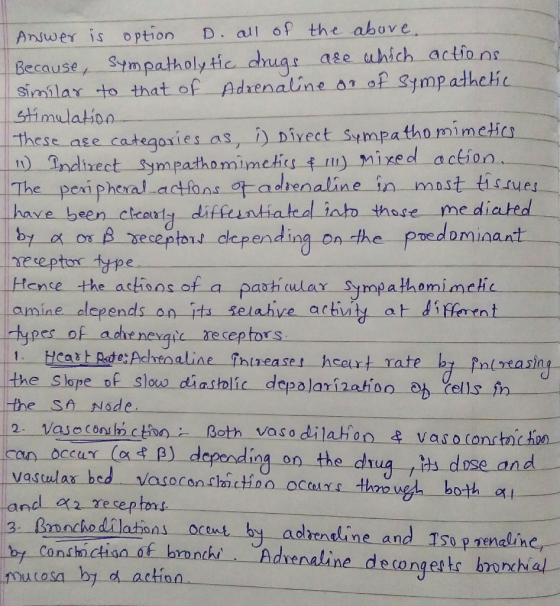
Sympatholytic drugs produce which of the following effects:
Sympatholytic drugs produce which of the following effects:
A. increased heart rate
B. vasoco striction
C. bronchodilation
D. all of the above
E. none of the above
Homework Answers
15. Which of the following drugs may be used to treat heart failure? (Select all that...
15. Which of the following drugs may be used to treat heart failure? (Select all that apply.) a. Spironolactone b. Amiodarone c. Valsartan d. Metoprolol succinate e. Diltiazem f. Furosemide 16. What is the type of hypotension that occurs after shifting positions too quickly and occurs with antihypertensive medications? a. Orthostatic hypotension b. Postprandial hypotension c. Hypertension d. Standing hypotension 17. Which of the following are side effects commonly experienced with direct vasodilators? (Select all that apply.) a. Weight loss...
1. Which of the following information is accurate regarding hypertension? (Select all that apply.) a. It...
1. Which of the following information is accurate regarding hypertension? (Select all that apply.) a. It is an increase in blood pressure that is sustained over a long period of time b. It is a decrease in blood pressure that is sustained over a long period of time c. Increased resistance to arteries influence blood flow and can lead to hypertension d. Changes in blood viscosity with the use of certain drugs can result in high blood pressure e. Uncontrolled...
11. Which of the following drugs can be used to treat increased afterload in cases of...
11. Which of the following drugs can be used to treat increased afterload in cases of heart failure? (Select all that apply.) a. Digoxin b. Lisinopril c. Nifedipine d. Losartan e. Hydrochlorothiazide 12. Diuretics work by altering electrolyte absorption in the kidneys. Which of the following electrolytes are most often excreted with both loop and thiazide diuretics? a. sodium & potassium b. calcium & magnesium c. sodium & phosphorus d. potassium & phosphorus 13. Which of the following are unwanted...
Preview File Edi View Go Tools WindowHelp Unit 2 Exam Review PPT 1 (2).ppt (page 3...
 Preview File Edi View Go Tools WindowHelp Unit 2 Exam Review PPT 1 (2).ppt (page 3 of 24) Q Search 2. Syn pathetic nervous system effects include which of the followng: A. increased heart rate mydriasis C. bronchodilation D. vasoconstriction E. all of the above 1 Medication Digoxin # Classification The... See answer A:
select one : ( which is the right answer) Question 1. Which of the following drugs used to treat dysrythmias should not...
select one : ( which is the right answer) Question 1. Which of the following drugs used to treat dysrythmias should not be used in asthmatics? a) Verapamil b) sotalol c) amiodarone 4) disopyramide Question 2) The cardiac conduction system comprises : a) the sinoatrial ( SA) node b) the AV node 3) the bundle of his 4) all of the above Question 3) ACE inhibitors have the potential to interact with ( should be avoided) : a) potassium supplements...
4. Which of the following is not a source of drugs? a. Plants b. Animals c....
 4. Which of the following is not a source of drugs? a. Plants b. Animals c. Minerals d. Microbiological sources All of the above This use of drugs relicves the symptoms while the body fights off the disease. a. Prevention 5. b. Cure c. Treatment d. Palliative e. Replacement 6. This use of drugs do not cure or treat the disease but improves a person's quality of life. a. Prevention b. Treatment c. Contraceptive d. Health maintenance e. Palliative uion,...
. Autonom ous Drug 73 which side effects would the health care p Chat in r receiving an g lurred vision, headache,...
 . Autonom ous Drug 73 which side effects would the health care p Chat in r receiving an g lurred vision, headache, dry mouth, paltos, and tachycardia Hypotension, bradycardia, cholinergic crisis and C Muscle cramps, weakness, and euphoria D. Jaundice, excessive salivation, and weating Matching A Match the category of autonomic nervous system drugs listed in Column with the action or use of the drugs in the specific category in Column A. Note that the choices in Column B can...
How is bonding a factor ion creating the effects that drugs produce?
How is bonding a factor ion creating the effects that drugs produce?
Describe the difference in the therapeutic effects of these drugs given to produce general anesthesia: ultrashort-...
Describe the difference in the therapeutic effects of these drugs given to produce general anesthesia: ultrashort- acting barbiturate drugs, narcotic drugs, inhaled anesthetic gases
3. Two drugs are compared to see which of them is more likely to produce unpleasant side effects....
 3. Two drugs are compared to see which of them is more likely to produce unpleasant side effects. Each of 100 subjects is given the two drugs on different occasions. The results are tabulated below Nausea with drug B 38 10 No nausea with B Nausea with drug A No nausea with A 50 Let pij denote the probabilities that a patient has a response in the ijth cell. For instance p12 denotes the probability that a patient experiences nausea...
 Preview File Edi View Go Tools WindowHelp Unit 2 Exam Review PPT 1 (2).ppt (page 3 of 24) Q Search 2. Syn pathetic nervous system effects include which of the followng: A. increased heart rate mydriasis C. bronchodilation D. vasoconstriction E. all of the above 1 Medication Digoxin # Classification The... See answer A:
 4. Which of the following is not a source of drugs? a. Plants b. Animals c. Minerals d. Microbiological sources All of the above This use of drugs relicves the symptoms while the body fights off the disease. a. Prevention 5. b. Cure c. Treatment d. Palliative e. Replacement 6. This use of drugs do not cure or treat the disease but improves a person's quality of life. a. Prevention b. Treatment c. Contraceptive d. Health maintenance e. Palliative uion,...
 . Autonom ous Drug 73 which side effects would the health care p Chat in r receiving an g lurred vision, headache, dry mouth, paltos, and tachycardia Hypotension, bradycardia, cholinergic crisis and C Muscle cramps, weakness, and euphoria D. Jaundice, excessive salivation, and weating Matching A Match the category of autonomic nervous system drugs listed in Column with the action or use of the drugs in the specific category in Column A. Note that the choices in Column B can...
 3. Two drugs are compared to see which of them is more likely to produce unpleasant side effects. Each of 100 subjects is given the two drugs on different occasions. The results are tabulated below Nausea with drug B 38 10 No nausea with B Nausea with drug A No nausea with A 50 Let pij denote the probabilities that a patient has a response in the ijth cell. For instance p12 denotes the probability that a patient experiences nausea...
Most questions answered within 3 hours.
-
Where is the error in this code sequence?
String s1 = "Hello";
String s2 = "ello";...
asked 11 months ago -
Financial data for Joel de Paris, Inc., for last year
follow:
Joel de Paris, Inc.
Balance...
asked 11 months ago -
Consider this reaction:
Al2(SO4)3 (aq)+ BaCl3
(aq) Al2Cl6 (aq)- +
3BaSO4(s) . What is the...
asked 11 months ago -
Suppose that Savneet is considering increasing her
recent random sample from 20 car rentals to 40...
asked 11 months ago -
Trucks arrive at an unloading terminal at an average rate of 120
per hour.
Trucks arrive...
asked 11 months ago -
Why are methanol and ethanol completely soluble in water while
octanol is not very little soluble....
asked 11 months ago -
A facilities manager at a university reads in a research report
that the mean amount of...
asked 11 months ago -
When the CuSO4 is rehydrated by adding water to the anhydrous
compound, is this an endothermic...
asked 11 months ago -
A ray of sunlight is passing from diamond into crown glass; the
angle of incidence is...
asked 11 months ago -
A block of mass 0.249 kg is placed on top of a light, vertical
spring of...
asked 11 months ago -
how do the kidneys compensate in the presences of acidosis
a) trigger hyperventilate
b) reserve acid...
asked 11 months ago -
Question 501 pts
The rental rate of capital to the firm increases. Which of the
following...
asked 11 months ago