
Homework Answers
Add Answer to:
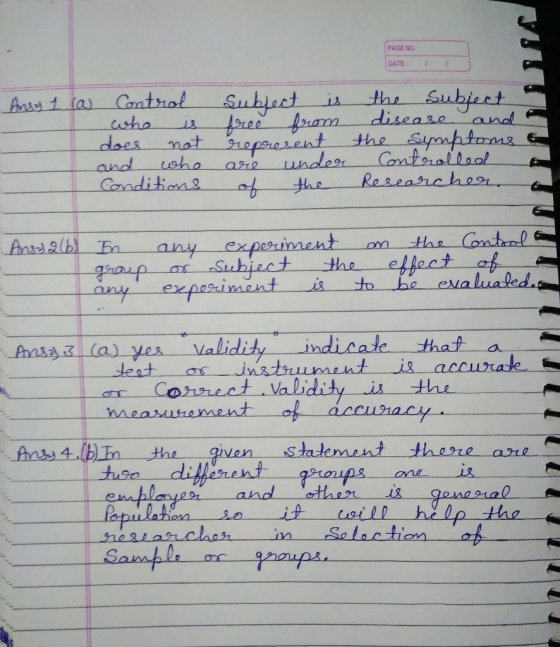
1. Describe: a) a control subject in a case-control study, 2. and b) a control subject...
27. Interpret your findings that you calculated in # 26. study design. c. experimental 28. The...
 27. Interpret your findings that you calculated in # 26. study design. c. experimental 28. The well-known Framingham Study employs the a case-control b. cohort 20. When selecting control subjects for a case-control study, the control group members should (select the best answer): resemble the case subjects b. have already had the disease of interest have had no opportunity to be exposed to the disease. be very ill hospital patients 30. True False W hen using the cohort study design...
9. When you desire to study the effects of a rare exposure on a disease using...
 9. When you desire to study the effects of a rare exposure on a disease using observational methods, you would optimally employ the type of study design. Remember you would likely need to conduct your study in a place where the exposure occurs. cohort b ase-control 10. Another name for a retrospective study is an) study b. cohort e experimental 11. You have completed a year long study of the effectiveness of a reading program among second graders. At the...
Control of the internal validity 1: The placebo effect of the internal validity can be cured...
Control of the internal validity 1: The placebo effect of the internal validity can be cured by random assignment subject to both experimental and control placebo groups(Shader, 2017). 2: History threat can be removed by assigning random subjects to both control and experimental groups. 3: Maturation the third threat to validity can be handled with the help of the control groups of subjects which can change those in experimental groups. Assigning of random subjects can also be used. 4: Repeat...
For the first six issues below, cite which study is best to use (case-control or cohort...
 For the first six issues below, cite which study is best to use (case-control or cohort study). For the last 3 types of bias, cite which study is less likely to have that particular type of bias (case-control or cohort) Answer 26 1) Study a rare discase 2) Study a rare exposure 3) Study multiple exposures 4) Study multiple outcomes 5) Study progression of the illness 6) Calculate disease rates 7) Recall bias 8) Loss to follow-up 9) Selection bias...
A case-control study was conducted to examine the association between a high fat diet and coronary...
A case-control study was conducted to examine the association between a high fat diet and coronary artery disease. Subjects with physician diagnosed heart disease and controls without heart disease are recruited and asked to complete questionnaires about their dietary habits in order to categorize them as having diets with high fat content or not. This situation is more likely to generate which type of bias: a. non-differential misclassification b. differential misclassification c. selection bias d. none of the above
Part 3:1dentify the following features with appropriate study design: ...Case-control study 1 b. Cohort study Categorize...
 Part 3:1dentify the following features with appropriate study design: ...Case-control study 1 b. Cohort study Categorize subjects on the basis of exposure and then follow up to see if they develop the health condition we are studying. 1. Generally used to explore rare diseases. Useful for exploring several risk factors for a given outcome. After some time compare the disease rate for the exposed with that of the unexposed. Generally used when the exposure is rare. 1 Useful when there...
In a case control study of the association between obesity and late onset menopause, you think...
In a case control study of the association between obesity and late onset menopause, you think that women who are and are not obese are equally as likely to misreport that they had late onset menopause. a. What type of misclassification is this? Be sure to state whether it is differential or nondifferential, AND whether it is misclassification of the exposure or the disease in your response b. How would this misclassification bias the OR you calculate using your study...
Controls are needed in a case-control study because? A. They are matched to the cases for...
Controls are needed in a case-control study because? A. They are matched to the cases for suspected etiological factors B. They may be followed to determine if they develop the disease in question. C. They increase the sample size, so that statistical significance may be achieved. D. They provide a comparable estimate of the frequency of exposure in the absence of disease. E. They reduce bias.
1. For the case-control study in Example 9.3 (the toxoplasmosis study): (a) Find a 99% confidence...
1. For the case-control study in Example 9.3 (the toxoplasmosis study): (a) Find a 99% confidence interval for a parameter which compares the probability of being infected for drivers who had accidents and drivers who did not. (b) A test of homogeneity is designed for cohort studies, where you sample from each population and test to see if there is evidence that the distribution of the categorical variable is different on some of the populations. In a case-control study, you...
1. Ifa study includes random assignment but not a control group, the design may still be...
 1. Ifa study includes random assignment but not a control group, the design may still be considered to be a true experimental design. True a. b. False Using control groups help account for which of the following threats to internal validity except? 2. History a. b. Testing Maturation c. None of the above d. If the results of a study determine that an intervention did not work, though for reasons not related to the intervention, the 3. study would have...
 27. Interpret your findings that you calculated in # 26. study design. c. experimental 28. The well-known Framingham Study employs the a case-control b. cohort 20. When selecting control subjects for a case-control study, the control group members should (select the best answer): resemble the case subjects b. have already had the disease of interest have had no opportunity to be exposed to the disease. be very ill hospital patients 30. True False W hen using the cohort study design...
 9. When you desire to study the effects of a rare exposure on a disease using observational methods, you would optimally employ the type of study design. Remember you would likely need to conduct your study in a place where the exposure occurs. cohort b ase-control 10. Another name for a retrospective study is an) study b. cohort e experimental 11. You have completed a year long study of the effectiveness of a reading program among second graders. At the...
 For the first six issues below, cite which study is best to use (case-control or cohort study). For the last 3 types of bias, cite which study is less likely to have that particular type of bias (case-control or cohort) Answer 26 1) Study a rare discase 2) Study a rare exposure 3) Study multiple exposures 4) Study multiple outcomes 5) Study progression of the illness 6) Calculate disease rates 7) Recall bias 8) Loss to follow-up 9) Selection bias...
 Part 3:1dentify the following features with appropriate study design: ...Case-control study 1 b. Cohort study Categorize subjects on the basis of exposure and then follow up to see if they develop the health condition we are studying. 1. Generally used to explore rare diseases. Useful for exploring several risk factors for a given outcome. After some time compare the disease rate for the exposed with that of the unexposed. Generally used when the exposure is rare. 1 Useful when there...
 1. Ifa study includes random assignment but not a control group, the design may still be considered to be a true experimental design. True a. b. False Using control groups help account for which of the following threats to internal validity except? 2. History a. b. Testing Maturation c. None of the above d. If the results of a study determine that an intervention did not work, though for reasons not related to the intervention, the 3. study would have...
Most questions answered within 3 hours.
-
Where is the error in this code sequence?
String s1 = "Hello";
String s2 = "ello";...
asked 10 months ago -
Financial data for Joel de Paris, Inc., for last year
follow:
Joel de Paris, Inc.
Balance...
asked 10 months ago -
Consider this reaction:
Al2(SO4)3 (aq)+ BaCl3
(aq) Al2Cl6 (aq)- +
3BaSO4(s) . What is the...
asked 10 months ago -
Suppose that Savneet is considering increasing her
recent random sample from 20 car rentals to 40...
asked 10 months ago -
Trucks arrive at an unloading terminal at an average rate of 120
per hour.
Trucks arrive...
asked 10 months ago -
Why are methanol and ethanol completely soluble in water while
octanol is not very little soluble....
asked 10 months ago -
A facilities manager at a university reads in a research report
that the mean amount of...
asked 10 months ago -
When the CuSO4 is rehydrated by adding water to the anhydrous
compound, is this an endothermic...
asked 10 months ago -
A ray of sunlight is passing from diamond into crown glass; the
angle of incidence is...
asked 10 months ago -
A block of mass 0.249 kg is placed on top of a light, vertical
spring of...
asked 10 months ago -
how do the kidneys compensate in the presences of acidosis
a) trigger hyperventilate
b) reserve acid...
asked 10 months ago -
Question 501 pts
The rental rate of capital to the firm increases. Which of the
following...
asked 10 months ago