1. It’s been estimated that if a truck collides with a car, the damage to the...
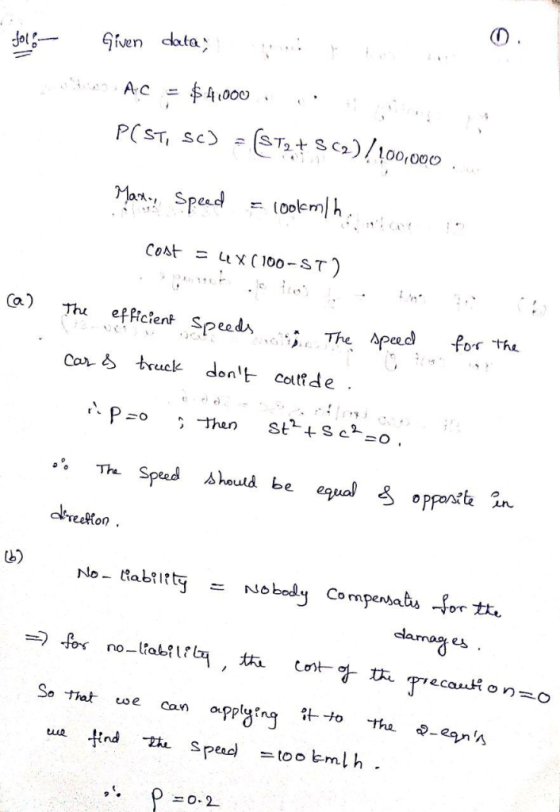
1. It’s been estimated that if a truck collides with a car, the damage to the car one is AC = $4,000. There is no damage to the truck. The probability of a collision is described by p(sT, sC) = (sT2 + sC2)/100,000, where sT is the truck speed and sC is the car speed, in km/h. The maximum speed the vehicles are capable of is 100 km/h. Each driver can take precautions; assume the only feasible precaution is to reduce the speed. The cost of taking precautions by the truck driver is 4×(100 – sT), that is the truck driver loses $4 value for every 1 km/h slowing down. The cost of taking precautions by the truck driver is 3×(100 – sC), that is the car driver loses $3 value for every 1 km/h slowing down.
- What are the efficient speeds by each driver? How often do collisions happen (i.e., what is the probability of a collision p) at the efficient speeds?
- Suppose the rule is no liability = nobody compensates anyone else for the damages, in case of an accident. What speed would the truck driver choose? What speed would the car driver choose? How often do collisions happen (i.e., what is the probability of a collision p) at these chosen speeds?
- Suppose the rule is strict liability = the truck driver must fully compensate the car owner for the damages no matter how they drive, in case of an accident. What speed would the truck driver choose? What speed would the car driver choose? How often do collisions happen (i.e., what is the probability of a collision p) at these chosen speeds?
- Suppose the rule is shared liability = the truck driver must compensate the car owner for half of the damages no matter how they drive, in case of an accident. What speed would the truck driver choose? What speed would the car driver choose? How often do collisions happen (i.e., what is the probability of a collision p) at these chosen speeds?
- If the rule were any other allocation of liability and damages where the truck driver must pay some compensation LT and the car driver assumes the rest of the damages, AC – LT?, would the efficient speeds be chosen by both drivers? Explain.
- What do you conclude from these examples? I.e., can the efficient outcome be achieved by any ex post allocation of liability and damages? Explain.
- Now consider how this could be solved by introducing a negligence rule. Let us pick a simple negligence rule = if the truck driver does not exceed the legal speed limit of 50 km/h, the truck driver is not liable for any damages; if the truck driver exceeds the legal speed limit of 50 km/h, the truck driver is fully liable for the damages.
- Draw the truck driver’s expected full cost (cost of taking precautions + expected liability) as a function of sT. What speed would the truck driver choose?
- Draw the car driver’s expected full losses (cost of taking precautions + expected damages) as a function of sC if the truck driver is not speeding. What speed would the car driver choose?
- Draw the car driver’s expected full losses (cost of taking precautions + expected damages + expected compensation [remember the damages and compensation have opposite signs for the car driver]) as a function of sC if the truck driver is speeding. What speed would the car driver choose?
- What are the equilibrium sT and sC? Explain. Is this outcome efficient?
Homework Answers

Add Answer to:
1. It’s been estimated that if a truck collides with a car, the
damage to the...
1. A 1,000 kg car moving north at 30 mph collides into a 2,000 kg truck...
1. A 1,000 kg car moving north at 30 mph collides into a 2,000 kg truck which is also moving north, but at 10 mph. Immediately after the collision, the truck’s speed is 13 mph. What is the speed of the car after the collision? Express your answer in mph and input the number only. 2. Was kinetic energy conserved in this collision? A. Yes B. No 3. What type of collision was this? A. Perfectly inelastic B. Inelastic C....
Name 37) You have been hired as an expert witness in a crash investigation. Car A of mass 1900 kg crashed into stationary car B of mass 1000 kg. You measure the coefficient of kinetic friction betwee...
 Name 37) You have been hired as an expert witness in a crash investigation. Car A of mass 1900 kg crashed into stationary car B of mass 1000 kg. You measure the coefficient of kinetic friction between the locked tires a was in park so the tires did not turn). Car A hits car B, locking bumpers so that they s bef nd the road to be 0.6 (car B kid off together. They skid 20 m ore coming to...
1. A car accelerates from zero to 105 km/h in 5.21 s. What is its average...
 1. A car accelerates from zero to 105 km/h in 5.21 s. What is its average acceleration in km/h/s and m/s? 2. An object moving in the x-direction has a position described by the function x(t) - 6.30t + 8.70t2, where t is in seconds and x is in meters. What is the acceleration as a function of time? The figure shows the graph of v vs t for the motion of a motorcyle that starts from rest and moves...
Question 1: Alan has a PAP with the following coverages: · Liability coverages: $100,000/$300,000/$50,000 · Medical...
Question 1: Alan has a PAP with the following coverages: · Liability coverages: $100,000/$300,000/$50,000 · Medical payments coverage: $5,000 each person · Uninsured motorists coverage: $25,000 each person · Collision loss: $250 deductible · Other-than-collision loss: $100 deductible With respect to each of the following situations, indicate whether the loss is covered and the amount payable, if any, under the policy. Assume that each situation is a separate event. a. Alan’s son, age 16, is driving a family car, runs...
2. Suppose a car travels 108 km at a speed of 20.0 m/s, and uses 2.20...
 2. Suppose a car travels 108 km at a speed of 20.0 m/s, and uses
2.20 gallons of gasoline. Only 30% of the gasoline goes into useful
work by the force that keeps the car moving at constant speed
despite friction. (The energy content of gasoline is 1.3 ✕
108 J per gallon.)
(a) What is the force exerted to keep the car moving at constant
speed?
N
(b) If the required force is directly proportional to speed, how
many...
2. Suppose a car travels 108 km at a speed of 20.0 m/s, and uses
2.20 gallons of gasoline. Only 30% of the gasoline goes into useful
work by the force that keeps the car moving at constant speed
despite friction. (The energy content of gasoline is 1.3 ✕
108 J per gallon.)
(a) What is the force exerted to keep the car moving at constant
speed?
N
(b) If the required force is directly proportional to speed, how
many...
3. Diagrams, networks, models and commuting [40 marks) commuting by car from north of the city...
 3. Diagrams, networks, models and commuting [40 marks) commuting by car from north of the city to the Uni, I ask myself a simple question cach moming: for the most efficient journey, should I choose the left lane (Path A - Cahill Expressway) or the right lane (Path B -City/Airport) to go over the Harbour Bridge and on towards Darling Harbour? Choose A or B Cross Bus Lane Elaven Merge (A3/B3) Figure 2: An aerial view of the road layout...
HDT Truck Company HDT Truck Company has been located in Crown Point, Indiana, since 1910. Its...
HDT Truck Company HDT Truck Company has been located in Crown Point, Indiana, since 1910. Its only products— large trucks—are built to individual customer specifications. The firm once produced automobiles but dropped out of the auto business in 1924. The firm nearly went out of business in the late 1930s, but by 1940 its fortunes were buoyed by receipt of several military contracts for tank retrievers—large-wheeled vehicles that can pull a disabled tank onto a low trailer and haul it...
Please let me know below question and explain it with attached content ! Questions 1.Help Alex...
Please let me know below question and explain it with attached content ! Questions 1.Help Alex and Meghan brainstorm risks for each of the three sourcing alternatives. Write down all of your risks—don't be too judgmental or selective. 2.Conduct an FMEA. Build a thoughtful worksheet (see Table 5-4). You'll have to make judgment calls on severity, likelihood, and detectability. Compute appropriate RPNs. What actions would you suggest to mitigate these risks? 3.Considering short- and long-term implications, articulate your overall risk-mitigation...
Please see the articles below… 1. What is your opinion on the subject? 2. Which ethical views (i.e.,...
Please see the articles below… 1. What is your opinion on the subject? 2. Which ethical views (i.e., utilitarian view, moral rights view, justice view, practical view) you feel are being used by both sides of the argument (i.e., for and against downloading) to justify their positions? High Court Enters File-Sharing Spat; Justices Must Determine Software Providers' Liability For Copyright Violations by Anne Marie Squeo. Wall Street Journal. (Eastern edition). New York, N.Y.: Mar 30, 2005. pg. A.2 WASHINGTON -- The Supreme...
Please read the article and answer about questions. You and the Law Business and law are...
Please read the article and answer about questions. You and the Law Business and law are inseparable. For B-Money, the two predictably merged when he was negotiat- ing a deal for his tracks. At other times, the merger is unpredictable, like when your business faces an unexpected auto accident, product recall, or government regulation change. In either type of situation, when business owners know the law, they can better protect themselves and sometimes even avoid the problems completely. This chapter...
 Name 37) You have been hired as an expert witness in a crash investigation. Car A of mass 1900 kg crashed into stationary car B of mass 1000 kg. You measure the coefficient of kinetic friction between the locked tires a was in park so the tires did not turn). Car A hits car B, locking bumpers so that they s bef nd the road to be 0.6 (car B kid off together. They skid 20 m ore coming to...
 1. A car accelerates from zero to 105 km/h in 5.21 s. What is its average acceleration in km/h/s and m/s? 2. An object moving in the x-direction has a position described by the function x(t) - 6.30t + 8.70t2, where t is in seconds and x is in meters. What is the acceleration as a function of time? The figure shows the graph of v vs t for the motion of a motorcyle that starts from rest and moves...
 2. Suppose a car travels 108 km at a speed of 20.0 m/s, and uses
2.20 gallons of gasoline. Only 30% of the gasoline goes into useful
work by the force that keeps the car moving at constant speed
despite friction. (The energy content of gasoline is 1.3 ✕
108 J per gallon.)
(a) What is the force exerted to keep the car moving at constant
speed?
N
(b) If the required force is directly proportional to speed, how
many...
2. Suppose a car travels 108 km at a speed of 20.0 m/s, and uses
2.20 gallons of gasoline. Only 30% of the gasoline goes into useful
work by the force that keeps the car moving at constant speed
despite friction. (The energy content of gasoline is 1.3 ✕
108 J per gallon.)
(a) What is the force exerted to keep the car moving at constant
speed?
N
(b) If the required force is directly proportional to speed, how
many...
 3. Diagrams, networks, models and commuting [40 marks) commuting by car from north of the city to the Uni, I ask myself a simple question cach moming: for the most efficient journey, should I choose the left lane (Path A - Cahill Expressway) or the right lane (Path B -City/Airport) to go over the Harbour Bridge and on towards Darling Harbour? Choose A or B Cross Bus Lane Elaven Merge (A3/B3) Figure 2: An aerial view of the road layout...
Most questions answered within 3 hours.
-
Where is the error in this code sequence?
String s1 = "Hello";
String s2 = "ello";...
asked 10 months ago -
Financial data for Joel de Paris, Inc., for last year
follow:
Joel de Paris, Inc.
Balance...
asked 10 months ago -
Consider this reaction:
Al2(SO4)3 (aq)+ BaCl3
(aq) Al2Cl6 (aq)- +
3BaSO4(s) . What is the...
asked 10 months ago -
Suppose that Savneet is considering increasing her
recent random sample from 20 car rentals to 40...
asked 10 months ago -
Trucks arrive at an unloading terminal at an average rate of 120
per hour.
Trucks arrive...
asked 10 months ago -
Why are methanol and ethanol completely soluble in water while
octanol is not very little soluble....
asked 10 months ago -
A facilities manager at a university reads in a research report
that the mean amount of...
asked 10 months ago -
When the CuSO4 is rehydrated by adding water to the anhydrous
compound, is this an endothermic...
asked 10 months ago -
A ray of sunlight is passing from diamond into crown glass; the
angle of incidence is...
asked 10 months ago -
A block of mass 0.249 kg is placed on top of a light, vertical
spring of...
asked 10 months ago -
how do the kidneys compensate in the presences of acidosis
a) trigger hyperventilate
b) reserve acid...
asked 10 months ago -
Question 501 pts
The rental rate of capital to the firm increases. Which of the
following...
asked 10 months ago