please help me with drag forces?

Part A and B is done. I just need help wit

part E F G and H
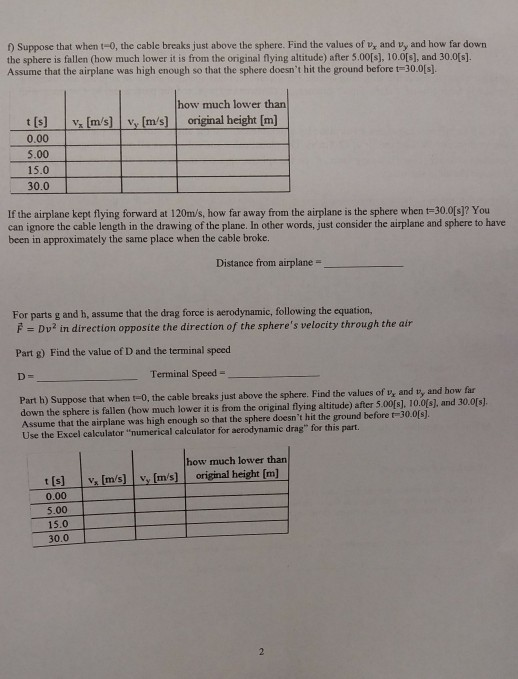
f) Suppose that when t-0, the cable breaks just above the sphere. Find the values of v, and v, and how far down the sphere is fallen (how much lower it is from the origitnal flying altitude) after 5.00[s], 10.0[s], and 30.0[s]. Assume that the airplane was high enough so that the sphere doesn't hit the ground before t-30.0[s]. how much lower than t [s] v [m/s] original height [m] v, [m's] 0.00 5.00 15.0 30.0 If the airplane kept flying forward at 120m/s, how far away from the airplane is the sphere when t-30.0[s]? You can ignore the cable length in the drawing of the plane. In other words, just consider the airplane and sphere to have been in approximately the same place when the cable broke. Distance from airplane - For parts g and h, assume that the drag force is aerodynamic, following the equation, Dv2 in direction opposite the direction of the sphere's velocity through the air Part g) Find the value ofD and the terminal speed Terminal Speed - D - Part h) Suppose that when t-0, the cable breaks just above the sphere. Find the values of v, and , and how far down the sphere is fallen (how much lower it is from the original flying altitude) after 5.00[s], 10.0(s], and 30.0[s]. Assume that the airplane was high enough so that the sphere doesn't hit the ground before t-30.0[s). Use the Excel calculator ""numerical calculator for aerodynamic drag" for this part. how much lower than original height [m] v. [m/s] v [m/s] t s 0.00 5.00 15.0 30.0 2
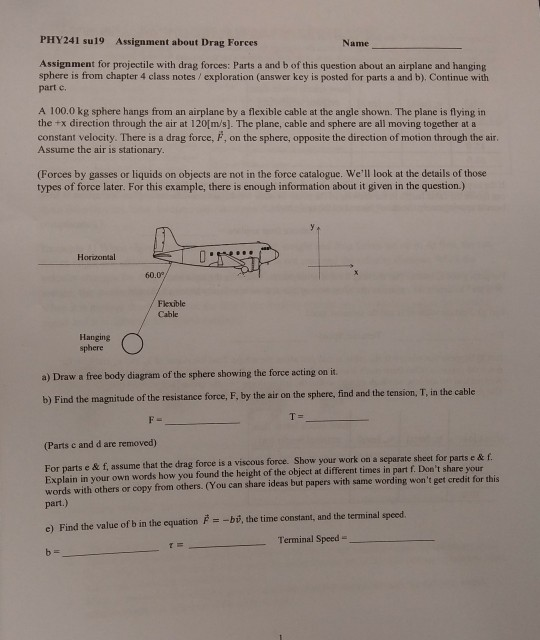
PHY241 su19 Assignment about Drag Forces Name Assignment for projectile with drag forces: Parts a and b of this question about an sphere is from chapter 4 class notes / exploration (answer key is posted for parts a and b). Continue with part c airplane and hanging A 100.0 kg sphere hangs from an the +x direction through the air at 120[m/s]. The plane, cable and sphere constant velocity. There is a Assume the air is stationary. airplane by a flexible cable at the angle shown. The plane is flying in are all moving together at a on the sphere, opposite the direction of motion through the air drag force, F, (Forces by gasses or types of force later. For this example, there is enough information about it given in the question.) on objects are not in the force catalogue. We'll look at the details of those liquids 1 y Horizontal 60.0 Flexible Cable wemg-90 Hanging sphere a) Draw a free body diagram of the sphere showing the force acting on it. b) Find the magnitude of the resistance force, F, by the air on the sphere, find and the tension, T, in the cable 1130 LN 5 66 T- F= (Parts c and d are removed) For parts e & f, assume that the drag force is a viscous force. Show your work on a separate sheet for parts e & f Explain in your own words how you found the height of the object at different times in part f. Don't share your words with others or copy from others. (You can share ideas but papers with same wording won't get credit for this part.) e) Find the value of b in the equation F=-bi, the time constant, and the terminal speed. Terminal Speed= 1H
Homework Answers
e. Drag force F = 566N = -b

b = -566/120 = -4.72 N-s/m
time const 
f. at t=0 
velocity in x -direction changes as exp(-t/
t =5 
t = 15 = 120 exp(-15/21.19) = 59.12 m/s
t = 30 = 120 exp(-30/21.19) = 29.13 m/s
in vertical direction there is gain in vel due to gravity and loss due to drag force
v(t) = g

t = 0 
t =5 = 9.8*21.19 (1- exp(-5/21.19) ) = 43.65 m/s
t = 15 = 9.8*21.19 (1- exp(-15/21.19) ) = 105.35 m/s
t =30 = 9.8*21.19 (1- exp(-30/21.19) ) = 157.25 m/s
g)
F = D v2 = 566 N
D = 566 /1202 = 4.72
at terminal speed the sphere false with const vel. no external force
mg = D 

Add Answer to:
please help me with drag forces?
Part A and B is done. I just need help...
Experiments show that the coefficient of drag C=F/(1/2ApV^2) for smooth spheres should only be a function...
 Experiments show that the coefficient of drag C=F/(1/2ApV^2) for
smooth spheres should only be a function of a Reynold's
number.
8. Experiments show that the coefticient of drag Cp F(Ap) for smooth spheres should only be a function of a Reynold's number, Re PVD/μ). I lere F is the total drag force of the fluid on the sphere, and includes all the viscous and pressure forces, and A is the frontal area A D"4. The drag force ơn small spheres...
Experiments show that the coefficient of drag C=F/(1/2ApV^2) for
smooth spheres should only be a function of a Reynold's
number.
8. Experiments show that the coefticient of drag Cp F(Ap) for smooth spheres should only be a function of a Reynold's number, Re PVD/μ). I lere F is the total drag force of the fluid on the sphere, and includes all the viscous and pressure forces, and A is the frontal area A D"4. The drag force ơn small spheres...
A 50kg skydiver jumps out of an airplane. We assume that the forces acting on the body are the force of gravity and a retarding force of air resistance with direction opposite to the direction of motion and with magnitude cv^2 where c=.1275 kg/m and i
A 50kg skydiver jumps out of an airplane. We assume that the forces acting on the body are the force of gravity and a retarding force of air resistance with direction opposite to the direction of motion and with magnitude cv^2 where c=.1275 kg/m and is the velocity of the skydiver at time t (and upward is positive velocity). The gravitational constant is 9.8 m/s^2 . a) Find a differential equation for the velocity. b) Determine the terminal velocity in...
Please don't attempt if you can not write a MATLAB PROGRAM. I don't need numerical physics...
 Please don't attempt if you can not write a MATLAB
PROGRAM.
I don't need numerical physics solution, I need MATLAB code.
Read the question carefully
2) Falling Drops Imagine a solid sphere of diameter, d, falling through the air. After its release, the sphere accelerates until it reaches its terminal velocity. The terminal velocity is obtained when the drag force due to air friction, Fa, balances the weight of the sphere, W. The weight of the sphere is simply its...
Please don't attempt if you can not write a MATLAB
PROGRAM.
I don't need numerical physics solution, I need MATLAB code.
Read the question carefully
2) Falling Drops Imagine a solid sphere of diameter, d, falling through the air. After its release, the sphere accelerates until it reaches its terminal velocity. The terminal velocity is obtained when the drag force due to air friction, Fa, balances the weight of the sphere, W. The weight of the sphere is simply its...
Please help me with both parts b and c. I am confused Constants A 9.00 m...
 Please help me with both parts
b and c. I am confused
Constants A 9.00 m uniform beam is hinged to a vertical wall and held horizontally by a 5.00 m cable attached to the wall 4.00 m above the hinge, as shown in the figure below (Figure 1). The metal of this cable has a test strength of 1.10 kN , which means that it will break if the tension in it exceeds that amount. Part A What is...
Please help me with both parts
b and c. I am confused
Constants A 9.00 m uniform beam is hinged to a vertical wall and held horizontally by a 5.00 m cable attached to the wall 4.00 m above the hinge, as shown in the figure below (Figure 1). The metal of this cable has a test strength of 1.10 kN , which means that it will break if the tension in it exceeds that amount. Part A What is...
please do all abcde and show steps. thank you! they are very confusing to me. 3.)...
 please do all abcde and show steps. thank you! they are very
confusing to me.
3.) Vectors are useful in physics and engineering. Force is one example of a vector quantity. Definition. If several forces are acting on an object, the resultant (net) force experienced by the object is the vector sum of these force. Below is information about two forces acting on an airplane. Force 1: Suppose that the wind is blowing 45 degrees Northwest at a speed of...
please do all abcde and show steps. thank you! they are very
confusing to me.
3.) Vectors are useful in physics and engineering. Force is one example of a vector quantity. Definition. If several forces are acting on an object, the resultant (net) force experienced by the object is the vector sum of these force. Below is information about two forces acting on an airplane. Force 1: Suppose that the wind is blowing 45 degrees Northwest at a speed of...
please help Question 1 1.1 If the velocity distribution of a fluid flowing over a 1m²...
 please help
Question 1 1.1 If the velocity distribution of a fluid flowing over a 1m² flat plate is given by u=l+ y + y, find the m. Assume dynamic viscosity to be y=6x10*(Ns/m”). force acting on a plate at y = [5 marks] 1.2 A 2D velocity field in an incompressible flow was measured by PIV method and determined to follow the following functions u= 2x’ +2y and v=x - 4y. Check whether your measurements are correct at a...
please help
Question 1 1.1 If the velocity distribution of a fluid flowing over a 1m² flat plate is given by u=l+ y + y, find the m. Assume dynamic viscosity to be y=6x10*(Ns/m”). force acting on a plate at y = [5 marks] 1.2 A 2D velocity field in an incompressible flow was measured by PIV method and determined to follow the following functions u= 2x’ +2y and v=x - 4y. Check whether your measurements are correct at a...
I need help on the second picture. they did not give us a air drag coeffient
 i need help on the second picture.
they did not give us a air drag coeffient
Physics 220 by David Michaels Lab 8 Instructor's Initials Activity 8.1 Score Potential to Work to Reach Great Heights Part I In this activity you are to use the same spring launcher or Nerfo gun you used in Lab 4 (check your Lab 4.1 for which one you used) to analyze energy conservation in various forms Let's assume the launching mechanism of the Nerfo...
i need help on the second picture.
they did not give us a air drag coeffient
Physics 220 by David Michaels Lab 8 Instructor's Initials Activity 8.1 Score Potential to Work to Reach Great Heights Part I In this activity you are to use the same spring launcher or Nerfo gun you used in Lab 4 (check your Lab 4.1 for which one you used) to analyze energy conservation in various forms Let's assume the launching mechanism of the Nerfo...
A physic student sets out to experiment on the effect of drag forces on a ball...
 A physic student sets out to experiment on the effect of drag forces on a ball of mass m by giving the ball an initial velocity nu_0 upwards and then downwards as describe below. In both cases, the ball experiences a force of air resistance whose magnitude is given by F = -k nu Where k is a positive constant. The positive direction for all vector quantities is taken to be upwards. Express all algebraic answers in terms of m....
PART A - Find the relation between the forces acting on these airplanes (neglect the missiles)....
 PART A - Find the relation between the forces acting on these
airplanes (neglect the missiles). Also, find the resultant external
force (F) using the indicated coordinate system in Figure 2. (T is
the thrust, A is the aerodynamic force, W is the weight, D
represents the drag force and L shows the lift force. V is the
velocity. ? and ? represent the path angle and thrust angle of
attack, respectively.) Hint 1: Use the following graph for the...
PART A - Find the relation between the forces acting on these
airplanes (neglect the missiles). Also, find the resultant external
force (F) using the indicated coordinate system in Figure 2. (T is
the thrust, A is the aerodynamic force, W is the weight, D
represents the drag force and L shows the lift force. V is the
velocity. ? and ? represent the path angle and thrust angle of
attack, respectively.) Hint 1: Use the following graph for the...
in this lab we will drop a steel ball P steel=8000 kg/m^3, r ball=2.18x10^-3) through the...
in this lab we will drop a steel ball P steel=8000 kg/m^3, r ball=2.18x10^-3) through the air (nair=1.8x10^-5 Pas, P air= 1.29kg/m^3) and through a viscous soap solution (n soap ~ 9.0 Pa s) you will measure this number in lab, but use this number for prelab.( P soap = 1000kg/m^3) 1Pa= 1N/m 1. (a) assuming that the ball falling through the soap solution experiences visocus drag, find the terminal speed of the ball, the speed at which the weight...
 Experiments show that the coefficient of drag C=F/(1/2ApV^2) for
smooth spheres should only be a function of a Reynold's
number.
8. Experiments show that the coefticient of drag Cp F(Ap) for smooth spheres should only be a function of a Reynold's number, Re PVD/μ). I lere F is the total drag force of the fluid on the sphere, and includes all the viscous and pressure forces, and A is the frontal area A D"4. The drag force ơn small spheres...
Experiments show that the coefficient of drag C=F/(1/2ApV^2) for
smooth spheres should only be a function of a Reynold's
number.
8. Experiments show that the coefticient of drag Cp F(Ap) for smooth spheres should only be a function of a Reynold's number, Re PVD/μ). I lere F is the total drag force of the fluid on the sphere, and includes all the viscous and pressure forces, and A is the frontal area A D"4. The drag force ơn small spheres...
 Please don't attempt if you can not write a MATLAB
PROGRAM.
I don't need numerical physics solution, I need MATLAB code.
Read the question carefully
2) Falling Drops Imagine a solid sphere of diameter, d, falling through the air. After its release, the sphere accelerates until it reaches its terminal velocity. The terminal velocity is obtained when the drag force due to air friction, Fa, balances the weight of the sphere, W. The weight of the sphere is simply its...
Please don't attempt if you can not write a MATLAB
PROGRAM.
I don't need numerical physics solution, I need MATLAB code.
Read the question carefully
2) Falling Drops Imagine a solid sphere of diameter, d, falling through the air. After its release, the sphere accelerates until it reaches its terminal velocity. The terminal velocity is obtained when the drag force due to air friction, Fa, balances the weight of the sphere, W. The weight of the sphere is simply its...
 Please help me with both parts
b and c. I am confused
Constants A 9.00 m uniform beam is hinged to a vertical wall and held horizontally by a 5.00 m cable attached to the wall 4.00 m above the hinge, as shown in the figure below (Figure 1). The metal of this cable has a test strength of 1.10 kN , which means that it will break if the tension in it exceeds that amount. Part A What is...
Please help me with both parts
b and c. I am confused
Constants A 9.00 m uniform beam is hinged to a vertical wall and held horizontally by a 5.00 m cable attached to the wall 4.00 m above the hinge, as shown in the figure below (Figure 1). The metal of this cable has a test strength of 1.10 kN , which means that it will break if the tension in it exceeds that amount. Part A What is...
 please do all abcde and show steps. thank you! they are very
confusing to me.
3.) Vectors are useful in physics and engineering. Force is one example of a vector quantity. Definition. If several forces are acting on an object, the resultant (net) force experienced by the object is the vector sum of these force. Below is information about two forces acting on an airplane. Force 1: Suppose that the wind is blowing 45 degrees Northwest at a speed of...
please do all abcde and show steps. thank you! they are very
confusing to me.
3.) Vectors are useful in physics and engineering. Force is one example of a vector quantity. Definition. If several forces are acting on an object, the resultant (net) force experienced by the object is the vector sum of these force. Below is information about two forces acting on an airplane. Force 1: Suppose that the wind is blowing 45 degrees Northwest at a speed of...
 please help
Question 1 1.1 If the velocity distribution of a fluid flowing over a 1m² flat plate is given by u=l+ y + y, find the m. Assume dynamic viscosity to be y=6x10*(Ns/m”). force acting on a plate at y = [5 marks] 1.2 A 2D velocity field in an incompressible flow was measured by PIV method and determined to follow the following functions u= 2x’ +2y and v=x - 4y. Check whether your measurements are correct at a...
please help
Question 1 1.1 If the velocity distribution of a fluid flowing over a 1m² flat plate is given by u=l+ y + y, find the m. Assume dynamic viscosity to be y=6x10*(Ns/m”). force acting on a plate at y = [5 marks] 1.2 A 2D velocity field in an incompressible flow was measured by PIV method and determined to follow the following functions u= 2x’ +2y and v=x - 4y. Check whether your measurements are correct at a...
 i need help on the second picture.
they did not give us a air drag coeffient
Physics 220 by David Michaels Lab 8 Instructor's Initials Activity 8.1 Score Potential to Work to Reach Great Heights Part I In this activity you are to use the same spring launcher or Nerfo gun you used in Lab 4 (check your Lab 4.1 for which one you used) to analyze energy conservation in various forms Let's assume the launching mechanism of the Nerfo...
i need help on the second picture.
they did not give us a air drag coeffient
Physics 220 by David Michaels Lab 8 Instructor's Initials Activity 8.1 Score Potential to Work to Reach Great Heights Part I In this activity you are to use the same spring launcher or Nerfo gun you used in Lab 4 (check your Lab 4.1 for which one you used) to analyze energy conservation in various forms Let's assume the launching mechanism of the Nerfo...
 A physic student sets out to experiment on the effect of drag forces on a ball of mass m by giving the ball an initial velocity nu_0 upwards and then downwards as describe below. In both cases, the ball experiences a force of air resistance whose magnitude is given by F = -k nu Where k is a positive constant. The positive direction for all vector quantities is taken to be upwards. Express all algebraic answers in terms of m....
 PART A - Find the relation between the forces acting on these
airplanes (neglect the missiles). Also, find the resultant external
force (F) using the indicated coordinate system in Figure 2. (T is
the thrust, A is the aerodynamic force, W is the weight, D
represents the drag force and L shows the lift force. V is the
velocity. ? and ? represent the path angle and thrust angle of
attack, respectively.) Hint 1: Use the following graph for the...
PART A - Find the relation between the forces acting on these
airplanes (neglect the missiles). Also, find the resultant external
force (F) using the indicated coordinate system in Figure 2. (T is
the thrust, A is the aerodynamic force, W is the weight, D
represents the drag force and L shows the lift force. V is the
velocity. ? and ? represent the path angle and thrust angle of
attack, respectively.) Hint 1: Use the following graph for the...
Most questions answered within 3 hours.
-
Where is the error in this code sequence?
String s1 = "Hello";
String s2 = "ello";...
asked 11 months ago -
Financial data for Joel de Paris, Inc., for last year
follow:
Joel de Paris, Inc.
Balance...
asked 11 months ago -
Consider this reaction:
Al2(SO4)3 (aq)+ BaCl3
(aq) Al2Cl6 (aq)- +
3BaSO4(s) . What is the...
asked 11 months ago -
Suppose that Savneet is considering increasing her
recent random sample from 20 car rentals to 40...
asked 11 months ago -
Trucks arrive at an unloading terminal at an average rate of 120
per hour.
Trucks arrive...
asked 11 months ago -
Why are methanol and ethanol completely soluble in water while
octanol is not very little soluble....
asked 11 months ago -
A facilities manager at a university reads in a research report
that the mean amount of...
asked 11 months ago -
When the CuSO4 is rehydrated by adding water to the anhydrous
compound, is this an endothermic...
asked 11 months ago -
A ray of sunlight is passing from diamond into crown glass; the
angle of incidence is...
asked 11 months ago -
A block of mass 0.249 kg is placed on top of a light, vertical
spring of...
asked 11 months ago -
how do the kidneys compensate in the presences of acidosis
a) trigger hyperventilate
b) reserve acid...
asked 11 months ago -
Question 501 pts
The rental rate of capital to the firm increases. Which of the
following...
asked 11 months ago