You can change the coild density, n, of the solenoid by: A. using a different magnet...
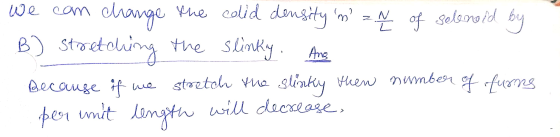
You can change the coild density, n, of the solenoid by:
A. using a different magnet
B. stretching the slinky
C. increasing the voltage on the power supply
D. changing the orientation of the slinky relative to the Earth's magnetic field
Homework Answers
Add Answer to:
You can change the coild density, n, of the solenoid by:
A. using a different magnet...
The main magnet in an MRI machine is a superconducting solenoid 2.0 m long and 33...
The main magnet in an MRI machine is a superconducting solenoid 2.0 m long and 33 cm in radius. During normal operation, the current through the windings is 81 A, and the resistance of the windings is zero. The inductance of the solenoid is 89 H. (a) Calculate the turns per meter of the solenoid. (b) Calculate the magnitude of the magnetic field generated by the MRI machine during normal operations. (c) Calculate the magnetic flux through a single turn...
physics Imagine a magnet impended in n clear fluid and allowed to rotate in all directions...
 physics
Imagine a magnet impended in n clear fluid and allowed to rotate in all directions The fluid in in a clear container and you can observe the magnet suspended in the liquid .sitting on a table here in the UALR Physics Laboratory. The magnet is clearly and correctly marked N and S, indicating its Magnetic North Pole and Magnetic South Pole. Again, assuming the magnet were free to orient itself in the earth's magnetic field, you would find that...
physics
Imagine a magnet impended in n clear fluid and allowed to rotate in all directions The fluid in in a clear container and you can observe the magnet suspended in the liquid .sitting on a table here in the UALR Physics Laboratory. The magnet is clearly and correctly marked N and S, indicating its Magnetic North Pole and Magnetic South Pole. Again, assuming the magnet were free to orient itself in the earth's magnetic field, you would find that...
1. Consider a solenoid, such as the slinky used in part B of the experiment. What...
1. Consider a solenoid, such as the slinky used in part B of the experiment. What would happen to the magnetic field inside this solenoid if you doubled the number of turns while simultaneously stretching the solenoid to twice the original length? Assume the voltage applied was kept constant and the additional length of wire for the extra turns of the coil do not add appreciably to the resistance of the solenoid. Which would be the result? a) The magnetic...
A solenoid made of magnet wire (#20 gauge) with 12.3 turns per cm is attached to...
 A solenoid made of magnet wire (#20 gauge) with 12.3 turns per cm is attached to a 536 Ω resistor and a 110 V DC source. The diameter of the solenoid is 1.8 cm and its length is 15 cm a. (5 points) What is the self-inductance of the solenoid? b. (5 points) The emf induced in the solenoid depends on a changing current. After a long time the current will stop changing, and the only voltage drop in the...
A. After placing a CRT into the center of a solenoid, you wohld start increasing the...
A. After placing a CRT into the center of a solenoid, you wohld start increasing the current steadily until you find the current value that we must use in calculating the charge-to-mass ratio of the electron. How can you tell the value shown on the power supply is the right one to use? B. Is it more or less accurate to measure the magnetic field inside the solenoid just once with the gaussmeter instead of measuring the field along the...
6. A very long solenoid has a density of coils n turns per unit length. We apply a current I through the solenoid. Use Biot-Savart law to derive the magnetic field in the center of the the solenoid....
 6. A very long solenoid has a density of coils n turns per unit length. We apply a current I through the solenoid. Use Biot-Savart law to derive the magnetic field in the center of the the solenoid. Verify that it agrees with the result from the Ampere's law. You can approximate the solenoid as infinitely long
6. A very long solenoid has a density of coils n turns per unit length. We apply a current I through the solenoid....
6. A very long solenoid has a density of coils n turns per unit length. We apply a current I through the solenoid. Use Biot-Savart law to derive the magnetic field in the center of the the solenoid. Verify that it agrees with the result from the Ampere's law. You can approximate the solenoid as infinitely long
6. A very long solenoid has a density of coils n turns per unit length. We apply a current I through the solenoid....
1) Induced emf in a coil depends on a) Relative motion of magnet b) Relative motion...
 1) Induced emf in a coil depends on a) Relative motion of magnet b) Relative motion of coil c) Both d) None 2) When is passed through coil is there magnet a a (changing/unchanging) magnetic flux through the coil that induces an electromotive force(emf) in the coil; the incoming flux is (equal /not equal)to the outgoing flux. 3) While a magnet is moved toward the end of a solenoid, a voltage difference is induced between the two ends of the...
Question 2 14 pts You have 100 m of fine copper wire with a radius of...
 Question 2 14 pts You have 100 m of fine copper wire with a radius of 0.5 mm. Having only a 12 V power supply that can be treated as ideal, a pencil, and a bag of long nails made from 99.8% pure iron (relative magnetic permeability of 200) you need to make a magnet that would produce a strong magnetic field. A. (2 points) What is the resistance of the 100 m of the given copper wire? Assume the...
Magnetic Field. I have no idea how to solve these questions, please help!!!! MAGNETIC FIELDS SUMMARY...
 Magnetic Field. I have no idea how to solve these questions,
please help!!!!
MAGNETIC FIELDS SUMMARY You will measure how the magnetic field, B, produced by a coil varies with the current, I, in the coil. From your measurements, you w calculate the permeability constant Ho. Lastly you w use a magnet to induce a voltage in the coil. THEORY The magnetic field Batthe center of a circular coil (solenoid) of radius R with N turns that carries a current...
Magnetic Field. I have no idea how to solve these questions,
please help!!!!
MAGNETIC FIELDS SUMMARY You will measure how the magnetic field, B, produced by a coil varies with the current, I, in the coil. From your measurements, you w calculate the permeability constant Ho. Lastly you w use a magnet to induce a voltage in the coil. THEORY The magnetic field Batthe center of a circular coil (solenoid) of radius R with N turns that carries a current...
III. Mapping the Field Around a Bar Magnet: An Observation Experiment Purposes: Design an experiment to take approp...
 III. Mapping the Field Around a Bar Magnet: An Observation Experiment Purposes: Design an experiment to take appropriate data to find a relationship. Construct a mathematical model to describe that relationship Description: Your task is to use a compass to map the magnetic field of a small magnet. Construct a circle of radius 10 cm on a clean sheet of paper, and mark points on the circle every 30°. Place the bar magnet so that its center is resting at...
 physics
Imagine a magnet impended in n clear fluid and allowed to rotate in all directions The fluid in in a clear container and you can observe the magnet suspended in the liquid .sitting on a table here in the UALR Physics Laboratory. The magnet is clearly and correctly marked N and S, indicating its Magnetic North Pole and Magnetic South Pole. Again, assuming the magnet were free to orient itself in the earth's magnetic field, you would find that...
physics
Imagine a magnet impended in n clear fluid and allowed to rotate in all directions The fluid in in a clear container and you can observe the magnet suspended in the liquid .sitting on a table here in the UALR Physics Laboratory. The magnet is clearly and correctly marked N and S, indicating its Magnetic North Pole and Magnetic South Pole. Again, assuming the magnet were free to orient itself in the earth's magnetic field, you would find that...
 A solenoid made of magnet wire (#20 gauge) with 12.3 turns per cm is attached to a 536 Ω resistor and a 110 V DC source. The diameter of the solenoid is 1.8 cm and its length is 15 cm a. (5 points) What is the self-inductance of the solenoid? b. (5 points) The emf induced in the solenoid depends on a changing current. After a long time the current will stop changing, and the only voltage drop in the...
 6. A very long solenoid has a density of coils n turns per unit length. We apply a current I through the solenoid. Use Biot-Savart law to derive the magnetic field in the center of the the solenoid. Verify that it agrees with the result from the Ampere's law. You can approximate the solenoid as infinitely long
6. A very long solenoid has a density of coils n turns per unit length. We apply a current I through the solenoid....
6. A very long solenoid has a density of coils n turns per unit length. We apply a current I through the solenoid. Use Biot-Savart law to derive the magnetic field in the center of the the solenoid. Verify that it agrees with the result from the Ampere's law. You can approximate the solenoid as infinitely long
6. A very long solenoid has a density of coils n turns per unit length. We apply a current I through the solenoid....
 1) Induced emf in a coil depends on a) Relative motion of magnet b) Relative motion of coil c) Both d) None 2) When is passed through coil is there magnet a a (changing/unchanging) magnetic flux through the coil that induces an electromotive force(emf) in the coil; the incoming flux is (equal /not equal)to the outgoing flux. 3) While a magnet is moved toward the end of a solenoid, a voltage difference is induced between the two ends of the...
 Question 2 14 pts You have 100 m of fine copper wire with a radius of 0.5 mm. Having only a 12 V power supply that can be treated as ideal, a pencil, and a bag of long nails made from 99.8% pure iron (relative magnetic permeability of 200) you need to make a magnet that would produce a strong magnetic field. A. (2 points) What is the resistance of the 100 m of the given copper wire? Assume the...
 Magnetic Field. I have no idea how to solve these questions,
please help!!!!
MAGNETIC FIELDS SUMMARY You will measure how the magnetic field, B, produced by a coil varies with the current, I, in the coil. From your measurements, you w calculate the permeability constant Ho. Lastly you w use a magnet to induce a voltage in the coil. THEORY The magnetic field Batthe center of a circular coil (solenoid) of radius R with N turns that carries a current...
Magnetic Field. I have no idea how to solve these questions,
please help!!!!
MAGNETIC FIELDS SUMMARY You will measure how the magnetic field, B, produced by a coil varies with the current, I, in the coil. From your measurements, you w calculate the permeability constant Ho. Lastly you w use a magnet to induce a voltage in the coil. THEORY The magnetic field Batthe center of a circular coil (solenoid) of radius R with N turns that carries a current...
 III. Mapping the Field Around a Bar Magnet: An Observation Experiment Purposes: Design an experiment to take appropriate data to find a relationship. Construct a mathematical model to describe that relationship Description: Your task is to use a compass to map the magnetic field of a small magnet. Construct a circle of radius 10 cm on a clean sheet of paper, and mark points on the circle every 30°. Place the bar magnet so that its center is resting at...
Most questions answered within 3 hours.
-
Where is the error in this code sequence?
String s1 = "Hello";
String s2 = "ello";...
asked 11 months ago -
Financial data for Joel de Paris, Inc., for last year
follow:
Joel de Paris, Inc.
Balance...
asked 11 months ago -
Consider this reaction:
Al2(SO4)3 (aq)+ BaCl3
(aq) Al2Cl6 (aq)- +
3BaSO4(s) . What is the...
asked 11 months ago -
Suppose that Savneet is considering increasing her
recent random sample from 20 car rentals to 40...
asked 11 months ago -
Trucks arrive at an unloading terminal at an average rate of 120
per hour.
Trucks arrive...
asked 11 months ago -
Why are methanol and ethanol completely soluble in water while
octanol is not very little soluble....
asked 11 months ago -
A facilities manager at a university reads in a research report
that the mean amount of...
asked 11 months ago -
When the CuSO4 is rehydrated by adding water to the anhydrous
compound, is this an endothermic...
asked 11 months ago -
A ray of sunlight is passing from diamond into crown glass; the
angle of incidence is...
asked 11 months ago -
A block of mass 0.249 kg is placed on top of a light, vertical
spring of...
asked 11 months ago -
how do the kidneys compensate in the presences of acidosis
a) trigger hyperventilate
b) reserve acid...
asked 11 months ago -
Question 501 pts
The rental rate of capital to the firm increases. Which of the
following...
asked 11 months ago