
Homework Answers
Add Answer to:
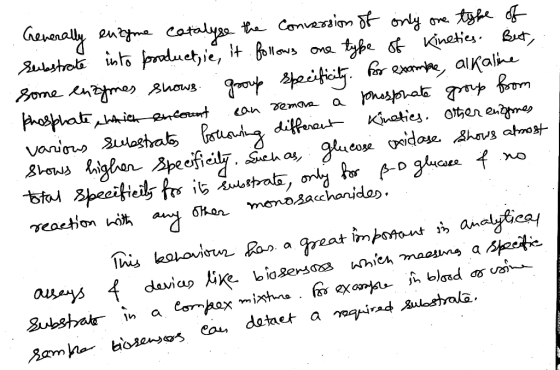
8. Can same enzyme have different kinetics for different substrates? What is the biological significance that?
yule grapn below comparing two different enzymes with different enzyme kinetics. a. Do the graphs have...
 yule grapn below comparing two different enzymes with different enzyme kinetics. a. Do the graphs have any of the same values for their Vmax, Vmax/2 or Km? If so which are the affinity for substrate same which are different? Enzyme with high Enzyme with low affinity for substrate Difference in reaction rate at low [5] Reaction rater Low (S] Substrate concentration [5] b. READ THIS: Enzyme-substrate affinity is the tendency for enzyme and substrate to bind together and form the...
After collecting enzyme kinetics data using substrates in mM and reaction velocities in mM/min, you make...
 After collecting enzyme kinetics data using substrates in mM and reaction velocities in mM/min, you make a Lineweaver-Burk plot. Your line of best fit has the equation: y = 0.00160 x + 0.00759. Calculate the Vmax of the enzyme using the equation: 1 KM 1 - = v Vmax [S] Vmax +
Why might we make enzymes that work on the same substrate, but with different enzyme kinetics?...
Why might we make enzymes that work on the same substrate, but with different enzyme kinetics? How do the different hexokinase isozymes of liver and muscle reflect the different roles of these organs in carbohydrate metabolism? Why is the fact how hexokinase 4 is not inhibited by glucose 6-phosphate, instead being inhibited by reversible binding of a regulatory protein specific to liver be important in its function?
5. Enzyme kinetics and ligand-receptor binding can be analyzed with the same equations. Explain why
 5. Enzyme kinetics and ligand-receptor binding can be analyzed with the same equations. Explain why
Enzymes. The enzyme tryptophan-tRNA synthetase binds to three different substrates, with the following Michaelis constants: ATP...
Enzymes. The enzyme tryptophan-tRNA synthetase binds to three different substrates, with the following Michaelis constants: ATP (KM = 50µM), tryptophan (KM = 0.5µM), and tRNATrp (KM = 1.5µM). - A) Which substrate binds to the enzyme with highest affinity? _________________________ - B) When is the enzyme mostly saturated (i.e., mostly bound to all three substrates)? [Circle one number (1 – 3).] 1) 1 µM ATP, 10 µM tryptophan, and 100 µM tRNATrp 2) 100 µM ATP, 1 µM tryptophan, and...
1. do all enzymes have the same active site? why ? 2. What is meant by...
1. do all enzymes have the same active site? why ? 2. What is meant by the optimal temperature and the optimal pH for an enzyme? What biological significance do these parameters have?
36. Many biochemical enzyme reactions fit the form of Michaelis Menton Kinetics. These reactions have the...
 36. Many biochemical enzyme reactions fit the form of Michaelis Menton Kinetics. These reactions have the following characteristics: a) the rate of reaction is proportional to the enzyme concentration, E. b) at low substrate concentration the rate is proportional to the substrate concentration, S. c) at high substrate concentration the rate is independent of the substrate concentration, S. This type of reaction rate has the form - SE Ky + S When carried out in a batch reactor a material...
Enzyme Kinetics Problem The initial rate for an enzyme-catalyzed reaction has been determined at a number...
 Enzyme Kinetics Problem The initial rate for an enzyme-catalyzed reaction has been determined at a number of substrate concentrations. Data are given below: 5 27 23 65 1. Estimate V and K from a Michaelis-Menten graph of V versus [S] 2. Use a Lineweaver-Burk plot to analyze the same data. a. Determine V and Ka from the Lineweaver-Burk BONUS: If the total enzyme concentration was I nmol/L, what is K?
Enzyme Kinetics Problem The initial rate for an enzyme-catalyzed reaction...
Enzyme Kinetics Problem The initial rate for an enzyme-catalyzed reaction has been determined at a number of substrate concentrations. Data are given below: 5 27 23 65 1. Estimate V and K from a Michaelis-Menten graph of V versus [S] 2. Use a Lineweaver-Burk plot to analyze the same data. a. Determine V and Ka from the Lineweaver-Burk BONUS: If the total enzyme concentration was I nmol/L, what is K?
Enzyme Kinetics Problem The initial rate for an enzyme-catalyzed reaction...
A.Your summer research project is to study the kinetics of a newly discovered enzyme. You have...
A.Your summer research project is to study the kinetics of a newly discovered enzyme. You have already identified the substrate and optimal reaction conditions. Propose how you would set up experiments to characterize the maximum velocity (Vmax) and Michaelis constant (KM) of this enzyme, assuming that it will display Michaelis-Menten kinetics. B. How would you compare the specificity of the enzyme for its natural substrate versus its specificity for a chromogenic substrate analog that was synthesized in the lab
What is the net reaction that HIV- protease enzyme catalyzes. In other words list the substrates...
What is the net reaction that HIV- protease enzyme catalyzes. In other words list the substrates and products.
 yule grapn below comparing two different enzymes with different enzyme kinetics. a. Do the graphs have any of the same values for their Vmax, Vmax/2 or Km? If so which are the affinity for substrate same which are different? Enzyme with high Enzyme with low affinity for substrate Difference in reaction rate at low [5] Reaction rater Low (S] Substrate concentration [5] b. READ THIS: Enzyme-substrate affinity is the tendency for enzyme and substrate to bind together and form the...
 After collecting enzyme kinetics data using substrates in mM and reaction velocities in mM/min, you make a Lineweaver-Burk plot. Your line of best fit has the equation: y = 0.00160 x + 0.00759. Calculate the Vmax of the enzyme using the equation: 1 KM 1 - = v Vmax [S] Vmax +
 5. Enzyme kinetics and ligand-receptor binding can be analyzed with the same equations. Explain why
 36. Many biochemical enzyme reactions fit the form of Michaelis Menton Kinetics. These reactions have the following characteristics: a) the rate of reaction is proportional to the enzyme concentration, E. b) at low substrate concentration the rate is proportional to the substrate concentration, S. c) at high substrate concentration the rate is independent of the substrate concentration, S. This type of reaction rate has the form - SE Ky + S When carried out in a batch reactor a material...
 Enzyme Kinetics Problem The initial rate for an enzyme-catalyzed reaction has been determined at a number of substrate concentrations. Data are given below: 5 27 23 65 1. Estimate V and K from a Michaelis-Menten graph of V versus [S] 2. Use a Lineweaver-Burk plot to analyze the same data. a. Determine V and Ka from the Lineweaver-Burk BONUS: If the total enzyme concentration was I nmol/L, what is K?
Enzyme Kinetics Problem The initial rate for an enzyme-catalyzed reaction...
Enzyme Kinetics Problem The initial rate for an enzyme-catalyzed reaction has been determined at a number of substrate concentrations. Data are given below: 5 27 23 65 1. Estimate V and K from a Michaelis-Menten graph of V versus [S] 2. Use a Lineweaver-Burk plot to analyze the same data. a. Determine V and Ka from the Lineweaver-Burk BONUS: If the total enzyme concentration was I nmol/L, what is K?
Enzyme Kinetics Problem The initial rate for an enzyme-catalyzed reaction...
Most questions answered within 3 hours.
-
Where is the error in this code sequence?
String s1 = "Hello";
String s2 = "ello";...
asked 10 months ago -
Financial data for Joel de Paris, Inc., for last year
follow:
Joel de Paris, Inc.
Balance...
asked 10 months ago -
Consider this reaction:
Al2(SO4)3 (aq)+ BaCl3
(aq) Al2Cl6 (aq)- +
3BaSO4(s) . What is the...
asked 10 months ago -
Suppose that Savneet is considering increasing her
recent random sample from 20 car rentals to 40...
asked 10 months ago -
Trucks arrive at an unloading terminal at an average rate of 120
per hour.
Trucks arrive...
asked 10 months ago -
Why are methanol and ethanol completely soluble in water while
octanol is not very little soluble....
asked 10 months ago -
A facilities manager at a university reads in a research report
that the mean amount of...
asked 10 months ago -
When the CuSO4 is rehydrated by adding water to the anhydrous
compound, is this an endothermic...
asked 10 months ago -
A ray of sunlight is passing from diamond into crown glass; the
angle of incidence is...
asked 10 months ago -
A block of mass 0.249 kg is placed on top of a light, vertical
spring of...
asked 10 months ago -
how do the kidneys compensate in the presences of acidosis
a) trigger hyperventilate
b) reserve acid...
asked 10 months ago -
Question 501 pts
The rental rate of capital to the firm increases. Which of the
following...
asked 10 months ago