
Homework Answers
ANSWER:
Both the enzyme kinetics and ligand receptor binding can be analysed with the same equations because of the following reasons:
1. Both enzyme and ligand trigger a series of reaction to occur.
2. Both enzyme and ligand remain unused or unaltered during the reaction.
3. Both enzyme and ligand should have specific structure ( a three dimensional structure) for them to bind to the active site or for them to perform their specific function.
4.Both enzyme and ligands share similar kinetic behaviour and specificity.
5. Both are sensitive to temperature , pH and substrate concentration.
Add Answer to:
5. Enzyme kinetics and ligand-receptor binding can be analyzed with the same equations. Explain why
D5. Receptor-ligand interactions and enzyme-substrate interactions are similar because they both involve highly specific binding both...
 D5. Receptor-ligand interactions and enzyme-substrate interactions are similar because they both involve highly specific binding both the ligand and the substrate undergo a chemical change both the receptor and the enzyme alter their activities after the interaction they both rely on covalent binding D 6. Electron carriers like NADH and FADH2 are what type of molecules? enzymes receptors lipids proteins coenzymes
please make sure to draw not just explain Ligand binding to certain receptor tyrosine kinases results...
 please make sure to draw not just explain
Ligand binding to certain receptor tyrosine kinases results in the activation of a sphingomyelinase enzyme. Draw the reaction that shows the sphingomyelinase catalyzed hydrolysis of sphingomyelin to ceramide.
please make sure to draw not just explain
Ligand binding to certain receptor tyrosine kinases results in the activation of a sphingomyelinase enzyme. Draw the reaction that shows the sphingomyelinase catalyzed hydrolysis of sphingomyelin to ceramide.
Why might we make enzymes that work on the same substrate, but with different enzyme kinetics?...
Why might we make enzymes that work on the same substrate, but with different enzyme kinetics? How do the different hexokinase isozymes of liver and muscle reflect the different roles of these organs in carbohydrate metabolism? Why is the fact how hexokinase 4 is not inhibited by glucose 6-phosphate, instead being inhibited by reversible binding of a regulatory protein specific to liver be important in its function?
Acetylcholine is the substrate for the enzyme acetylcholinesterase. 1. Suggest what sort of binding interactions could...
 Acetylcholine is the substrate for the enzyme
acetylcholinesterase.
1. Suggest what sort of binding interactions could be involved
in holding acetylcholine to the active site.
2. The ester bond of acetylcholine is hydrolysed by
acetylcholinesterase. Suggest a mechanism by which the enzyme
catalyses this reaction.
3. Suggest how binding interactions might make acetylcholine
more susceptible to hydrolysis.
4. Structure I is an agonist which binds to the cholinergic
receptor and mimics the action of the natural ligand acetylcholine.
Structure II,...
Acetylcholine is the substrate for the enzyme
acetylcholinesterase.
1. Suggest what sort of binding interactions could be involved
in holding acetylcholine to the active site.
2. The ester bond of acetylcholine is hydrolysed by
acetylcholinesterase. Suggest a mechanism by which the enzyme
catalyses this reaction.
3. Suggest how binding interactions might make acetylcholine
more susceptible to hydrolysis.
4. Structure I is an agonist which binds to the cholinergic
receptor and mimics the action of the natural ligand acetylcholine.
Structure II,...
Usually a protein-binding curve is a hyperbolic function, with theta on the y-axis and [total ligand]...
 Usually a protein-binding curve
is a hyperbolic function, with theta on the y-axis and [total
ligand] on the x-axis. We can only assume that [Free L]=[L total]
when the ligand is in excess of the protein. For example the
[protein] would be 0.001 nM and you start adding ligand in .05nm
increments. But what would the binding curve above look like if the
[receptor]=1 nM: the ligand concentration is no longer in excess of
the protein concentration? Would you still...
Usually a protein-binding curve
is a hyperbolic function, with theta on the y-axis and [total
ligand] on the x-axis. We can only assume that [Free L]=[L total]
when the ligand is in excess of the protein. For example the
[protein] would be 0.001 nM and you start adding ligand in .05nm
increments. But what would the binding curve above look like if the
[receptor]=1 nM: the ligand concentration is no longer in excess of
the protein concentration? Would you still...
8. Can same enzyme have different kinetics for different substrates? What is the biological significance that?
 8. Can same enzyme have different kinetics for different substrates? What is the biological significance that?
You are studying a ligand-gated ion channel. The ligand is a neurotransmitter. Upon binding the neurotransmitter,...
You are studying a ligand-gated ion channel. The ligand is a neurotransmitter. Upon binding the neurotransmitter, the ion channel opens and Na+ flows into the cell. The receptor is found on the dendrites of frog neurons. You are going to use one of the patch-clamp variations to study the effect of (1) the neurotransmitter and (2) second (and separately) the effect of an antagonist. Explain the patch-clamp technique variation you would use and why. Explain how you will study the...
Activity 4. Receptor signaling pathway A model of a G protein receptor signaling pathway is represented...
 Activity 4. Receptor signaling pathway A model of a G protein receptor signaling pathway is represented below. Activation of the signaling pathway results in a cell secreting a neurotransmitter through exocytosis. Activated - Activated adenylyl receptor cyclase GTP АТР CAMP Active G protein Protein- kinase A Inactive Active Protein targets Phosphate group A. Different steps in a signaling pathway can amplify the initial signal of one ligand binding to one receptor. Choose one step in the pathway below that results...
Question 6 The following three molecules are camptothecin analogues that target the topoisomerase I enzyme and...
 Question 6 The following three molecules are camptothecin analogues that target the topoisomerase I enzyme and are used to treat cancer. LOH Oy “ HO a. Using common structural features generate a simple ligand-based pharmacophore to explain why these compounds may be binding to the same enzyme. List how can pharmacophores be used in a research setting to aid drug discovery? b. ehte c. Given that the compound 3 is metabolised by an esterase in vivo (compounds 1 and 2...
can someone please help with this? 5. Below are two types of enzyme kinetics curves -...
 can someone please help with this?
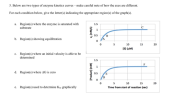
5. Below are two types of enzyme kinetics curves - make careful note of how the axes are different. For each condition below, give the letter(s) indicating the appropriate region(s) of the graph(s). a. Region(s) where the enzyme is saturated with substrate v, (mM/s) b. Region(s) showing equilibration 5 15 20 10 [S] (M) c. Region(s) where an initial velocity is able to be determined d. Region(s) where AG is zero [Product] (MM) 5...
can someone please help with this?
5. Below are two types of enzyme kinetics curves - make careful note of how the axes are different. For each condition below, give the letter(s) indicating the appropriate region(s) of the graph(s). a. Region(s) where the enzyme is saturated with substrate v, (mM/s) b. Region(s) showing equilibration 5 15 20 10 [S] (M) c. Region(s) where an initial velocity is able to be determined d. Region(s) where AG is zero [Product] (MM) 5...
 D5. Receptor-ligand interactions and enzyme-substrate interactions are similar because they both involve highly specific binding both the ligand and the substrate undergo a chemical change both the receptor and the enzyme alter their activities after the interaction they both rely on covalent binding D 6. Electron carriers like NADH and FADH2 are what type of molecules? enzymes receptors lipids proteins coenzymes
 please make sure to draw not just explain
Ligand binding to certain receptor tyrosine kinases results in the activation of a sphingomyelinase enzyme. Draw the reaction that shows the sphingomyelinase catalyzed hydrolysis of sphingomyelin to ceramide.
please make sure to draw not just explain
Ligand binding to certain receptor tyrosine kinases results in the activation of a sphingomyelinase enzyme. Draw the reaction that shows the sphingomyelinase catalyzed hydrolysis of sphingomyelin to ceramide.
 Acetylcholine is the substrate for the enzyme
acetylcholinesterase.
1. Suggest what sort of binding interactions could be involved
in holding acetylcholine to the active site.
2. The ester bond of acetylcholine is hydrolysed by
acetylcholinesterase. Suggest a mechanism by which the enzyme
catalyses this reaction.
3. Suggest how binding interactions might make acetylcholine
more susceptible to hydrolysis.
4. Structure I is an agonist which binds to the cholinergic
receptor and mimics the action of the natural ligand acetylcholine.
Structure II,...
Acetylcholine is the substrate for the enzyme
acetylcholinesterase.
1. Suggest what sort of binding interactions could be involved
in holding acetylcholine to the active site.
2. The ester bond of acetylcholine is hydrolysed by
acetylcholinesterase. Suggest a mechanism by which the enzyme
catalyses this reaction.
3. Suggest how binding interactions might make acetylcholine
more susceptible to hydrolysis.
4. Structure I is an agonist which binds to the cholinergic
receptor and mimics the action of the natural ligand acetylcholine.
Structure II,...
 Usually a protein-binding curve
is a hyperbolic function, with theta on the y-axis and [total
ligand] on the x-axis. We can only assume that [Free L]=[L total]
when the ligand is in excess of the protein. For example the
[protein] would be 0.001 nM and you start adding ligand in .05nm
increments. But what would the binding curve above look like if the
[receptor]=1 nM: the ligand concentration is no longer in excess of
the protein concentration? Would you still...
Usually a protein-binding curve
is a hyperbolic function, with theta on the y-axis and [total
ligand] on the x-axis. We can only assume that [Free L]=[L total]
when the ligand is in excess of the protein. For example the
[protein] would be 0.001 nM and you start adding ligand in .05nm
increments. But what would the binding curve above look like if the
[receptor]=1 nM: the ligand concentration is no longer in excess of
the protein concentration? Would you still...
 8. Can same enzyme have different kinetics for different substrates? What is the biological significance that?
 Activity 4. Receptor signaling pathway A model of a G protein receptor signaling pathway is represented below. Activation of the signaling pathway results in a cell secreting a neurotransmitter through exocytosis. Activated - Activated adenylyl receptor cyclase GTP АТР CAMP Active G protein Protein- kinase A Inactive Active Protein targets Phosphate group A. Different steps in a signaling pathway can amplify the initial signal of one ligand binding to one receptor. Choose one step in the pathway below that results...
 Question 6 The following three molecules are camptothecin analogues that target the topoisomerase I enzyme and are used to treat cancer. LOH Oy “ HO a. Using common structural features generate a simple ligand-based pharmacophore to explain why these compounds may be binding to the same enzyme. List how can pharmacophores be used in a research setting to aid drug discovery? b. ehte c. Given that the compound 3 is metabolised by an esterase in vivo (compounds 1 and 2...
 can someone please help with this?
5. Below are two types of enzyme kinetics curves - make careful note of how the axes are different. For each condition below, give the letter(s) indicating the appropriate region(s) of the graph(s). a. Region(s) where the enzyme is saturated with substrate v, (mM/s) b. Region(s) showing equilibration 5 15 20 10 [S] (M) c. Region(s) where an initial velocity is able to be determined d. Region(s) where AG is zero [Product] (MM) 5...
can someone please help with this?
5. Below are two types of enzyme kinetics curves - make careful note of how the axes are different. For each condition below, give the letter(s) indicating the appropriate region(s) of the graph(s). a. Region(s) where the enzyme is saturated with substrate v, (mM/s) b. Region(s) showing equilibration 5 15 20 10 [S] (M) c. Region(s) where an initial velocity is able to be determined d. Region(s) where AG is zero [Product] (MM) 5...
Most questions answered within 3 hours.
-
Where is the error in this code sequence?
String s1 = "Hello";
String s2 = "ello";...
asked 10 months ago -
Financial data for Joel de Paris, Inc., for last year
follow:
Joel de Paris, Inc.
Balance...
asked 10 months ago -
Consider this reaction:
Al2(SO4)3 (aq)+ BaCl3
(aq) Al2Cl6 (aq)- +
3BaSO4(s) . What is the...
asked 10 months ago -
Suppose that Savneet is considering increasing her
recent random sample from 20 car rentals to 40...
asked 10 months ago -
Trucks arrive at an unloading terminal at an average rate of 120
per hour.
Trucks arrive...
asked 10 months ago -
Why are methanol and ethanol completely soluble in water while
octanol is not very little soluble....
asked 10 months ago -
A facilities manager at a university reads in a research report
that the mean amount of...
asked 10 months ago -
When the CuSO4 is rehydrated by adding water to the anhydrous
compound, is this an endothermic...
asked 10 months ago -
A ray of sunlight is passing from diamond into crown glass; the
angle of incidence is...
asked 10 months ago -
A block of mass 0.249 kg is placed on top of a light, vertical
spring of...
asked 10 months ago -
how do the kidneys compensate in the presences of acidosis
a) trigger hyperventilate
b) reserve acid...
asked 10 months ago -
Question 501 pts
The rental rate of capital to the firm increases. Which of the
following...
asked 10 months ago