Do plant cells exist in a hypotonic or hypertronic state? Explain. What cell structures or organelles...
Do plant cells exist in a hypotonic or hypertronic state? Explain.
What cell structures or organelles would be involved in the creation and exocytosis of waste products?
Homework Answers
First need to understand what is hypertonic and hypotonic solution.
- hypotonic solution- when solvent is more and solute is less / dilute solution
- hypertonic solution - when solvent is less and solute is more / concentrated solution
- Osmosis is the movement of water from the region of its higher concentration to lower concentration that is from hypotonic to hypertonic.
Plants prefer to keep their cell in hypertonic condition so that water from their surronding environment which is hypotonic can enter inside the cell throgh the process of osmosis. Since osmosis is passive transport, does not utilizes energy for water of entry, it helps plant to save energy
If the plant cell would by in hypotonic state and the environement surrounding the plant cell being hypertonic , then it would lead to water leaving the cell. Hence plants would lose water and plasma membrane would shrink causing plasmolysis. Plasmolysis is shrinking of plasma membrane due to losing water. To avoid this situation plant cells naturally maintain hypertonic condition inside the cell.
CONCLUSION: Plant cells are more efficient when their inside cell is in hypertonic state and the outside environment is in hypotonic state.
Part B
The metabolic activities of the cell such as photosynthesis, respiration produces various by products which has to be released from the plant for example gaseous waste such as carbon dioxide and oxygen which exit through stomata, water which exits through transpiration process and other organic by product such as amino acids, resin latex etc is stored in a strorage vacuole of the plant.
Vacuoles is the main cell organelle in plant associated in production , storage, and excretion of the waste of plant. It is similar in function like lysosoms of animal cells and can also be called as suicidal bag of plant. Plants do not have lysosomes like animal cell and neither they have well deeloped excretory system. So vacuoles is one of the important organelle in plants.
Vacuoles are formed by small vesicles. These vesicles also called exocytic vesicles is a membrane bound organelle containing the substances that has to be removed from the cell and are formed by golgi apparatus. The waste of the cell first accumulates in these smaller vesicle, These vesicles merge together and form a large central vacuole which can store the waste product temporariy or permanently.
In the process of exocytosis cell transport substances which include the waste from the inside the cell to outside the cell.
Conclusion:
Vacuoles is the main cell rganelle of plant associated with waste production and removal of the waste through exocytosis..
Add Answer to:
Do plant cells exist in a hypotonic or hypertronic state?
Explain.
What cell structures or organelles...
Cell Organelles and their Functions This unit we are learning about cells and the organelles contained...
Cell Organelles and their Functions This unit we are learning about cells and the organelles contained within. In this Discussion, we’ll focus on the functions of the various organelles and cell structures: Cell membrane | Mitochondria | Plant cell wall | Plant chloroplast | Nucleus | Lysosomes | Nuclear envelope | Rough endoplasmic reticulum | Golgi apparatus | Smooth endoplasmic reticulum |Cytoskeleton | Cilia and flagella Select four of the organelles or structures above and briefly describe where each is...
Put a check in the appropriate column(s) to indicate whether the following organelles are found in plant cells, animal cells or both.
Site where ribosomes are madeThe membrane surrounding the cellProvides support for the cell, has two "subparis"Name for the collection of DNA in the nucleus of eukaryotic cellsConsist of hollow tubes which provide support for the cellSmall hair-like structures used for movement or sensing thingsComposed of a phospholipid bilayerLonger whip-like structures used for movementPut a check in the appropriate column(s) to indicate whether the following organelles are found in plant cells, animal cells or both. OrganellePlant CellsAnimal CellsCell WallVesicleChloroplastChromatinCytoplasmCytoskeletonEndoplasmic reticulumGolgi apparatusOrganellePlant CellsAnimal...
2 pt Question 30 organelles responsible for photosynthesis. Unlike animal cells, plant cells possess_ chloroplasts central...
 2 pt Question 30 organelles responsible for photosynthesis. Unlike animal cells, plant cells possess_ chloroplasts central vacuoles plasmodesmata mitochondria D Question 31 2 pts The cell wall of plants is primarily made of the carbohydrate effectively digest. which humans can not cellulose fructose glycogen pucose Question 32 In multicellular organisms, it is important that cells communicate with each other. In plant cells. structures called plasmodesmata facilitate the movement of signaling molecules between cells. In animal cells, analogous structures are called...
1. Choose all of the organelles below that you would find in a plant cell, but...
1. Choose all of the organelles below that you would find in a plant cell, but not in an animal cell. Group of answer choices cytoplasm centrioles large central vacuole choloroplasts cell wall ribosomes 2. Prokaryotic cells: Group of answer choices have membrane bound organelles have a nucleus are much larger than eukaryotic cells can make single-celled or multicellular organisms can only make single-celled organisms 3. Eukaryotic cells: (Choose all that apply) Group of answer choices have a nucleus are...
what are endospores made of You have been assigned two cell structures/organelles to learn more about...
 what are endospores made of
You have been assigned two cell structures/organelles to learn more about in. During this activity, you will share the following information with other teaching them what you have learned, so it's really important that you questions! Use chapters 6 and 27 in your text as your information sour but you are responsible for verifying the accuracy of the information Assigned cell structures/organelles: Are these considered TRUE organelles or "just" cell structures? Your structures/organelles are made...
what are endospores made of
You have been assigned two cell structures/organelles to learn more about in. During this activity, you will share the following information with other teaching them what you have learned, so it's really important that you questions! Use chapters 6 and 27 in your text as your information sour but you are responsible for verifying the accuracy of the information Assigned cell structures/organelles: Are these considered TRUE organelles or "just" cell structures? Your structures/organelles are made...
Question 46 (1 point) Plant cells are typically exposed to a hypotonic environment. Therefore, you would...
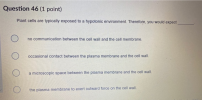 Question 46 (1 point) Plant cells are typically exposed to a hypotonic environment. Therefore, you would expect O no communication between the cell wall and the cell membrane. occasional contact between the plasma membrane and the cell wall a microscopic space between the plasma membrane and the cell wall. the plasma membrane to exert outward force on the cell wall.
Of Solute particles. If a cell is in a hypotonic solution, the extracellular fluid has a...
 Of Solute particles. If a cell is in a hypotonic solution, the extracellular fluid has a osmolarity then the inside of the cell. This means it has a solute concentration outside of the cell. Water will move the cell. If a cell is in a hypertonic solution, the extracellular fluid has a osmolarity then the inside of the cell. This means it has a solute concentration outside of the cell. Water will move the cell. If the osmolarity of the...
21. The ______ prevents plants cells from bursting when place in a ____ solution. a) centrioles-hypotonic...
21. The ______ prevents plants cells from bursting when place in a ____ solution. a) centrioles-hypotonic b) chloroplasts-hypertonic c) plasma membrane-hypertonic d) vacuole-hypertonic e) cell wall-hypotonic 22. Specialized cells like your own lung cells each lack which of the following organelles which are commonly found in an onion. a) cell membrane b)cell wall c)ribosomes d)nucleolus e) none of the above ______ 23. White blood cells engulf and destroy foreign particles by a process known as phagocytosis which is actually a)...
3. Which type of cell has membrane-bound organelles, like a mitochondria? Cukan 4. Which type of...
 3. Which type of cell has membrane-bound organelles, like a mitochondria? Cukan 4. Which type of cell has ribosomes? Prokaryotes 4 eukaryote 5. Which type of cell has cell membranes? Prokaryotes deukaryo Quick Eukaryotic Cell Function Questions: 1. What is the endoplasmic reticulum composed of? folded membranes 2. What is the largest organelle of the cell? 3. Which organelle is responsible for releasing energy from sugar? 4. Which organelle packages and distributes organic compounds? 5. The controls the passage of...
Read the following: Erythrocytes (red blood cells) have no nuclei, mitochondria, or other organelles when they...
Read the following: Erythrocytes (red blood cells) have no nuclei, mitochondria, or other organelles when they are mature. These organelles are ejected when the erythrocyte enters the bloodstream or shortly thereafter. Post a paragraph that addresses the following: Should erythrocytes still be considered eukaryotic cells? Explain your rationale. What do you predict would be the effects of having no nucleus? Explain. In erythrocytes, the lack of mitochondria is an advantage. Why do you think this is true? Explain.
 2 pt Question 30 organelles responsible for photosynthesis. Unlike animal cells, plant cells possess_ chloroplasts central vacuoles plasmodesmata mitochondria D Question 31 2 pts The cell wall of plants is primarily made of the carbohydrate effectively digest. which humans can not cellulose fructose glycogen pucose Question 32 In multicellular organisms, it is important that cells communicate with each other. In plant cells. structures called plasmodesmata facilitate the movement of signaling molecules between cells. In animal cells, analogous structures are called...
 what are endospores made of
You have been assigned two cell structures/organelles to learn more about in. During this activity, you will share the following information with other teaching them what you have learned, so it's really important that you questions! Use chapters 6 and 27 in your text as your information sour but you are responsible for verifying the accuracy of the information Assigned cell structures/organelles: Are these considered TRUE organelles or "just" cell structures? Your structures/organelles are made...
what are endospores made of
You have been assigned two cell structures/organelles to learn more about in. During this activity, you will share the following information with other teaching them what you have learned, so it's really important that you questions! Use chapters 6 and 27 in your text as your information sour but you are responsible for verifying the accuracy of the information Assigned cell structures/organelles: Are these considered TRUE organelles or "just" cell structures? Your structures/organelles are made...
 Question 46 (1 point) Plant cells are typically exposed to a hypotonic environment. Therefore, you would expect O no communication between the cell wall and the cell membrane. occasional contact between the plasma membrane and the cell wall a microscopic space between the plasma membrane and the cell wall. the plasma membrane to exert outward force on the cell wall.
 Of Solute particles. If a cell is in a hypotonic solution, the extracellular fluid has a osmolarity then the inside of the cell. This means it has a solute concentration outside of the cell. Water will move the cell. If a cell is in a hypertonic solution, the extracellular fluid has a osmolarity then the inside of the cell. This means it has a solute concentration outside of the cell. Water will move the cell. If the osmolarity of the...
 3. Which type of cell has membrane-bound organelles, like a mitochondria? Cukan 4. Which type of cell has ribosomes? Prokaryotes 4 eukaryote 5. Which type of cell has cell membranes? Prokaryotes deukaryo Quick Eukaryotic Cell Function Questions: 1. What is the endoplasmic reticulum composed of? folded membranes 2. What is the largest organelle of the cell? 3. Which organelle is responsible for releasing energy from sugar? 4. Which organelle packages and distributes organic compounds? 5. The controls the passage of...
Most questions answered within 3 hours.
-
Where is the error in this code sequence?
String s1 = "Hello";
String s2 = "ello";...
asked 10 months ago -
Financial data for Joel de Paris, Inc., for last year
follow:
Joel de Paris, Inc.
Balance...
asked 10 months ago -
Consider this reaction:
Al2(SO4)3 (aq)+ BaCl3
(aq) Al2Cl6 (aq)- +
3BaSO4(s) . What is the...
asked 10 months ago -
Suppose that Savneet is considering increasing her
recent random sample from 20 car rentals to 40...
asked 10 months ago -
Trucks arrive at an unloading terminal at an average rate of 120
per hour.
Trucks arrive...
asked 10 months ago -
Why are methanol and ethanol completely soluble in water while
octanol is not very little soluble....
asked 10 months ago -
A facilities manager at a university reads in a research report
that the mean amount of...
asked 10 months ago -
When the CuSO4 is rehydrated by adding water to the anhydrous
compound, is this an endothermic...
asked 10 months ago -
A ray of sunlight is passing from diamond into crown glass; the
angle of incidence is...
asked 10 months ago -
A block of mass 0.249 kg is placed on top of a light, vertical
spring of...
asked 10 months ago -
how do the kidneys compensate in the presences of acidosis
a) trigger hyperventilate
b) reserve acid...
asked 10 months ago -
Question 501 pts
The rental rate of capital to the firm increases. Which of the
following...
asked 10 months ago