Figure 21-15 On the graph, Qx represents the quantity of good x and Qy represents the...
Figure 21-15 On the graph,
Qx represents the quantity of good x and
Qy represents the quantity of good y. The lines
drawn on the graph represent three of Barbara’s indifference
curves.
Refer to Figure 21-15. For Barbara, goods x and y are
|
|||
|
|||
|
|||
|
Homework Answers
When indifference curves are linear and downward sloping,then the two goods are perfect substitutes of each other.
Answer-C
Add Answer to:
Figure 21-15 On the graph,
Qx represents the quantity of good x and
Qy represents the...
While moving from I2 to I3, the quantity of goods in the bundle decreases. Any point...
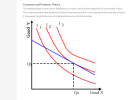 While moving from I2 to I3, the quantity of goods in the
bundle decreases.
Any point on I1 is more preferred by the consumer than
any point on I2
A slight reduction in consumer’s budget would make I2
unaffordable.
The quantities Qx and Qy would remain constant even if
the prices of the Good X and Good Y change.
Consumer and Producer Theory The following figure shows three indifference curves in red and the budget line of a consumer in...
While moving from I2 to I3, the quantity of goods in the
bundle decreases.
Any point on I1 is more preferred by the consumer than
any point on I2
A slight reduction in consumer’s budget would make I2
unaffordable.
The quantities Qx and Qy would remain constant even if
the prices of the Good X and Good Y change.
Consumer and Producer Theory The following figure shows three indifference curves in red and the budget line of a consumer in...
For each of three potential buyers of oranges, the table displays the willingness to pay for...
For each of three potential buyers of oranges, the table displays the willingness to pay for the first three oranges of the day. Assume Allison, Bob, and Charisse are the only three buyers of oranges, and only three oranges can be supplied per day. First Orange Second Orange Third Orange Allison $2.00 $1.50 $0.75 Bob $1.50 $1.00 $0.60 Charisse $0.75 $0.25 $0 Refer to Table 7-5. If the market price of an orange is $0.90, then the market quantity of...
Quantity of Y Quantity of Y Quantity of X Figure A Quantity of X Figure B...
 Quantity of Y Quantity of Y Quantity of X Figure A Quantity of X Figure B Quantity of Y Quantity of Y Quantity of X Figure C Quantity of X Figure D 17) Consider the indifference maps shown above. If X and Y are perfect substitutes, your indifference curves between them would look like those in A) Figure A. B) Figure B. C) Figure C. D) Figure D. CDs (number per year) 5 10 15 20 25 DVDs (number per...
Figure 5-6 Good X Good Y Good Z Price Price Price Demand Quantity Quantity Quantity Refer...
 Figure 5-6 Good X Good Y Good Z Price Price Price Demand Quantity Quantity Quantity Refer to Figure 5-6. Identify the two goods which are substitutes. O It is not possible to distinguish any relationship among the goods. O Good X and Good Y O Good X and Good Z O Good Y and Good Z
Figure 5-6 Good Z Good Y Good X Price Price Price Demand Quantity Quantity Quantity Refer...
 Figure 5-6 Good Z Good Y Good X Price Price Price Demand Quantity Quantity Quantity Refer to Figure 5-6. Identify the two goods which are substitutes. It is not possible to distinguish any relationship among the goods. Good X and Good Y Good Y and Good Z Good X and Good Z If the market for a product is broadly defined, then the expenditure on the good is likely to make up a large share of one's budget there are...
Question 16 1 pts A typical indifference curve is negatively sloped because: as we consume more...
 Question 16 1 pts A typical indifference curve is negatively sloped because: as we consume more of one good, we are willing to give up the consumption of another good without changing our utility higher indifference curves represent higher levels of utility higher indifference curves represent lower levels of utility we assume that a consumer's income is constant Question 17 1 pts A typical indifference curve: O is convex to the origin (bowed in) has a constant slope is concave...
4.1. Suppose you have two distinct bundles X and Y, and, for you, X is strictly...
 4.1. Suppose you have two distinct bundles X and Y, and, for you, X is strictly better than Y. Explain briefly using a graph and words why the two indifference curves associated to two bundles X and Y I(X) and I(Y) cannot cross each other. 4.2. Explain using a graph and words why if the assumption of monotonic preferences (aka "more-is- better") implies that indifference curves are not thick and they must be downward sloped. 4.3. Provide three examples of...
Question 15 1 pts According to the following graph, Good X and Good Yare Y P:...
 Question 15 1 pts According to the following graph, Good X and Good Yare Y P: P2 IC: IC IC O х substitutes O undetermined O independent substitutes when Px is high and complements when Px is low o complements
Question 4: Answer the following questions regarding preferences: 4.1. Suppose you have two distinct bundles X...
 Question 4: Answer the following questions regarding preferences: 4.1. Suppose you have two distinct bundles X and Y, and, for you, X is strictly better than Y. Explain briefly using a graph and words why the two indifference curves associated to two bundlesX and Y --I(X) and I(Y cannot cross each other. 4.2. Explain using a graph and words why if the assumption of monotonic preferences (aka "more- is-better" implies that indifference curves are not thick and they must be...
When the price of good X falls and other things remain the same: 1. The quantity...
 When the price of good X falls and other things remain the same: 1. The quantity of good X demanded increases, 2. The quantity of good Y demanded decreases, and 3. The quantity of good Z demanded increases Because a fall in the price of good X brings O A. a decrease in the quantity of good Y, good X and good Y are complements O B. a change in the quantity of both good Y and good Z, all...
 While moving from I2 to I3, the quantity of goods in the
bundle decreases.
Any point on I1 is more preferred by the consumer than
any point on I2
A slight reduction in consumer’s budget would make I2
unaffordable.
The quantities Qx and Qy would remain constant even if
the prices of the Good X and Good Y change.
Consumer and Producer Theory The following figure shows three indifference curves in red and the budget line of a consumer in...
While moving from I2 to I3, the quantity of goods in the
bundle decreases.
Any point on I1 is more preferred by the consumer than
any point on I2
A slight reduction in consumer’s budget would make I2
unaffordable.
The quantities Qx and Qy would remain constant even if
the prices of the Good X and Good Y change.
Consumer and Producer Theory The following figure shows three indifference curves in red and the budget line of a consumer in...
 Quantity of Y Quantity of Y Quantity of X Figure A Quantity of X Figure B Quantity of Y Quantity of Y Quantity of X Figure C Quantity of X Figure D 17) Consider the indifference maps shown above. If X and Y are perfect substitutes, your indifference curves between them would look like those in A) Figure A. B) Figure B. C) Figure C. D) Figure D. CDs (number per year) 5 10 15 20 25 DVDs (number per...
 Figure 5-6 Good X Good Y Good Z Price Price Price Demand Quantity Quantity Quantity Refer to Figure 5-6. Identify the two goods which are substitutes. O It is not possible to distinguish any relationship among the goods. O Good X and Good Y O Good X and Good Z O Good Y and Good Z
 Figure 5-6 Good Z Good Y Good X Price Price Price Demand Quantity Quantity Quantity Refer to Figure 5-6. Identify the two goods which are substitutes. It is not possible to distinguish any relationship among the goods. Good X and Good Y Good Y and Good Z Good X and Good Z If the market for a product is broadly defined, then the expenditure on the good is likely to make up a large share of one's budget there are...
 Question 16 1 pts A typical indifference curve is negatively sloped because: as we consume more of one good, we are willing to give up the consumption of another good without changing our utility higher indifference curves represent higher levels of utility higher indifference curves represent lower levels of utility we assume that a consumer's income is constant Question 17 1 pts A typical indifference curve: O is convex to the origin (bowed in) has a constant slope is concave...
 4.1. Suppose you have two distinct bundles X and Y, and, for you, X is strictly better than Y. Explain briefly using a graph and words why the two indifference curves associated to two bundles X and Y I(X) and I(Y) cannot cross each other. 4.2. Explain using a graph and words why if the assumption of monotonic preferences (aka "more-is- better") implies that indifference curves are not thick and they must be downward sloped. 4.3. Provide three examples of...
 Question 15 1 pts According to the following graph, Good X and Good Yare Y P: P2 IC: IC IC O х substitutes O undetermined O independent substitutes when Px is high and complements when Px is low o complements
 Question 4: Answer the following questions regarding preferences: 4.1. Suppose you have two distinct bundles X and Y, and, for you, X is strictly better than Y. Explain briefly using a graph and words why the two indifference curves associated to two bundlesX and Y --I(X) and I(Y cannot cross each other. 4.2. Explain using a graph and words why if the assumption of monotonic preferences (aka "more- is-better" implies that indifference curves are not thick and they must be...
 When the price of good X falls and other things remain the same: 1. The quantity of good X demanded increases, 2. The quantity of good Y demanded decreases, and 3. The quantity of good Z demanded increases Because a fall in the price of good X brings O A. a decrease in the quantity of good Y, good X and good Y are complements O B. a change in the quantity of both good Y and good Z, all...
Most questions answered within 3 hours.
-
Where is the error in this code sequence?
String s1 = "Hello";
String s2 = "ello";...
asked 10 months ago -
Financial data for Joel de Paris, Inc., for last year
follow:
Joel de Paris, Inc.
Balance...
asked 10 months ago -
Consider this reaction:
Al2(SO4)3 (aq)+ BaCl3
(aq) Al2Cl6 (aq)- +
3BaSO4(s) . What is the...
asked 10 months ago -
Suppose that Savneet is considering increasing her
recent random sample from 20 car rentals to 40...
asked 10 months ago -
Trucks arrive at an unloading terminal at an average rate of 120
per hour.
Trucks arrive...
asked 10 months ago -
Why are methanol and ethanol completely soluble in water while
octanol is not very little soluble....
asked 10 months ago -
A facilities manager at a university reads in a research report
that the mean amount of...
asked 10 months ago -
When the CuSO4 is rehydrated by adding water to the anhydrous
compound, is this an endothermic...
asked 10 months ago -
A ray of sunlight is passing from diamond into crown glass; the
angle of incidence is...
asked 10 months ago -
A block of mass 0.249 kg is placed on top of a light, vertical
spring of...
asked 10 months ago -
how do the kidneys compensate in the presences of acidosis
a) trigger hyperventilate
b) reserve acid...
asked 10 months ago -
Question 501 pts
The rental rate of capital to the firm increases. Which of the
following...
asked 10 months ago