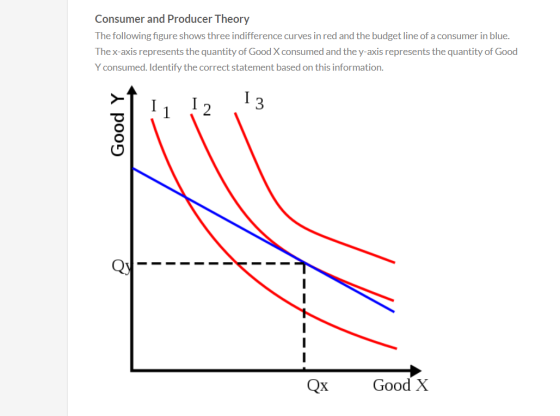
While moving from I2 to I3, the quantity of goods in the bundle decreases.
Any point on I1 is more preferred by the consumer than any point on I2
A slight reduction in consumer’s budget would make I2 unaffordable.
The quantities Qx and Qy would remain constant even if the prices of the Good X and Good Y change.
Homework Answers
In the given indifference curves, I1, I2 and I3, only the following statement is correct:
A slight reduction in consumer’s budget would make I2 unaffordable.
--
This is because as the budget line will shift to the left, even by a small margin, it will no longer be tangential to the indifference curve. This makes it unaffordable and unattainable.
--
Other options:
While moving from I2 to I3, the quantity in the bundles increases.
Any point on a higher indifference curve is always more preferred.
If the relative prices change, the quantities will also change.
Add Answer to:
While moving from I2 to I3, the quantity of goods in the
bundle decreases.
Any point...
8.If bundle A is weakly preferred to bundle B, bundle B is strictly preferred to bundle...
8.If bundle A is weakly preferred to bundle B, bundle B is strictly preferred to bundle C, and bundle C is weakly preferred to bundle A, what can we conclude? a. The consumer is indifferent between bundles A and B b. The consumer violates monotonicity c. The consumer violates transitivity. d.The consumer prefers C to B e. None of the above 11. Consider a consumer who can buy good 1 or 2. The price of good 1 is $5 and...
Figure 21-15 On the graph, Qx represents the quantity of good x and Qy represents the...
Figure 21-15 On the graph, Qx represents the quantity of good x and Qy represents the quantity of good y. The lines drawn on the graph represent three of Barbara’s indifference curves. Refer to Figure 21-15. For Barbara, goods x and y are a. imperfect complements. b. imperfect substitutes. c. perfect substitutes. d. perfect complements.
Question 2 A consumer purchases two goods, food (x) and clothing (y). He has the utility function...
Question 2 A consumer purchases two goods, food (x) and clothing (y). He has the utility function U(X,Y) = XY, where X and Y denote amounts of X and Y consumed. Marginal utilities of X and Y are MUx = y and MUy = x. The consumer’s income is $72 per week and that the price of y is Py = $1 per unit and price of x is Px1 = $9 per unit. What are his initial quantities of X and...
Imagine a representative consumer, whose utility for apples (X) and all other goods (Y) can be...
Imagine a representative consumer, whose utility for apples (X) and all other goods (Y) can be represented in a Cobb-Douglas form. 1. Please graphically represent consumer indifference curves, given prices Px and Py and the budget constraint M. 2. What will happen to consumer utility and optimal bundle if consumer income (budget) increases and apples are a necessity good? Please show graphically and explain the intuition. 3. What will happen to consumer utility and optimal bundle if apple price decreases...
Suppose that there two goods, X and Y , available in arbitrary nonnegative quantities (so the the...
Suppose that there two goods, X and Y , available in arbitrary nonnegative quantities (so the the consumption set is R 2 +). The consumer has preferences over consumption bundles that are monotone, strictly convex, and represented by the following (differentiable) utility function: u(x, y) = α √ x + (1 − α) √ y, where x is the quantity of good X, y is the quantity of good Y , and α ≥ 0 is a utility parameter. The...
Imagine a representative consumer, whose utility for apples (X) and all other goods (Y) can be...
Imagine a representative consumer, whose utility for apples (X) and all other goods (Y) can be represented in a Cobb-Douglas form. 1) Please graphically represent consumer indifference curves, given prices Px and Py and the budget constraint M. 2) What will happen to consumer utility and optimal bundle if consumer income (budget) increases and apples are a necessity good? Please show graphically and explain the intuition. 3) How would the Engel curve look like for point #2?
Suppose that there two goods X and Y, available in arbitrary non- negative quantities (so the...
 Suppose that there two goods X and Y, available in arbitrary non- negative quantities (so the the consumption set is R2). The consumer has preferences over consumption bundles that are strongly monotone, strictly convex, and represented by the following (differentiable) utility function: u(x, y)-y+2aVT, where z is the quantity of good X, and y is the quantity of good Y, and a 20 is a utility parameter The consumer has strictly positive wealth w > 0. The price of good...
If pA = $10, PB = $5,Y = $75, where p is the price of a...
 If pA = $10, PB = $5,Y = $75, where p is the price of a good, A and B are goods, and Y is income. Given that the utility function is U = 25A2B, determine the optimal bundle of x and yfor this consumer. Be sure to show your work and box your answers. a) Solve for the marginal utility of A and the marginal utility of B b) Solve for the relationship (trade-off) between A and B c)...
Consider a consumer in a two commodity world whose indifference map is such that the slope...
Consider a consumer in a two commodity world whose indifference map is such that the slope of the indifference curves is everywhere equal to -(Y?X), where Y is the quantity of good Y measured along the vertical axis, and X is the quantity of good X measured along the horizontal axis. a. what is the value of the optimum Marginal Rate of Substitution for this consumer, given that the price of X is $1, the price of Y is $3...
Question 16 1 pts A typical indifference curve is negatively sloped because: as we consume more...
 Question 16 1 pts A typical indifference curve is negatively sloped because: as we consume more of one good, we are willing to give up the consumption of another good without changing our utility higher indifference curves represent higher levels of utility higher indifference curves represent lower levels of utility we assume that a consumer's income is constant Question 17 1 pts A typical indifference curve: O is convex to the origin (bowed in) has a constant slope is concave...
 Suppose that there two goods X and Y, available in arbitrary non- negative quantities (so the the consumption set is R2). The consumer has preferences over consumption bundles that are strongly monotone, strictly convex, and represented by the following (differentiable) utility function: u(x, y)-y+2aVT, where z is the quantity of good X, and y is the quantity of good Y, and a 20 is a utility parameter The consumer has strictly positive wealth w > 0. The price of good...
 If pA = $10, PB = $5,Y = $75, where p is the price of a good, A and B are goods, and Y is income. Given that the utility function is U = 25A2B, determine the optimal bundle of x and yfor this consumer. Be sure to show your work and box your answers. a) Solve for the marginal utility of A and the marginal utility of B b) Solve for the relationship (trade-off) between A and B c)...
 Question 16 1 pts A typical indifference curve is negatively sloped because: as we consume more of one good, we are willing to give up the consumption of another good without changing our utility higher indifference curves represent higher levels of utility higher indifference curves represent lower levels of utility we assume that a consumer's income is constant Question 17 1 pts A typical indifference curve: O is convex to the origin (bowed in) has a constant slope is concave...
Most questions answered within 3 hours.
-
Where is the error in this code sequence?
String s1 = "Hello";
String s2 = "ello";...
asked 10 months ago -
Financial data for Joel de Paris, Inc., for last year
follow:
Joel de Paris, Inc.
Balance...
asked 10 months ago -
Consider this reaction:
Al2(SO4)3 (aq)+ BaCl3
(aq) Al2Cl6 (aq)- +
3BaSO4(s) . What is the...
asked 10 months ago -
Suppose that Savneet is considering increasing her
recent random sample from 20 car rentals to 40...
asked 10 months ago -
Trucks arrive at an unloading terminal at an average rate of 120
per hour.
Trucks arrive...
asked 10 months ago -
Why are methanol and ethanol completely soluble in water while
octanol is not very little soluble....
asked 10 months ago -
A facilities manager at a university reads in a research report
that the mean amount of...
asked 10 months ago -
When the CuSO4 is rehydrated by adding water to the anhydrous
compound, is this an endothermic...
asked 10 months ago -
A ray of sunlight is passing from diamond into crown glass; the
angle of incidence is...
asked 10 months ago -
A block of mass 0.249 kg is placed on top of a light, vertical
spring of...
asked 10 months ago -
how do the kidneys compensate in the presences of acidosis
a) trigger hyperventilate
b) reserve acid...
asked 10 months ago -
Question 501 pts
The rental rate of capital to the firm increases. Which of the
following...
asked 10 months ago