8.If bundle A is weakly preferred to bundle B, bundle B is strictly preferred to bundle...
8.If bundle A is weakly preferred to bundle B, bundle B is strictly preferred to bundle C, and bundle C is weakly preferred to bundle A, what can we conclude?
a. The consumer is indifferent between bundles A and B
b. The consumer violates monotonicity
c. The consumer violates transitivity.
d.The consumer prefers C to B
e. None of the above
11. Consider a consumer who can buy good 1 or 2. The price of good 1 is $5 and the price for good 2 is $4. The consumer has income of 60. She buys 12 units of good 2. The consumer wants to also purchase 2 units of good 1. Which statement is true?
a. This is feasible, as the consumer is inside her budget set
b. This is outside the consumer’s budget set – it is unaffordable
c. This is affordable – the consumer would be consuming on her budget constraint
d. all of the above
e. none of the above
18. If a consumer has a utility function of U = x + 2y, which statement is true?
a. The MRSy→x = -1/2; x and y are perfect substitutes
b. The MRSy→x = -2; x and y are perfect substitutes
c. The MRSy→x = -1/2; x and y are perfect complements
d. The MRSy→x = -1; x and y are perfect substitutes
e. None of the above
Homework Answers

Add Answer to:
8.If bundle A is weakly preferred to bundle B, bundle B is
strictly preferred to bundle...
1. In a two-good world, let - bundle x 3 loaves of bread and 0 apples;...
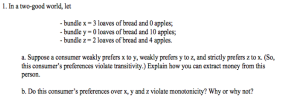 1. In a two-good world, let - bundle x 3 loaves of bread and 0 apples; - bundle y 0 loaves of bread and 10 apples; - bundle z 2 loaves of bread and 4 apples. Suppose a consumer weakly prefers x to y, weakly prefers y to z, and strictly prefers z to x. (So, this consumer's preferences violate transitivity.) Explain how you can extract money from this person a. b. Do this consumer's preferences over x, y and...
While moving from I2 to I3, the quantity of goods in the bundle decreases. Any point...
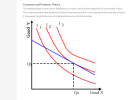 While moving from I2 to I3, the quantity of goods in the
bundle decreases.
Any point on I1 is more preferred by the consumer than
any point on I2
A slight reduction in consumer’s budget would make I2
unaffordable.
The quantities Qx and Qy would remain constant even if
the prices of the Good X and Good Y change.
Consumer and Producer Theory The following figure shows three indifference curves in red and the budget line of a consumer in...
While moving from I2 to I3, the quantity of goods in the
bundle decreases.
Any point on I1 is more preferred by the consumer than
any point on I2
A slight reduction in consumer’s budget would make I2
unaffordable.
The quantities Qx and Qy would remain constant even if
the prices of the Good X and Good Y change.
Consumer and Producer Theory The following figure shows three indifference curves in red and the budget line of a consumer in...
If x > y and y < z, then Group of answer choices x > z...
If x > y and y < z, then Group of answer choices x > z x < z x ~ z z < x it is not possible to say if anything about the consumer’s preference for x relative to z If x > y and y > z then Group of answer choices 1.x > z 2.x < z 3.x ~ z 4.z < x or z > x 5.it is not possible to say if anything about...
Draw the consumer’s budget constraint and indicate the consumer’s optimal bundle on the budget constraint. Make...
 Draw the consumer’s budget constraint and indicate the
consumer’s optimal bundle on the budget constraint. Make sure your
graph is accurate and clearly labeled.
c) U(X,Y) 2X +3Y. The consumer has $20 to spend and the prices of the goods are Px $2 and Py $4.
Draw the consumer’s budget constraint and indicate the
consumer’s optimal bundle on the budget constraint. Make sure your
graph is accurate and clearly labeled.
c) U(X,Y) 2X +3Y. The consumer has $20 to spend and the prices of the goods are Px $2 and Py $4.
The weekly utility function of a consumer is: U = 2AB where A and B are...
The weekly utility function of a consumer is: U = 2AB where A and B are two goods in the consumer’s consumption bundle. Based on this utility function the marginal utility of good A is: MUA = 2B and the marginal utility of good B is: MUB = 2A, where A and B represent the quantities of good A and good B, respectively. The price of good A is $5 whereas the price good B is $10. a. Write the...
1. (24 total points) Suppose a consumer’s utility function is given by U(X,Y) = X1/2*Y1/2. Also,...
1. (24 total points) Suppose a consumer’s utility function is given by U(X,Y) = X1/2*Y1/2. Also, the consumer has $72 to spend, and the price of Good X, PX = $4. Let Good Y be a composite good whose price is PY = $1. So on the Y-axis, we are graphing the amount of money that the consumer has available to spend on all other goods for any given value of X. a) (2 points) How much X and Y...
Suppose that a consumer’s utility function is U=xy with MUx=y and MUy=x. Suppose the consumer‘s income...
Suppose that a consumer’s utility function is U=xy with MUx=y and MUy=x. Suppose the consumer‘s income is $480. For this question you may need to use the following approximations: sqrt(2) is approximately 1.4, sqrt(3) is approx. 1.7 and sqrt(5) is approx 2.2. a) Initially, the price of y is $4 and the price of x is $6. What is the consumer’s optimal bundle? b) What is the consumer's initial utility? Now suppose that price of x increases to $8 and...
Question 2. Consider the following 8 bundles of goods x and y: A = (8,4) B...
Question 2. Consider the following 8 bundles of goods x and y: A = (8,4) B = (5,6) C = (5,9) D = (10,3) E =(1,4) F =(6,5) G=(2,8) H =(7,8) (a) Come up with an example of a utility function that will produce the following order of preference for the bundles, where H is most preferred, A and G are equally preferred, and E is least preferred. H , C , B , F , A = G ,...
5. A consumer's preferences are given by the utility function U-2 2 The price of good 1 is 3 and the price of 2 is...
 5. A consumer's preferences are given by the utility function U-2 2 The price of good 1 is 3 and the price of 2 is 6, while her income is 36. The utility maximising bundle for the consumer is a. xi = 4, = 4 b. x1 = 4,=3 c. ri = 2 = 6 d. x = 8,5 = 2 e. None of the above 6. A consumer's preferences are given by the utility function U = . The...
1. True or False, and explain briefly. 1) The assumption that more is better implies that...
 1. True or False, and explain briefly. 1) The assumption that more is better implies that the indifference curves are upward sloping 2) Convexity of indifference curves implies that consumers are willing to give up more to get an extra the more they have 3) Consider the following three bundles. Bundle Good Goody If Bundles A and B are on the same indifference curve, preferences satisfy all the usual assumptions introduced in the lecture, Bundle Cis preferred to Bundle A...
 1. In a two-good world, let - bundle x 3 loaves of bread and 0 apples; - bundle y 0 loaves of bread and 10 apples; - bundle z 2 loaves of bread and 4 apples. Suppose a consumer weakly prefers x to y, weakly prefers y to z, and strictly prefers z to x. (So, this consumer's preferences violate transitivity.) Explain how you can extract money from this person a. b. Do this consumer's preferences over x, y and...
 While moving from I2 to I3, the quantity of goods in the
bundle decreases.
Any point on I1 is more preferred by the consumer than
any point on I2
A slight reduction in consumer’s budget would make I2
unaffordable.
The quantities Qx and Qy would remain constant even if
the prices of the Good X and Good Y change.
Consumer and Producer Theory The following figure shows three indifference curves in red and the budget line of a consumer in...
While moving from I2 to I3, the quantity of goods in the
bundle decreases.
Any point on I1 is more preferred by the consumer than
any point on I2
A slight reduction in consumer’s budget would make I2
unaffordable.
The quantities Qx and Qy would remain constant even if
the prices of the Good X and Good Y change.
Consumer and Producer Theory The following figure shows three indifference curves in red and the budget line of a consumer in...
 Draw the consumer’s budget constraint and indicate the
consumer’s optimal bundle on the budget constraint. Make sure your
graph is accurate and clearly labeled.
c) U(X,Y) 2X +3Y. The consumer has $20 to spend and the prices of the goods are Px $2 and Py $4.
Draw the consumer’s budget constraint and indicate the
consumer’s optimal bundle on the budget constraint. Make sure your
graph is accurate and clearly labeled.
c) U(X,Y) 2X +3Y. The consumer has $20 to spend and the prices of the goods are Px $2 and Py $4.
 5. A consumer's preferences are given by the utility function U-2 2 The price of good 1 is 3 and the price of 2 is 6, while her income is 36. The utility maximising bundle for the consumer is a. xi = 4, = 4 b. x1 = 4,=3 c. ri = 2 = 6 d. x = 8,5 = 2 e. None of the above 6. A consumer's preferences are given by the utility function U = . The...
 1. True or False, and explain briefly. 1) The assumption that more is better implies that the indifference curves are upward sloping 2) Convexity of indifference curves implies that consumers are willing to give up more to get an extra the more they have 3) Consider the following three bundles. Bundle Good Goody If Bundles A and B are on the same indifference curve, preferences satisfy all the usual assumptions introduced in the lecture, Bundle Cis preferred to Bundle A...
Most questions answered within 3 hours.
-
Where is the error in this code sequence?
String s1 = "Hello";
String s2 = "ello";...
asked 10 months ago -
Financial data for Joel de Paris, Inc., for last year
follow:
Joel de Paris, Inc.
Balance...
asked 10 months ago -
Consider this reaction:
Al2(SO4)3 (aq)+ BaCl3
(aq) Al2Cl6 (aq)- +
3BaSO4(s) . What is the...
asked 10 months ago -
Suppose that Savneet is considering increasing her
recent random sample from 20 car rentals to 40...
asked 10 months ago -
Trucks arrive at an unloading terminal at an average rate of 120
per hour.
Trucks arrive...
asked 10 months ago -
Why are methanol and ethanol completely soluble in water while
octanol is not very little soluble....
asked 10 months ago -
A facilities manager at a university reads in a research report
that the mean amount of...
asked 10 months ago -
When the CuSO4 is rehydrated by adding water to the anhydrous
compound, is this an endothermic...
asked 10 months ago -
A ray of sunlight is passing from diamond into crown glass; the
angle of incidence is...
asked 10 months ago -
A block of mass 0.249 kg is placed on top of a light, vertical
spring of...
asked 10 months ago -
how do the kidneys compensate in the presences of acidosis
a) trigger hyperventilate
b) reserve acid...
asked 10 months ago -
Question 501 pts
The rental rate of capital to the firm increases. Which of the
following...
asked 10 months ago