
Homework Answers
 CCODE IMAGE
 OUTPUT IMAGE

CODE TEXT

![## Solver ip using Radau method Vada u – Sol - Solver ivplf, [0,1], [2], method = Radau). ## plotting . both equations us](http://img.homeworklib.com/questions/d86749c0-926d-11ea-bd65-75073674c6ca.png?x-oss-process=image/resize,w_560)
Add Answer to:
IN PYTHON:
6. Stiff Problem Consider the initial value problem y = -500(y - cost) -...
3. Consider the initial value problem dt Solve the initial value problem for є = 0, to obtain y(t) 3e-21 Using the method of perturbations, setting y-Yo + єу, find the first-order correction, y (t),...
 3. Consider the initial value problem dt Solve the initial value problem for є = 0, to obtain y(t) 3e-21 Using the method of perturbations, setting y-Yo + єу, find the first-order correction, y (t), for the initial value problem with є * 0 and є is a small parameter.
3. Consider the initial value problem dt Solve the initial value problem for є = 0, to obtain y(t) 3e-21 Using the method of perturbations, setting y-Yo + єу, find...
3. Consider the initial value problem dt Solve the initial value problem for є = 0, to obtain y(t) 3e-21 Using the method of perturbations, setting y-Yo + єу, find the first-order correction, y (t), for the initial value problem with є * 0 and є is a small parameter.
3. Consider the initial value problem dt Solve the initial value problem for є = 0, to obtain y(t) 3e-21 Using the method of perturbations, setting y-Yo + єу, find...
Solve the following initial value problem using ode45 and ode15s: y",(t) _ Зу"(t) + ty(t) _ sin2(...
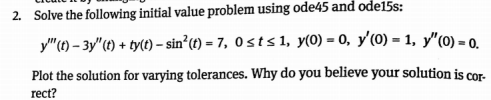 Solve the following initial value problem using ode45 and ode15s: y",(t) _ Зу"(t) + ty(t) _ sin2(t)-7, o s t Plot the solution for varying tolerances. Why do you believe your solution is cor- 2. 1, y(0)-0, y,(0) 1, y"(0)-0. rect?
Solve the following initial value problem using ode45 and ode15s: y",(t) _ Зу"(t) + ty(t) _ sin2(t)-7, o s t Plot the solution for varying tolerances. Why do you believe your solution is cor- 2. 1, y(0)-0, y,(0) 1,...
Solve the following initial value problem using ode45 and ode15s: y",(t) _ Зу"(t) + ty(t) _ sin2(t)-7, o s t Plot the solution for varying tolerances. Why do you believe your solution is cor- 2. 1, y(0)-0, y,(0) 1, y"(0)-0. rect?
Solve the following initial value problem using ode45 and ode15s: y",(t) _ Зу"(t) + ty(t) _ sin2(t)-7, o s t Plot the solution for varying tolerances. Why do you believe your solution is cor- 2. 1, y(0)-0, y,(0) 1,...
[7] 1. Consider the initial value problem (IVP) y′(t) = −y(t), y(0) = 1 The solution to this IVP ...
[7] 1. Consider the initial value problem (IVP) y′(t) = −y(t), y(0) = 1 The solution to this IVP is y(t) = e−t [1] i) Implement Euler’s method and generate an approximate solution of this IVP over the interval [0,2], using stepsize h = 0.1. (The Google sheet posted on LEARN is set up to carry out precisely this task.) Report the resulting approximation of the value y(2). [1] ii) Repeat part (ii), but use stepsize h = 0.05. Describe...
3. Consider the initial value problem y(t) = y, y(0) = 1. a. Write down (i.e.,...
 3. Consider the initial value problem y(t) = y, y(0) = 1. a. Write down (i.e., write the formula which describes one step, Yn+1 = yn + ...) the second order Taylor method with step size h for this initial value problem. b. Write down the time stepping formula Yn+1 = Yn +... for the modified Euler method 9n+1 := yn + hf(en +3.29 + s(tn, yn)), for this initial value problem. c. What is the difference between the two...
Problem 2. (a) Solve the initial value problem I y' + 2y = g(t), 1 y(0)...
 Problem 2. (a) Solve the initial value problem I y' + 2y = g(t), 1 y(0) = 0, where where | 1 if t < 1, g(t) = { 10 if t > 1 (t) = { for all t. Is this solution unique for all time? Is it unique for any time? Does this contradict the existence and uniqueness theorem? Explain. (b) If the initial condition y(0) = 0 were replaced with y(1) = 0, would there necessarily be...
3. Consider the initial value problem y'(t) = y2, y(0) = 1. a. Write down (i.e.,...
 3. Consider the initial value problem y'(t) = y2, y(0) = 1. a. Write down (i.e., write the formula which describes one step, Yn+1 = yn + ...) the second order Taylor method with step size h for this initial value problem. b. Write down the time stepping formula Yn+1 = Yn +... for the modified Euler method h Yn+1 := yn + hf(tn + h 2:9 » Yn + 5 f (tnYn)), for this initial value problem. c. What...
Assume that y' = y.t needs to solved i.e.one needs to find y(t) for the initial...
 Assume that y' = y.t needs to solved i.e.one needs to find y(t) for the initial condition yo = 0.3. In your Math classes, you were taught how to solve this differential equation. However, most differential equations are not easily solvable, and one needs to resort to numerical integration. This can easily be done in MATLAB for explicit first order differential equations like the one stated above. The time of interest is between tstart <t <tend let's say between O...
Consider the initial value problem for function y given by, Consider the initial value problem for...
 Consider the initial value problem for function y given by,
 (a) Find the Laplace Transform of the source function, F(s) = L[-3 F(s) = (b) Find the Laplace Transform of the solution, Y(s) Lt) Y(s) - (c) Find the solution y(t) of the initial value problem above. s(t) Recall: If needed, the step function at c is denoted as u(t - c) -1] Help Entering Answers Preview My Anawers Submit...
Consider the initial value problem for function y given by,
Consider the initial value problem for function y given by, (a) Find the Laplace Transform of the source function, F(s) = L[-3 F(s) = (b) Find the Laplace Transform of the solution, Y(s) Lt) Y(s) - (c) Find the solution y(t) of the initial value problem above. s(t) Recall: If needed, the step function at c is denoted as u(t - c) -1] Help Entering Answers Preview My Anawers Submit...
[15] 9. By using the Laplace transform method solve the initial value problem Y" + 2y...
 [15] 9. By using the Laplace transform method solve the initial value problem Y" + 2y + y = sint, y(0) = 0, y(0) = 0.
14. Consider the initial value problem where y is the damping coeficient (or resistance). (a) Let...
 14. Consider the initial value problem where y is the damping coeficient (or resistance). (a) Let γ =-. Find the solution of the initial value problem and plot its graph. (b) Find the time t, at which the solution attains its maxi mum value. Also find the maximum value y, of the solution. (c) Let γ = 4 and repeat parts (a) and (b). (d) Determine how ti andy, vary as γ decreases. What are the values of, and y,...
 3. Consider the initial value problem dt Solve the initial value problem for є = 0, to obtain y(t) 3e-21 Using the method of perturbations, setting y-Yo + єу, find the first-order correction, y (t), for the initial value problem with є * 0 and є is a small parameter.
3. Consider the initial value problem dt Solve the initial value problem for є = 0, to obtain y(t) 3e-21 Using the method of perturbations, setting y-Yo + єу, find...
3. Consider the initial value problem dt Solve the initial value problem for є = 0, to obtain y(t) 3e-21 Using the method of perturbations, setting y-Yo + єу, find the first-order correction, y (t), for the initial value problem with є * 0 and є is a small parameter.
3. Consider the initial value problem dt Solve the initial value problem for є = 0, to obtain y(t) 3e-21 Using the method of perturbations, setting y-Yo + єу, find...
 Solve the following initial value problem using ode45 and ode15s: y",(t) _ Зу"(t) + ty(t) _ sin2(t)-7, o s t Plot the solution for varying tolerances. Why do you believe your solution is cor- 2. 1, y(0)-0, y,(0) 1, y"(0)-0. rect?
Solve the following initial value problem using ode45 and ode15s: y",(t) _ Зу"(t) + ty(t) _ sin2(t)-7, o s t Plot the solution for varying tolerances. Why do you believe your solution is cor- 2. 1, y(0)-0, y,(0) 1,...
Solve the following initial value problem using ode45 and ode15s: y",(t) _ Зу"(t) + ty(t) _ sin2(t)-7, o s t Plot the solution for varying tolerances. Why do you believe your solution is cor- 2. 1, y(0)-0, y,(0) 1, y"(0)-0. rect?
Solve the following initial value problem using ode45 and ode15s: y",(t) _ Зу"(t) + ty(t) _ sin2(t)-7, o s t Plot the solution for varying tolerances. Why do you believe your solution is cor- 2. 1, y(0)-0, y,(0) 1,...
 3. Consider the initial value problem y(t) = y, y(0) = 1. a. Write down (i.e., write the formula which describes one step, Yn+1 = yn + ...) the second order Taylor method with step size h for this initial value problem. b. Write down the time stepping formula Yn+1 = Yn +... for the modified Euler method 9n+1 := yn + hf(en +3.29 + s(tn, yn)), for this initial value problem. c. What is the difference between the two...
 Problem 2. (a) Solve the initial value problem I y' + 2y = g(t), 1 y(0) = 0, where where | 1 if t < 1, g(t) = { 10 if t > 1 (t) = { for all t. Is this solution unique for all time? Is it unique for any time? Does this contradict the existence and uniqueness theorem? Explain. (b) If the initial condition y(0) = 0 were replaced with y(1) = 0, would there necessarily be...
 3. Consider the initial value problem y'(t) = y2, y(0) = 1. a. Write down (i.e., write the formula which describes one step, Yn+1 = yn + ...) the second order Taylor method with step size h for this initial value problem. b. Write down the time stepping formula Yn+1 = Yn +... for the modified Euler method h Yn+1 := yn + hf(tn + h 2:9 » Yn + 5 f (tnYn)), for this initial value problem. c. What...
 Assume that y' = y.t needs to solved i.e.one needs to find y(t) for the initial condition yo = 0.3. In your Math classes, you were taught how to solve this differential equation. However, most differential equations are not easily solvable, and one needs to resort to numerical integration. This can easily be done in MATLAB for explicit first order differential equations like the one stated above. The time of interest is between tstart <t <tend let's say between O...
 Consider the initial value problem for function y given by,
 (a) Find the Laplace Transform of the source function, F(s) = L[-3 F(s) = (b) Find the Laplace Transform of the solution, Y(s) Lt) Y(s) - (c) Find the solution y(t) of the initial value problem above. s(t) Recall: If needed, the step function at c is denoted as u(t - c) -1] Help Entering Answers Preview My Anawers Submit...
Consider the initial value problem for function y given by,
Consider the initial value problem for function y given by, (a) Find the Laplace Transform of the source function, F(s) = L[-3 F(s) = (b) Find the Laplace Transform of the solution, Y(s) Lt) Y(s) - (c) Find the solution y(t) of the initial value problem above. s(t) Recall: If needed, the step function at c is denoted as u(t - c) -1] Help Entering Answers Preview My Anawers Submit...
 [15] 9. By using the Laplace transform method solve the initial value problem Y" + 2y + y = sint, y(0) = 0, y(0) = 0.
 14. Consider the initial value problem where y is the damping coeficient (or resistance). (a) Let γ =-. Find the solution of the initial value problem and plot its graph. (b) Find the time t, at which the solution attains its maxi mum value. Also find the maximum value y, of the solution. (c) Let γ = 4 and repeat parts (a) and (b). (d) Determine how ti andy, vary as γ decreases. What are the values of, and y,...
Most questions answered within 3 hours.
-
Where is the error in this code sequence?
String s1 = "Hello";
String s2 = "ello";...
asked 11 months ago -
Financial data for Joel de Paris, Inc., for last year
follow:
Joel de Paris, Inc.
Balance...
asked 11 months ago -
Consider this reaction:
Al2(SO4)3 (aq)+ BaCl3
(aq) Al2Cl6 (aq)- +
3BaSO4(s) . What is the...
asked 11 months ago -
Suppose that Savneet is considering increasing her
recent random sample from 20 car rentals to 40...
asked 11 months ago -
Trucks arrive at an unloading terminal at an average rate of 120
per hour.
Trucks arrive...
asked 11 months ago -
Why are methanol and ethanol completely soluble in water while
octanol is not very little soluble....
asked 11 months ago -
A facilities manager at a university reads in a research report
that the mean amount of...
asked 11 months ago -
When the CuSO4 is rehydrated by adding water to the anhydrous
compound, is this an endothermic...
asked 11 months ago -
A ray of sunlight is passing from diamond into crown glass; the
angle of incidence is...
asked 11 months ago -
A block of mass 0.249 kg is placed on top of a light, vertical
spring of...
asked 11 months ago -
how do the kidneys compensate in the presences of acidosis
a) trigger hyperventilate
b) reserve acid...
asked 11 months ago -
Question 501 pts
The rental rate of capital to the firm increases. Which of the
following...
asked 11 months ago