

Homework Answers


Add Answer to:
3-6. Plot the waveform of y(t) = 4 rect((t + 1)/4) * 2 rect((t - 4)/2)....
Plot the resulting convolution y(t) = -3 rect(t/2) ∗ 5 rect(t + 4) and find y(-4)
Plot the resulting convolution y(t) = -3 rect(t/2) ∗ 5 rect(t + 4) and find y(-4)
Problem 1: Let y()- r(t+2)-r(t+1)+r(t)-r(t-1)-u(t-1)-r(t-2)+r(t-3), where r(t) is the ramp function. a) plot y(t) b) plot...
 Problem 1: Let y()- r(t+2)-r(t+1)+r(t)-r(t-1)-u(t-1)-r(t-2)+r(t-3), where r(t) is the ramp function. a) plot y(t) b) plot y'() c) Plot y(2t-3) d) calculate the energy of y(t) note: r(t) = t for t 0 and 0 for t < 0 Problem 2: Let x(t)s u(t)-u(t-2) and y(t) = t[u(t)-u(t-1)] a) b) plot x(t) and y(t) evaluate graphically and plot z(t) = x(t) * y(t) Problem 3: An LTI system has the impulse response h(t) = 5e-tu(t)-16e-2tu(t) + 13e-3t u(t) The input...
Section 2.1 I. Suppose 2(t) if 4<t 5 otherwise Determine the absolute time duration of this signal and plot it. 2. Suppose rn]-1 if n 23 otherwise Classify this signal as left-sided, right-sided,...
 Section 2.1 I. Suppose 2(t) if 4<t 5 otherwise Determine the absolute time duration of this signal and plot it. 2. Suppose rn]-1 if n 23 otherwise Classify this signal as left-sided, right-sided, two-sided, or time-limited and plot it. Section 2.2 3. Suppose r(t) is as given in Problem 1. Plot and give an expression for y(t) - (^ + ^t). Also determine the turn-on and turn-off times for y(t) 4. Suppose a[n] is as given in Problem 2. Plot...
- y(t)=r (+)-r(t-1)-rt 3)- u(4-3) +u4-4) where r() is the ramp function. a plot y(t) b)...
 - y(t)=r (+)-r(t-1)-rt 3)- u(4-3) +u4-4) where r() is the ramp function. a plot y(t) b) plot z(t) c) plot y' (t) d calculate the energy of y(t) r(t)=t for t o O for tco
Solve the following initial value problem using ode45 and ode15s: y",(t) _ Зу"(t) + ty(t) _ sin2(...
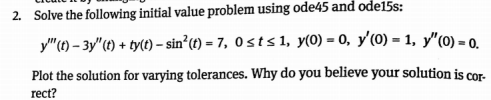 Solve the following initial value problem using ode45 and ode15s: y",(t) _ Зу"(t) + ty(t) _ sin2(t)-7, o s t Plot the solution for varying tolerances. Why do you believe your solution is cor- 2. 1, y(0)-0, y,(0) 1, y"(0)-0. rect?
Solve the following initial value problem using ode45 and ode15s: y",(t) _ Зу"(t) + ty(t) _ sin2(t)-7, o s t Plot the solution for varying tolerances. Why do you believe your solution is cor- 2. 1, y(0)-0, y,(0) 1,...
Solve the following initial value problem using ode45 and ode15s: y",(t) _ Зу"(t) + ty(t) _ sin2(t)-7, o s t Plot the solution for varying tolerances. Why do you believe your solution is cor- 2. 1, y(0)-0, y,(0) 1, y"(0)-0. rect?
Solve the following initial value problem using ode45 and ode15s: y",(t) _ Зу"(t) + ty(t) _ sin2(t)-7, o s t Plot the solution for varying tolerances. Why do you believe your solution is cor- 2. 1, y(0)-0, y,(0) 1,...
y(m) 1. (10 points) The temperature of a plate in the ry-plane is given by 3 48 2 T(x, y) x2 2y2 2 1 T is in degrees Ce...
 y(m) 1. (10 points) The temperature of a plate in the ry-plane is given by 3 48 2 T(x, y) x2 2y2 2 1 T is in degrees Celsius (°C) and x, y are in meters (m). A contour plot of T(x, y) is shown at right. -3 -2 4 3 4 (a) At the point (-2,1) draw and label a vector in the direction 6 of VT(-2, 1 8 4 (b) At (-2, 1) draw and label both vectors...
Problem 5 Consider the linear system [1 2 0 2 -4 7x(t) 1 -4 6 y(t)...
 Problem 5 Consider the linear system [1 2 0 2 -4 7x(t) 1 -4 6 y(t) [1 -2 2] (t). (4) a(t = (a) Is the system (4) observable? (b) Give a basis for the unobservable subspace of the system (4). In the remainder of this problem, consider the linear system а — 3 8— 2а 0 1 2a u(t) (t) (5) x(t) = with a a real parameter. (c) Determine all values of a for which the system (5)...
3. A system is excited by a signal x(t) = rect (2t) and its response is...
 3. A system is excited by a signal x(t) = rect (2t) and its response is y(t) = (2 – 2e-(t+1/4))u(t +1/4) -(2 – 2e-(t-1/4))u(t – 1/4) Hint1: try to factor inside Y@) and produce (279-e3€)/2j which will be sind. Hint2: don't simplify 1ljo and 1/(jo+a) and keep them “as is” until the last step when you want to do inverse Fourier Transform to find h(t) impulse responseis h(t) h(t) FT (0) Y(0) y(t)=h(t)*x(1) FT →Y(©)=H(@)X(@)= H(o)= X() rect(t) FT...
4. (20 points) A current waveform shown in the Fig. 4. | (mA) t(s) -3 -2...
 4. (20 points) A current waveform shown in the Fig. 4. | (mA) t(s) -3 -2 -1 1 2 3 4 5 6 Figure 4: Current waveform flowing through an inductor. (a) (15 points) Determine the capacitor voltage at t=1s, 3s, and 5s, which results from the capacitor with capacitance C = 311F. Capacitor voltage was 3V at -1s. (b) (5 points) Sketch the capacitor voltage.
 Problem 1: Let y()- r(t+2)-r(t+1)+r(t)-r(t-1)-u(t-1)-r(t-2)+r(t-3), where r(t) is the ramp function. a) plot y(t) b) plot y'() c) Plot y(2t-3) d) calculate the energy of y(t) note: r(t) = t for t 0 and 0 for t < 0 Problem 2: Let x(t)s u(t)-u(t-2) and y(t) = t[u(t)-u(t-1)] a) b) plot x(t) and y(t) evaluate graphically and plot z(t) = x(t) * y(t) Problem 3: An LTI system has the impulse response h(t) = 5e-tu(t)-16e-2tu(t) + 13e-3t u(t) The input...
 Section 2.1 I. Suppose 2(t) if 4<t 5 otherwise Determine the absolute time duration of this signal and plot it. 2. Suppose rn]-1 if n 23 otherwise Classify this signal as left-sided, right-sided, two-sided, or time-limited and plot it. Section 2.2 3. Suppose r(t) is as given in Problem 1. Plot and give an expression for y(t) - (^ + ^t). Also determine the turn-on and turn-off times for y(t) 4. Suppose a[n] is as given in Problem 2. Plot...
 - y(t)=r (+)-r(t-1)-rt 3)- u(4-3) +u4-4) where r() is the ramp function. a plot y(t) b) plot z(t) c) plot y' (t) d calculate the energy of y(t) r(t)=t for t o O for tco
 Solve the following initial value problem using ode45 and ode15s: y",(t) _ Зу"(t) + ty(t) _ sin2(t)-7, o s t Plot the solution for varying tolerances. Why do you believe your solution is cor- 2. 1, y(0)-0, y,(0) 1, y"(0)-0. rect?
Solve the following initial value problem using ode45 and ode15s: y",(t) _ Зу"(t) + ty(t) _ sin2(t)-7, o s t Plot the solution for varying tolerances. Why do you believe your solution is cor- 2. 1, y(0)-0, y,(0) 1,...
Solve the following initial value problem using ode45 and ode15s: y",(t) _ Зу"(t) + ty(t) _ sin2(t)-7, o s t Plot the solution for varying tolerances. Why do you believe your solution is cor- 2. 1, y(0)-0, y,(0) 1, y"(0)-0. rect?
Solve the following initial value problem using ode45 and ode15s: y",(t) _ Зу"(t) + ty(t) _ sin2(t)-7, o s t Plot the solution for varying tolerances. Why do you believe your solution is cor- 2. 1, y(0)-0, y,(0) 1,...
 y(m) 1. (10 points) The temperature of a plate in the ry-plane is given by 3 48 2 T(x, y) x2 2y2 2 1 T is in degrees Celsius (°C) and x, y are in meters (m). A contour plot of T(x, y) is shown at right. -3 -2 4 3 4 (a) At the point (-2,1) draw and label a vector in the direction 6 of VT(-2, 1 8 4 (b) At (-2, 1) draw and label both vectors...
 Problem 5 Consider the linear system [1 2 0 2 -4 7x(t) 1 -4 6 y(t) [1 -2 2] (t). (4) a(t = (a) Is the system (4) observable? (b) Give a basis for the unobservable subspace of the system (4). In the remainder of this problem, consider the linear system а — 3 8— 2а 0 1 2a u(t) (t) (5) x(t) = with a a real parameter. (c) Determine all values of a for which the system (5)...
 3. A system is excited by a signal x(t) = rect (2t) and its response is y(t) = (2 – 2e-(t+1/4))u(t +1/4) -(2 – 2e-(t-1/4))u(t – 1/4) Hint1: try to factor inside Y@) and produce (279-e3€)/2j which will be sind. Hint2: don't simplify 1ljo and 1/(jo+a) and keep them “as is” until the last step when you want to do inverse Fourier Transform to find h(t) impulse responseis h(t) h(t) FT (0) Y(0) y(t)=h(t)*x(1) FT →Y(©)=H(@)X(@)= H(o)= X() rect(t) FT...
 4. (20 points) A current waveform shown in the Fig. 4. | (mA) t(s) -3 -2 -1 1 2 3 4 5 6 Figure 4: Current waveform flowing through an inductor. (a) (15 points) Determine the capacitor voltage at t=1s, 3s, and 5s, which results from the capacitor with capacitance C = 311F. Capacitor voltage was 3V at -1s. (b) (5 points) Sketch the capacitor voltage.
Most questions answered within 3 hours.
-
Where is the error in this code sequence?
String s1 = "Hello";
String s2 = "ello";...
asked 10 months ago -
Financial data for Joel de Paris, Inc., for last year
follow:
Joel de Paris, Inc.
Balance...
asked 10 months ago -
Consider this reaction:
Al2(SO4)3 (aq)+ BaCl3
(aq) Al2Cl6 (aq)- +
3BaSO4(s) . What is the...
asked 10 months ago -
Suppose that Savneet is considering increasing her
recent random sample from 20 car rentals to 40...
asked 10 months ago -
Trucks arrive at an unloading terminal at an average rate of 120
per hour.
Trucks arrive...
asked 10 months ago -
Why are methanol and ethanol completely soluble in water while
octanol is not very little soluble....
asked 10 months ago -
A facilities manager at a university reads in a research report
that the mean amount of...
asked 10 months ago -
When the CuSO4 is rehydrated by adding water to the anhydrous
compound, is this an endothermic...
asked 10 months ago -
A ray of sunlight is passing from diamond into crown glass; the
angle of incidence is...
asked 10 months ago -
A block of mass 0.249 kg is placed on top of a light, vertical
spring of...
asked 10 months ago -
how do the kidneys compensate in the presences of acidosis
a) trigger hyperventilate
b) reserve acid...
asked 10 months ago -
Question 501 pts
The rental rate of capital to the firm increases. Which of the
following...
asked 10 months ago