
Homework Answers
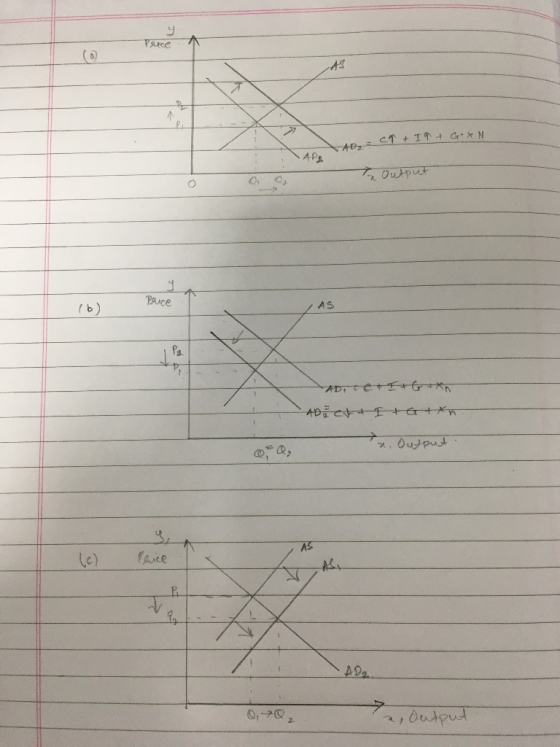
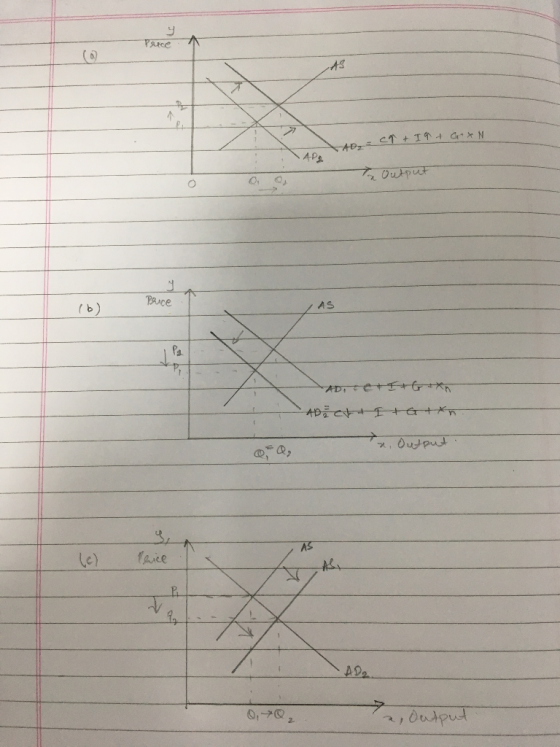
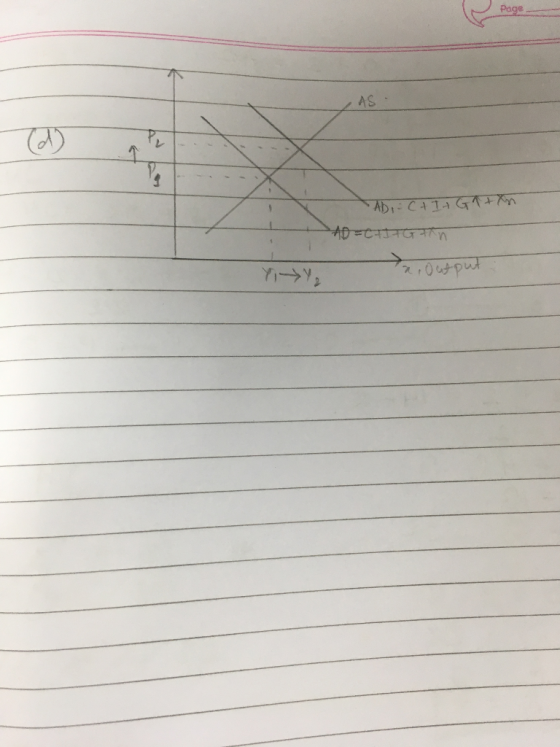
It is known that the aggregate demand function is made up of 4 major components, these components are consumption, investment, government spending, and net exports. (for questions a., b., and c. refer to the first image, and for question d. refer to the second image).
a.) If the fed decreases the interest rates, it would correspond to an implementation of the expansionary monetary policy. This means a drop in the interest rates would lead to an increase in interest-sensitive consumption and investment. This would cause the investment and consumption component of the AD to increase and cause the AD curve to shift to the right. This rightward shift would mean that the quantity of gross output increases and the price level also rise.
b.) If there is a pessimistic or bearish sentiment in the market and the consumers are expected to spend less, the consumption component of the AD would decreases, and this would lead to lower investments as consumption falls. This would lead to a fall in AD, and the AD curve would shift leftwards. As the AD shifts to the left the price level declines and the quantity of gross output also falls.
c.) Any innovation that aids in increasing the productive potential of the economy will cause the aggregate supply curve to shift to the right. This will cause the prices to fall and the quantity of gross output to increase.
d.) An increase in government spending will cause the government spending component of the AD function to increase (Expansionary Fiscal Policy). Through its positively linear relationship, this would cause the AD to increase and shift to the right, which will lead to the price levels to rise and the gross output to expand.
Add Answer to:
5. For each of the following, forecast how prices and output will change by drawing an...
Most questions answered within 3 hours.
-
Where is the error in this code sequence?
String s1 = "Hello";
String s2 = "ello";...
asked 11 months ago -
Financial data for Joel de Paris, Inc., for last year
follow:
Joel de Paris, Inc.
Balance...
asked 11 months ago -
Consider this reaction:
Al2(SO4)3 (aq)+ BaCl3
(aq) Al2Cl6 (aq)- +
3BaSO4(s) . What is the...
asked 11 months ago -
Suppose that Savneet is considering increasing her
recent random sample from 20 car rentals to 40...
asked 11 months ago -
Trucks arrive at an unloading terminal at an average rate of 120
per hour.
Trucks arrive...
asked 11 months ago -
Why are methanol and ethanol completely soluble in water while
octanol is not very little soluble....
asked 11 months ago -
A facilities manager at a university reads in a research report
that the mean amount of...
asked 11 months ago -
When the CuSO4 is rehydrated by adding water to the anhydrous
compound, is this an endothermic...
asked 11 months ago -
A ray of sunlight is passing from diamond into crown glass; the
angle of incidence is...
asked 11 months ago -
A block of mass 0.249 kg is placed on top of a light, vertical
spring of...
asked 11 months ago -
how do the kidneys compensate in the presences of acidosis
a) trigger hyperventilate
b) reserve acid...
asked 11 months ago -
Question 501 pts
The rental rate of capital to the firm increases. Which of the
following...
asked 11 months ago