What is the expression for pressure as a function of density P(density) of an isothermal atmosphere...
Homework Answers

Add Answer to:
What is the expression for pressure as a function of density
P(density) of an isothermal atmosphere...
1. For the earth, an estimate of the variation of pressure with altitude above the surface of the earth is made for a gas of molecular weight, M, assuming the atmosphere is isothermal, the variation...
 1. For the earth, an estimate of the variation of pressure with altitude above the surface of the earth is made for a gas of molecular weight, M, assuming the atmosphere is isothermal, the variation of g with altitude is negligible, and that the atmosphere behaves like an ideal gas. A significant error in this estimate arises from the assumption that the temperature of the atmosphere, T, is isothermal instead of decreasing with altitude. This decrease with altitude y in...
Show that for isothermal atmosphere e Z 71). (T is constant for isothermal atmosphere and p...
 Show that for isothermal atmosphere e Z 71). (T is constant for isothermal atmosphere and p pRT). The pressure at the base of a skyscraper is 14.7 psia and at the top of the skyscraper is 14.4 psia. The temperature is constant at 70°F i.e. isothermal atmosphere. How tall is the skyscraper?
31 and 33 Draw a diagram for each of processes (isothermal, isobaric, isochoric) in variables (P,...
 31 and 33
Draw a diagram for each of processes (isothermal, isobaric, isochoric) in variables (P, V), (P, T) and (V, T). Express density of an ideal gas using the equation of state: PV = n/M RT. Explain every step. One mode of oxygen gas is at a pressure of 6.00 and a temperature of 27.0 degree C. If the gas is heated at constant volume until the pressure triples, what is the final temperature? If the gas is heated...
31 and 33
Draw a diagram for each of processes (isothermal, isobaric, isochoric) in variables (P, V), (P, T) and (V, T). Express density of an ideal gas using the equation of state: PV = n/M RT. Explain every step. One mode of oxygen gas is at a pressure of 6.00 and a temperature of 27.0 degree C. If the gas is heated at constant volume until the pressure triples, what is the final temperature? If the gas is heated...
1. Boltzmann factor for an isothermal atmosphere (15 points) Our derivation of Debye shielding hinged on...
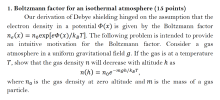 1. Boltzmann factor for an isothermal atmosphere (15 points) Our derivation of Debye shielding hinged on the assumption that the electron density in a potential ф(x) is given by the Boltzmann factor ne(x) - noexp[ep(x)/kBT]. The following problem is intended to provide an intuitive motivation for the Boltzmann factor. Consider a gas atmosphere in a uniform gravitational field g. If the gas is at a temperature T, show that the gas density n will decrease with altitude h as where...
Please derive an equation for the pressure as a function of height in a hydrostatic atmosphere....
Please derive an equation for the pressure as a function of height in a hydrostatic atmosphere. Assume that the atmosphere has a linear temperature lapse rate of Γ. (b) If the atmospheric lapse rate is 6 K/km, the surface pressure is 1000 hPa, and the surface temperature is 280K what is the pressure at 5 km? Assume the air is dry. (c) How does this pressure compare to that computed for an isothermal atmosphere? To do this calculation requires choosing...
An ideal monatomic gas initially has a temperature of T and a pressure of p. It is to expand...
An ideal monatomic gas initially has a temperature of T and a pressure of p. It is to expand from volume V1 to volume V2. If the expansion is isothermal, what are thefinal pressure pfi and the work Wi done by the gas? If, instead, the expansion is adiabatic, what are the final pressure pfa and the work Wa done by the gas? Stateyour answers in terms of the given variables.
4. The enthalpy H may be written as a function of temperature T and pressure P. If we have a system whose composition remains constant and using Maxwell's equations and the total differential, we...
 4. The enthalpy H may be written as a function of temperature T and pressure P. If we have a system whose composition remains constant and using Maxwell's equations and the total differential, we can write dH as avdP where Cp is the heat capacity at constant pressure and the subscript of P on the partial derivative represents the partial of volume with respect to temperature holding pressure connstant. Find the change in enthalpy (A) for an ideal gas undergoing...
I need help with the final pressure. An ideal gas is brought through an isothermal compression...
 I need help with the final
pressure.
An ideal gas is brought through an isothermal compression process. The 2.00 moles of gas go from having an initial volume of 214.3 x10 m to 128.010 m3. If 8270 J are released by the gas during this process, what are the temperature T of the gas and the final pressure pr? Number T- 975.20 Number /,,-11 169640.2 1 | Pa
I need help with the final
pressure.
An ideal gas is brought through an isothermal compression process. The 2.00 moles of gas go from having an initial volume of 214.3 x10 m to 128.010 m3. If 8270 J are released by the gas during this process, what are the temperature T of the gas and the final pressure pr? Number T- 975.20 Number /,,-11 169640.2 1 | Pa
Plot the P-V curve for an isothermal and an adiabatic expansion for a monoatomic and a...
Plot the P-V curve for an isothermal and an adiabatic expansion for a monoatomic and a diatomic ideal gas to double its volume with a starting temperature of 200 K. The starting pressure for both curves is 1 bar.
a)Rewrite ideal gas law as volume being a function of pressure and temperature. b) What is...
a)Rewrite ideal gas law as volume being a function of pressure and temperature. b) What is the expression for the total derivative dV as a function of pressure and temperature? c) At a pressure of 1.08 atm and 350 K for one mole of ideal gas, what is the predicted change in volume if the pressure changes by 0.10 atm (dp = 0.10 atm) and the temperature changes is 10.0 K?
 1. For the earth, an estimate of the variation of pressure with altitude above the surface of the earth is made for a gas of molecular weight, M, assuming the atmosphere is isothermal, the variation of g with altitude is negligible, and that the atmosphere behaves like an ideal gas. A significant error in this estimate arises from the assumption that the temperature of the atmosphere, T, is isothermal instead of decreasing with altitude. This decrease with altitude y in...
 Show that for isothermal atmosphere e Z 71). (T is constant for isothermal atmosphere and p pRT). The pressure at the base of a skyscraper is 14.7 psia and at the top of the skyscraper is 14.4 psia. The temperature is constant at 70°F i.e. isothermal atmosphere. How tall is the skyscraper?
 31 and 33
Draw a diagram for each of processes (isothermal, isobaric, isochoric) in variables (P, V), (P, T) and (V, T). Express density of an ideal gas using the equation of state: PV = n/M RT. Explain every step. One mode of oxygen gas is at a pressure of 6.00 and a temperature of 27.0 degree C. If the gas is heated at constant volume until the pressure triples, what is the final temperature? If the gas is heated...
31 and 33
Draw a diagram for each of processes (isothermal, isobaric, isochoric) in variables (P, V), (P, T) and (V, T). Express density of an ideal gas using the equation of state: PV = n/M RT. Explain every step. One mode of oxygen gas is at a pressure of 6.00 and a temperature of 27.0 degree C. If the gas is heated at constant volume until the pressure triples, what is the final temperature? If the gas is heated...
 1. Boltzmann factor for an isothermal atmosphere (15 points) Our derivation of Debye shielding hinged on the assumption that the electron density in a potential ф(x) is given by the Boltzmann factor ne(x) - noexp[ep(x)/kBT]. The following problem is intended to provide an intuitive motivation for the Boltzmann factor. Consider a gas atmosphere in a uniform gravitational field g. If the gas is at a temperature T, show that the gas density n will decrease with altitude h as where...
 4. The enthalpy H may be written as a function of temperature T and pressure P. If we have a system whose composition remains constant and using Maxwell's equations and the total differential, we can write dH as avdP where Cp is the heat capacity at constant pressure and the subscript of P on the partial derivative represents the partial of volume with respect to temperature holding pressure connstant. Find the change in enthalpy (A) for an ideal gas undergoing...
 I need help with the final
pressure.
An ideal gas is brought through an isothermal compression process. The 2.00 moles of gas go from having an initial volume of 214.3 x10 m to 128.010 m3. If 8270 J are released by the gas during this process, what are the temperature T of the gas and the final pressure pr? Number T- 975.20 Number /,,-11 169640.2 1 | Pa
I need help with the final
pressure.
An ideal gas is brought through an isothermal compression process. The 2.00 moles of gas go from having an initial volume of 214.3 x10 m to 128.010 m3. If 8270 J are released by the gas during this process, what are the temperature T of the gas and the final pressure pr? Number T- 975.20 Number /,,-11 169640.2 1 | Pa
Most questions answered within 3 hours.
-
Where is the error in this code sequence?
String s1 = "Hello";
String s2 = "ello";...
asked 10 months ago -
Financial data for Joel de Paris, Inc., for last year
follow:
Joel de Paris, Inc.
Balance...
asked 10 months ago -
Consider this reaction:
Al2(SO4)3 (aq)+ BaCl3
(aq) Al2Cl6 (aq)- +
3BaSO4(s) . What is the...
asked 10 months ago -
Suppose that Savneet is considering increasing her
recent random sample from 20 car rentals to 40...
asked 10 months ago -
Trucks arrive at an unloading terminal at an average rate of 120
per hour.
Trucks arrive...
asked 10 months ago -
Why are methanol and ethanol completely soluble in water while
octanol is not very little soluble....
asked 10 months ago -
A facilities manager at a university reads in a research report
that the mean amount of...
asked 10 months ago -
When the CuSO4 is rehydrated by adding water to the anhydrous
compound, is this an endothermic...
asked 10 months ago -
A ray of sunlight is passing from diamond into crown glass; the
angle of incidence is...
asked 10 months ago -
A block of mass 0.249 kg is placed on top of a light, vertical
spring of...
asked 10 months ago -
how do the kidneys compensate in the presences of acidosis
a) trigger hyperventilate
b) reserve acid...
asked 10 months ago -
Question 501 pts
The rental rate of capital to the firm increases. Which of the
following...
asked 10 months ago