
Homework Answers
b.

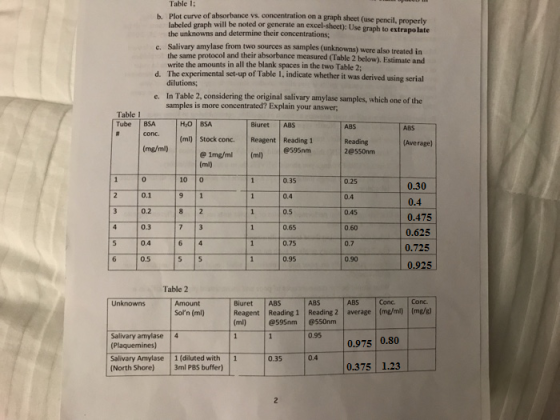
c. Sal-amy-plaquem is 0.8mg/ml; mg/g cannot be calculated from the given data because original substance in grams not given. Sal amy north is 1.23mg/ml and it is more concentrated because it has been diluted four times, mg/g cannot be calculated from the given data because original substance in grams not given.
d. no, its not derived from serial dilutions because stock is 1mg/ml and the total reaction is 10ml = first tube is 0.1mg/ml………to last tube is 0.5mg/ml.
e. Sal amy north is 1.23mg/ml and it is more concentrated because it has been diluted four times,
Add Answer to:
Table 1; of absorbance vs. concentration on a graph sheet (use pencil, properly amylase from two...
1) A graph of the Absorbance vs Concentration of BSA at 545 nm has a linear...
1) A graph of the Absorbance vs Concentration of BSA at 545 nm has a linear trendline with the equation y = 0.6587x + 0.0001. Please calculate the concentration of an unknown sample with an absorbance of 0.330. 0.0001 mg/mL 0.217 mg/mL 0.6587 mg/mL 0.501 mg/mL 2) Please review the “Absorbance Assay at 280 nm” portion of your lab. Please calculate the concentration of an unknown sample with an absorbance of 0.330, path length 1.00 cm, and a molar absorption...
Complete the purification table below for that group using the information supplied in Tables 1 &...
 Complete the purification table below for that group using the information supplied in Tables 1 & 2. You may refer to the description in your lab manual on how to calculate these parameters and account for any dilutions. Sample Activity Total (ABS/min/mL) activity (ABS/min OR U) Protein Concentration (mg/mL) Total Protein (mg) Specific activity (ABS/min/mg OR U/mg) Fold Purification RP PPE [28 marks] Table 1: Triplicate absorbance data of Group A for the catechol assay of banana PPO after 2...
live spectrophe Using test tubes, Proceed with the determination as shown in the table below to...
 live spectrophe Using test tubes, Proceed with the determination as shown in the table below to Reagents (ml) Sample Blank Std Sto2 Std Glucose stock (1.5 mg/mL) 0.1 0.2 0.4 water I 2.4 2.3 2.1 Sample 2.5 (Unknown) DNS reagent 1.0 1.0 1.0 1.0 1.0 2.5 1. Shake the tubes, put all at the same time in boiling water bath (must be boiling for 5 minutes, 2. After heating, cool the tubes in cold water and then add 6.5 ml...
PROCEDURE Table 4.1: Dilutions of Albumin for Standard Curve Determination. SAMPLE NUMBER VOLUME OF 0.9% NACL...
 PROCEDURE Table 4.1: Dilutions of Albumin for Standard Curve Determination. SAMPLE NUMBER VOLUME OF 0.9% NACL (mL) VOLUME OF 10 mg/ml ALBUMIN STOCK SOLUTION (mL) VOLUME OF BIURET REAGENT (mL) TOTAL VOLUME IN EACH TUBE ABSORBANCE READING ALBUMIN CONCENTRATION IN SOLUTION 1 (Blank) 1.0 mL OmL 4.0 mL 0.8 mL 0.2 mL 4.0 mL .4 0.6 mL 0.4 mL 4.0 mL 5 mL 5ml sme 5mL 5ml 5mL .228 .088 1 0.271 773 1.444 11827 0.4 mL 0.6 mL 4.0...
solve all 3 dont waste my answer 1. Check Beer's Law by plotting absorbance vs molar concentration using 2....
 solve all 3 dont waste my answer
1. Check Beer's Law by plotting absorbance vs molar concentration using 2. Is Beer's Law valid for this system? Explain your answer. 3. If Beer's Law is valid, the value of "E" should be constant. Use A-ECPL or E = A/(EL) and the data from Table II to calculate values of E for the five solutions below. The value of L is normally 1 cm so E - A/C in this experiment. Table...
solve all 3 dont waste my answer
1. Check Beer's Law by plotting absorbance vs molar concentration using 2. Is Beer's Law valid for this system? Explain your answer. 3. If Beer's Law is valid, the value of "E" should be constant. Use A-ECPL or E = A/(EL) and the data from Table II to calculate values of E for the five solutions below. The value of L is normally 1 cm so E - A/C in this experiment. Table...
PROCEDURE A. ABSORBANCE SPECTRA 1. Obtain three cuvettes. Add-2mL of the following samples to them: red...
 PROCEDURE A. ABSORBANCE SPECTRA 1. Obtain three cuvettes. Add-2mL of the following samples to them: red dye, blue dye, yellow dye. 2. Obtain a spectrum for each dye according to the provided directions (water is the blank). 3. For each of the three dyes (red, yellow, and blue) record the wavelength for the largest peak in the visible range (380 nm to 750 nm), Record this in the data table below. Save the red dye for part B. 4. Identify...
I am stuck on how to find concentration for standards and unknowns. Any kind of help would be appreciated. The correct...
 I am stuck on how to find concentration for standards and
unknowns. Any kind of help would be appreciated.
The corrected absorbance is = Blank - absorbance
1. Prepare the BCA working reagent. Use a graduated cylinder and add 30 ml of the BCA reagent into a 50 ml Erlenmeyer flask. Use the appropriate micropipette to add 600 uL of the CuSO4 solution into the flask and mix by swirling the flask. Record the exact mass of albumin and the...
I am stuck on how to find concentration for standards and
unknowns. Any kind of help would be appreciated.
The corrected absorbance is = Blank - absorbance
1. Prepare the BCA working reagent. Use a graduated cylinder and add 30 ml of the BCA reagent into a 50 ml Erlenmeyer flask. Use the appropriate micropipette to add 600 uL of the CuSO4 solution into the flask and mix by swirling the flask. Record the exact mass of albumin and the...
1. Carefully explain how to complete the table below to determine the SDH specific activity in...
 1. Carefully explain how to complete the table below to determine the SDH specific activity in the post nuclear supernatant using the data supplied. Assume the same volumes were used as in the practical and tubes 7 and 9 had a negligible change in DCPIP concentration over 30 minutes. tube A600nm 5 mins A600am 35 mins AA600nm 5-35 mins A[DCPIP) UM 5-35 mins 1 tube umoles DCPIP.min volume of extract assayed (ml) activity umoles.min l.ml1 specific activity umoles.min-1.mg 1 1...
I need help doing just the questions, not the graph or the conclusion F17 MATERIALS 0.12...
 I
need help doing just the questions, not the graph or the
conclusion
F17 MATERIALS 0.12 g [Fe(phen)3]Cl2 (student's red crystals from the previous experiment) 0.5 mL unknown [Fe(phen)3]Cl2 solution 175 mL DI water A. Series of Dilutions: Concentration of stock solution 3.15x10³M 105gx mol 667.354 IL 0.05004 Concentrations of the series of dilutions Solution Concentration 0.2/25 2.52x10m 0.4/25 5.04×10⁵m 0.6/25 7.56 X10 sm 0.8/25 1.0088 10" 1.0/25 1.26x10 "m Abs atmas 0.20_ Unknown 514nm 0.52 1.42 Solution 0.2/25 0.4/25...
I
need help doing just the questions, not the graph or the
conclusion
F17 MATERIALS 0.12 g [Fe(phen)3]Cl2 (student's red crystals from the previous experiment) 0.5 mL unknown [Fe(phen)3]Cl2 solution 175 mL DI water A. Series of Dilutions: Concentration of stock solution 3.15x10³M 105gx mol 667.354 IL 0.05004 Concentrations of the series of dilutions Solution Concentration 0.2/25 2.52x10m 0.4/25 5.04×10⁵m 0.6/25 7.56 X10 sm 0.8/25 1.0088 10" 1.0/25 1.26x10 "m Abs atmas 0.20_ Unknown 514nm 0.52 1.42 Solution 0.2/25 0.4/25...
1. Did the column separate NADH and BSA? Explain based on your graph 2. What assumptions have you made in determining the absorbance of the mixture at two different wavelengths? 3. Is the reaction...
 1. Did the column separate NADH and BSA? Explain based on your
graph
2. What assumptions have you made in determining the
absorbance of the mixture at two different
wavelengths?
3. Is the reaction catalysed by GPT a reversible
reaction? Give evidence from your experimental results in Table 3
to support your answer. (I DONT UNDERSTAND THIS QUESTION PLEASE
HELP)
Separation of BSA and NADH using Gel filtration chromatography 0.060 0.040 0.020 0.000 0.000 4.000 3.000 5.000 6.000 2.000 -0.020...
1. Did the column separate NADH and BSA? Explain based on your
graph
2. What assumptions have you made in determining the
absorbance of the mixture at two different
wavelengths?
3. Is the reaction catalysed by GPT a reversible
reaction? Give evidence from your experimental results in Table 3
to support your answer. (I DONT UNDERSTAND THIS QUESTION PLEASE
HELP)
Separation of BSA and NADH using Gel filtration chromatography 0.060 0.040 0.020 0.000 0.000 4.000 3.000 5.000 6.000 2.000 -0.020...
 Complete the purification table below for that group using the information supplied in Tables 1 & 2. You may refer to the description in your lab manual on how to calculate these parameters and account for any dilutions. Sample Activity Total (ABS/min/mL) activity (ABS/min OR U) Protein Concentration (mg/mL) Total Protein (mg) Specific activity (ABS/min/mg OR U/mg) Fold Purification RP PPE [28 marks] Table 1: Triplicate absorbance data of Group A for the catechol assay of banana PPO after 2...
 live spectrophe Using test tubes, Proceed with the determination as shown in the table below to Reagents (ml) Sample Blank Std Sto2 Std Glucose stock (1.5 mg/mL) 0.1 0.2 0.4 water I 2.4 2.3 2.1 Sample 2.5 (Unknown) DNS reagent 1.0 1.0 1.0 1.0 1.0 2.5 1. Shake the tubes, put all at the same time in boiling water bath (must be boiling for 5 minutes, 2. After heating, cool the tubes in cold water and then add 6.5 ml...
 PROCEDURE Table 4.1: Dilutions of Albumin for Standard Curve Determination. SAMPLE NUMBER VOLUME OF 0.9% NACL (mL) VOLUME OF 10 mg/ml ALBUMIN STOCK SOLUTION (mL) VOLUME OF BIURET REAGENT (mL) TOTAL VOLUME IN EACH TUBE ABSORBANCE READING ALBUMIN CONCENTRATION IN SOLUTION 1 (Blank) 1.0 mL OmL 4.0 mL 0.8 mL 0.2 mL 4.0 mL .4 0.6 mL 0.4 mL 4.0 mL 5 mL 5ml sme 5mL 5ml 5mL .228 .088 1 0.271 773 1.444 11827 0.4 mL 0.6 mL 4.0...
 solve all 3 dont waste my answer
1. Check Beer's Law by plotting absorbance vs molar concentration using 2. Is Beer's Law valid for this system? Explain your answer. 3. If Beer's Law is valid, the value of "E" should be constant. Use A-ECPL or E = A/(EL) and the data from Table II to calculate values of E for the five solutions below. The value of L is normally 1 cm so E - A/C in this experiment. Table...
solve all 3 dont waste my answer
1. Check Beer's Law by plotting absorbance vs molar concentration using 2. Is Beer's Law valid for this system? Explain your answer. 3. If Beer's Law is valid, the value of "E" should be constant. Use A-ECPL or E = A/(EL) and the data from Table II to calculate values of E for the five solutions below. The value of L is normally 1 cm so E - A/C in this experiment. Table...
 PROCEDURE A. ABSORBANCE SPECTRA 1. Obtain three cuvettes. Add-2mL of the following samples to them: red dye, blue dye, yellow dye. 2. Obtain a spectrum for each dye according to the provided directions (water is the blank). 3. For each of the three dyes (red, yellow, and blue) record the wavelength for the largest peak in the visible range (380 nm to 750 nm), Record this in the data table below. Save the red dye for part B. 4. Identify...
 I am stuck on how to find concentration for standards and
unknowns. Any kind of help would be appreciated.
The corrected absorbance is = Blank - absorbance
1. Prepare the BCA working reagent. Use a graduated cylinder and add 30 ml of the BCA reagent into a 50 ml Erlenmeyer flask. Use the appropriate micropipette to add 600 uL of the CuSO4 solution into the flask and mix by swirling the flask. Record the exact mass of albumin and the...
I am stuck on how to find concentration for standards and
unknowns. Any kind of help would be appreciated.
The corrected absorbance is = Blank - absorbance
1. Prepare the BCA working reagent. Use a graduated cylinder and add 30 ml of the BCA reagent into a 50 ml Erlenmeyer flask. Use the appropriate micropipette to add 600 uL of the CuSO4 solution into the flask and mix by swirling the flask. Record the exact mass of albumin and the...
 1. Carefully explain how to complete the table below to determine the SDH specific activity in the post nuclear supernatant using the data supplied. Assume the same volumes were used as in the practical and tubes 7 and 9 had a negligible change in DCPIP concentration over 30 minutes. tube A600nm 5 mins A600am 35 mins AA600nm 5-35 mins A[DCPIP) UM 5-35 mins 1 tube umoles DCPIP.min volume of extract assayed (ml) activity umoles.min l.ml1 specific activity umoles.min-1.mg 1 1...
 I
need help doing just the questions, not the graph or the
conclusion
F17 MATERIALS 0.12 g [Fe(phen)3]Cl2 (student's red crystals from the previous experiment) 0.5 mL unknown [Fe(phen)3]Cl2 solution 175 mL DI water A. Series of Dilutions: Concentration of stock solution 3.15x10³M 105gx mol 667.354 IL 0.05004 Concentrations of the series of dilutions Solution Concentration 0.2/25 2.52x10m 0.4/25 5.04×10⁵m 0.6/25 7.56 X10 sm 0.8/25 1.0088 10" 1.0/25 1.26x10 "m Abs atmas 0.20_ Unknown 514nm 0.52 1.42 Solution 0.2/25 0.4/25...
I
need help doing just the questions, not the graph or the
conclusion
F17 MATERIALS 0.12 g [Fe(phen)3]Cl2 (student's red crystals from the previous experiment) 0.5 mL unknown [Fe(phen)3]Cl2 solution 175 mL DI water A. Series of Dilutions: Concentration of stock solution 3.15x10³M 105gx mol 667.354 IL 0.05004 Concentrations of the series of dilutions Solution Concentration 0.2/25 2.52x10m 0.4/25 5.04×10⁵m 0.6/25 7.56 X10 sm 0.8/25 1.0088 10" 1.0/25 1.26x10 "m Abs atmas 0.20_ Unknown 514nm 0.52 1.42 Solution 0.2/25 0.4/25...
 1. Did the column separate NADH and BSA? Explain based on your
graph
2. What assumptions have you made in determining the
absorbance of the mixture at two different
wavelengths?
3. Is the reaction catalysed by GPT a reversible
reaction? Give evidence from your experimental results in Table 3
to support your answer. (I DONT UNDERSTAND THIS QUESTION PLEASE
HELP)
Separation of BSA and NADH using Gel filtration chromatography 0.060 0.040 0.020 0.000 0.000 4.000 3.000 5.000 6.000 2.000 -0.020...
1. Did the column separate NADH and BSA? Explain based on your
graph
2. What assumptions have you made in determining the
absorbance of the mixture at two different
wavelengths?
3. Is the reaction catalysed by GPT a reversible
reaction? Give evidence from your experimental results in Table 3
to support your answer. (I DONT UNDERSTAND THIS QUESTION PLEASE
HELP)
Separation of BSA and NADH using Gel filtration chromatography 0.060 0.040 0.020 0.000 0.000 4.000 3.000 5.000 6.000 2.000 -0.020...
Most questions answered within 3 hours.
-
Where is the error in this code sequence?
String s1 = "Hello";
String s2 = "ello";...
asked 10 months ago -
Financial data for Joel de Paris, Inc., for last year
follow:
Joel de Paris, Inc.
Balance...
asked 10 months ago -
Consider this reaction:
Al2(SO4)3 (aq)+ BaCl3
(aq) Al2Cl6 (aq)- +
3BaSO4(s) . What is the...
asked 10 months ago -
Suppose that Savneet is considering increasing her
recent random sample from 20 car rentals to 40...
asked 10 months ago -
Trucks arrive at an unloading terminal at an average rate of 120
per hour.
Trucks arrive...
asked 10 months ago -
Why are methanol and ethanol completely soluble in water while
octanol is not very little soluble....
asked 10 months ago -
A facilities manager at a university reads in a research report
that the mean amount of...
asked 10 months ago -
When the CuSO4 is rehydrated by adding water to the anhydrous
compound, is this an endothermic...
asked 10 months ago -
A ray of sunlight is passing from diamond into crown glass; the
angle of incidence is...
asked 10 months ago -
A block of mass 0.249 kg is placed on top of a light, vertical
spring of...
asked 10 months ago -
how do the kidneys compensate in the presences of acidosis
a) trigger hyperventilate
b) reserve acid...
asked 10 months ago -
Question 501 pts
The rental rate of capital to the firm increases. Which of the
following...
asked 10 months ago