
Homework Answers
Add Answer to:
What is it missing? This was all that was given. Please complete
the question with the...
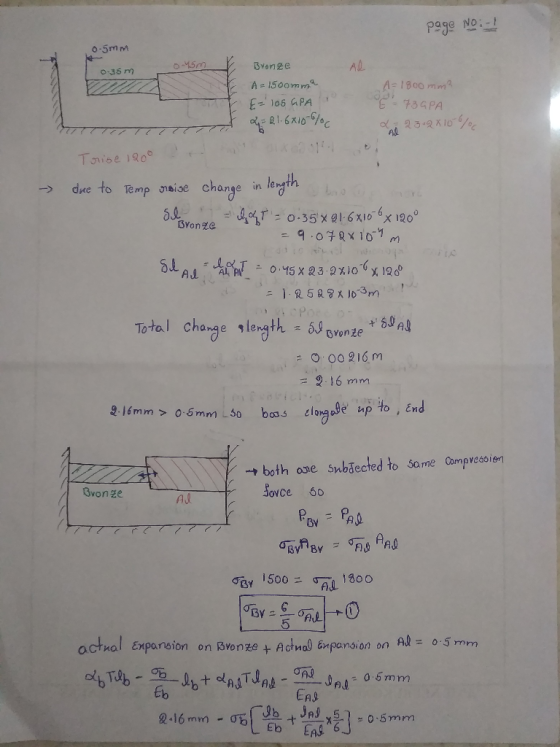
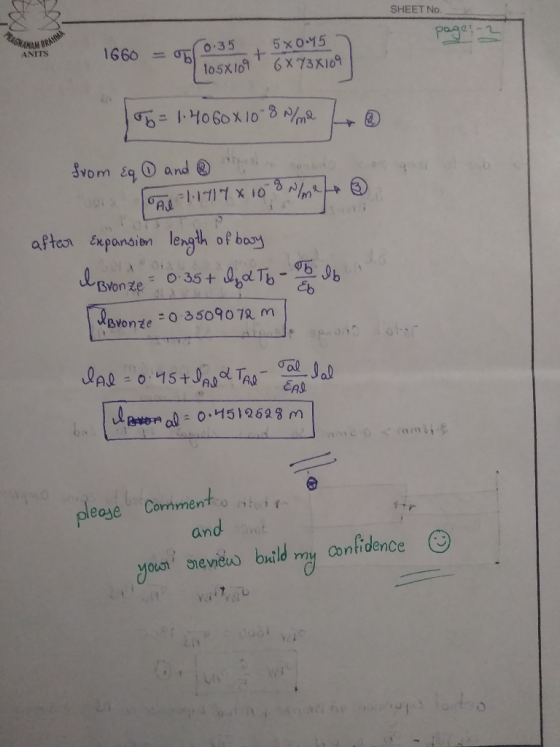
6. (20pts) Determine (a) the compressive force in the bars shown in Fig. 3 after a...
 6. (20pts) Determine (a) the compressive force in the bars shown in Fig. 3 after a temperature rise of 96 °C, (b) the corresponding change in length of the bronze bar. 0.5 mm -0.35 m p0.45 m 0.45 m Bronze A = 1500 min E = 105 CPa A = 21.6x10⁻⁶PC Aluminun A = 1600 min E = 73 CPa Q = 23.2x10 6C Fig. 3
d2 \\\ А Brass B Aluminum Li L2 The two rods below are constrained between two...
 d2 \\\ А Brass B Aluminum Li L2 The two rods below are constrained between two rigid walls. AB is brass (Ep = 105 GPa, ab = 20.9 x 10 6 m/(m-°C)) and BC is aluminum (Eai = 72 GPa, dal = 23.9 x 10⁻⁶ m/(m:°C)). At T1 = 10.8°C, there is no stress in the rods. Determine the stress in the brass rod AB at T2 = 60.9°C. Use the following dimensions: dų = 65 mm d2 = 38...
Arigid slab that is supported by two copper bars as shown in the Figure and there...
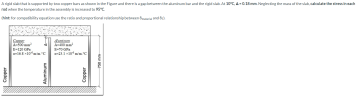 Arigid slab that is supported by two copper bars as shown in the Figure and there is a gap between the aluminum bar and the rigid slab. At 10°C, A = 0.18 mm. Neglecting the mass of the slab, calculate the stress in each rod when the temperature in the assembly is increased to 95°C. (hint: for compatibility equation use the ratio and proportional relationship between material and OT). Copper A=500 mm E=120 GPa a=16.8 x10m/m.°C Aluminum A=400 mm E=70...
Q2) The aluminum shell is fully bonded to the brass core and the assembly is unstressed...
 Q2) The aluminum shell is fully bonded to the brass core and the assembly is unstressed at a temperature of 15°C. Considering only axial deformations, determine the stress in the aluminum when the temperature reaches 195°C. 25 mm Brass core E = 105 GPa a = 20.9 x 10 6/C Fig.2 Aluminum shell E = 70 GPa a = 23.6 x 10 5/°C - 60 mm
Bar B of the pin connected system is made of aluminum alloy (E=105 GPa, A=1200 mm^2)...
 Bar B of the pin connected system is made of aluminum alloy
(E=105 GPa, A=1200 mm^2) and bar A is made of a hardened carbon
steel (E=210 GPa, A=1200 mm^2). Bar CDE is rigid. When the system
is unloaded, Bars A and B are unstressed.
Determine:
a) The Normal Stress in bars A and B. (5pts)
b) The Shearing Stress in the 20-mm diameter pin E which is in
double shear. (5pts)
c) If the yield stress of the material...
Bar B of the pin connected system is made of aluminum alloy
(E=105 GPa, A=1200 mm^2) and bar A is made of a hardened carbon
steel (E=210 GPa, A=1200 mm^2). Bar CDE is rigid. When the system
is unloaded, Bars A and B are unstressed.
Determine:
a) The Normal Stress in bars A and B. (5pts)
b) The Shearing Stress in the 20-mm diameter pin E which is in
double shear. (5pts)
c) If the yield stress of the material...
Chapter 5, Reserve Problem 079 (Multistep) A cylindrical bronze sleeve (2) is held in compression against...
 Chapter 5, Reserve Problem 079 (Multistep) A cylindrical bronze sleeve (2) is held in compression against a rigid machine wall by a high-strength steel bolt (1), as shown in the figure. The steel [E = 204 GPa; a = 11.7 x 10⁻⁶/°C] bolt has a diameter of 24 mm. The bronze [E = 105 GPa; a = 22.0 x 10⁻⁶/°C] sleeve has an outside diameter of 72 mm, a wall thickness of 8 mm, and a length of L =...
.. At room temperature (20°C) a 0.5-mm gap exists between the of the rods shown. At...
 .. At room temperature (20°C) a 0.5-mm gap exists between the of the rods shown. At a later time when the temperature has reached 140°C, determine (a) the normal stress in the aluminum rod, (b) the change in length of the aluminum rod. (Io 0.5 mm ー250 mm→ Aluminum Stainless steel A=2000min- E = 75 GPa α = 23 × 10-6PC A=soo E= 190 GPa α = 17.3 × 10⁻⁶/oC
2- Knowing that a 0.5-mm gap exists between the rods shown below when the temperature is...
 2- Knowing that a 0.5-mm gap exists between the rods shown below when the temperature is 20 °C, determine: (a) The temperature at which the normal stress in the stainless steel rod will be o = -150 MPa, (b) The corresponding exact length of the stainless steel rod 0.5 mm 300 mm- - 250 mm A В Aluminum Stainless steel A = 2000 mm2 E = 70 GPa 23 x 10-/C A = 800 mm2 E = 190 GPa 18...
2) The rigid bar CDE is attached to a pin support at E and rests on...
 2) The rigid bar CDE is attached to a pin support at E and rests on the 30-mm diameter brass cylinder BD. A 22-mm-diameter steel rod AC passes through a hole in the bar and is secured by a nut which is snugly fitted when the temperature of the entire assembly is 20°C. The temperature of the brass cylinder is then raised to 50°C while the steel rod remains at 20°C. Assuming that no stresses were present before the temperature...
 6. (20pts) Determine (a) the compressive force in the bars shown in Fig. 3 after a temperature rise of 96 °C, (b) the corresponding change in length of the bronze bar. 0.5 mm -0.35 m p0.45 m 0.45 m Bronze A = 1500 min E = 105 CPa A = 21.6x10⁻⁶PC Aluminun A = 1600 min E = 73 CPa Q = 23.2x10 6C Fig. 3
 d2 \\\ А Brass B Aluminum Li L2 The two rods below are constrained between two rigid walls. AB is brass (Ep = 105 GPa, ab = 20.9 x 10 6 m/(m-°C)) and BC is aluminum (Eai = 72 GPa, dal = 23.9 x 10⁻⁶ m/(m:°C)). At T1 = 10.8°C, there is no stress in the rods. Determine the stress in the brass rod AB at T2 = 60.9°C. Use the following dimensions: dų = 65 mm d2 = 38...
 Arigid slab that is supported by two copper bars as shown in the Figure and there is a gap between the aluminum bar and the rigid slab. At 10°C, A = 0.18 mm. Neglecting the mass of the slab, calculate the stress in each rod when the temperature in the assembly is increased to 95°C. (hint: for compatibility equation use the ratio and proportional relationship between material and OT). Copper A=500 mm E=120 GPa a=16.8 x10m/m.°C Aluminum A=400 mm E=70...
 Q2) The aluminum shell is fully bonded to the brass core and the assembly is unstressed at a temperature of 15°C. Considering only axial deformations, determine the stress in the aluminum when the temperature reaches 195°C. 25 mm Brass core E = 105 GPa a = 20.9 x 10 6/C Fig.2 Aluminum shell E = 70 GPa a = 23.6 x 10 5/°C - 60 mm
 Bar B of the pin connected system is made of aluminum alloy
(E=105 GPa, A=1200 mm^2) and bar A is made of a hardened carbon
steel (E=210 GPa, A=1200 mm^2). Bar CDE is rigid. When the system
is unloaded, Bars A and B are unstressed.
Determine:
a) The Normal Stress in bars A and B. (5pts)
b) The Shearing Stress in the 20-mm diameter pin E which is in
double shear. (5pts)
c) If the yield stress of the material...
Bar B of the pin connected system is made of aluminum alloy
(E=105 GPa, A=1200 mm^2) and bar A is made of a hardened carbon
steel (E=210 GPa, A=1200 mm^2). Bar CDE is rigid. When the system
is unloaded, Bars A and B are unstressed.
Determine:
a) The Normal Stress in bars A and B. (5pts)
b) The Shearing Stress in the 20-mm diameter pin E which is in
double shear. (5pts)
c) If the yield stress of the material...
 Chapter 5, Reserve Problem 079 (Multistep) A cylindrical bronze sleeve (2) is held in compression against a rigid machine wall by a high-strength steel bolt (1), as shown in the figure. The steel [E = 204 GPa; a = 11.7 x 10⁻⁶/°C] bolt has a diameter of 24 mm. The bronze [E = 105 GPa; a = 22.0 x 10⁻⁶/°C] sleeve has an outside diameter of 72 mm, a wall thickness of 8 mm, and a length of L =...
 .. At room temperature (20°C) a 0.5-mm gap exists between the of the rods shown. At a later time when the temperature has reached 140°C, determine (a) the normal stress in the aluminum rod, (b) the change in length of the aluminum rod. (Io 0.5 mm ー250 mm→ Aluminum Stainless steel A=2000min- E = 75 GPa α = 23 × 10-6PC A=soo E= 190 GPa α = 17.3 × 10⁻⁶/oC
 2- Knowing that a 0.5-mm gap exists between the rods shown below when the temperature is 20 °C, determine: (a) The temperature at which the normal stress in the stainless steel rod will be o = -150 MPa, (b) The corresponding exact length of the stainless steel rod 0.5 mm 300 mm- - 250 mm A В Aluminum Stainless steel A = 2000 mm2 E = 70 GPa 23 x 10-/C A = 800 mm2 E = 190 GPa 18...
 2) The rigid bar CDE is attached to a pin support at E and rests on the 30-mm diameter brass cylinder BD. A 22-mm-diameter steel rod AC passes through a hole in the bar and is secured by a nut which is snugly fitted when the temperature of the entire assembly is 20°C. The temperature of the brass cylinder is then raised to 50°C while the steel rod remains at 20°C. Assuming that no stresses were present before the temperature...
Most questions answered within 3 hours.
-
Where is the error in this code sequence?
String s1 = "Hello";
String s2 = "ello";...
asked 10 months ago -
Financial data for Joel de Paris, Inc., for last year
follow:
Joel de Paris, Inc.
Balance...
asked 10 months ago -
Consider this reaction:
Al2(SO4)3 (aq)+ BaCl3
(aq) Al2Cl6 (aq)- +
3BaSO4(s) . What is the...
asked 10 months ago -
Suppose that Savneet is considering increasing her
recent random sample from 20 car rentals to 40...
asked 10 months ago -
Trucks arrive at an unloading terminal at an average rate of 120
per hour.
Trucks arrive...
asked 10 months ago -
Why are methanol and ethanol completely soluble in water while
octanol is not very little soluble....
asked 10 months ago -
A facilities manager at a university reads in a research report
that the mean amount of...
asked 10 months ago -
When the CuSO4 is rehydrated by adding water to the anhydrous
compound, is this an endothermic...
asked 10 months ago -
A ray of sunlight is passing from diamond into crown glass; the
angle of incidence is...
asked 10 months ago -
A block of mass 0.249 kg is placed on top of a light, vertical
spring of...
asked 10 months ago -
how do the kidneys compensate in the presences of acidosis
a) trigger hyperventilate
b) reserve acid...
asked 10 months ago -
Question 501 pts
The rental rate of capital to the firm increases. Which of the
following...
asked 10 months ago