Homework Answers
Add Answer to:
1.
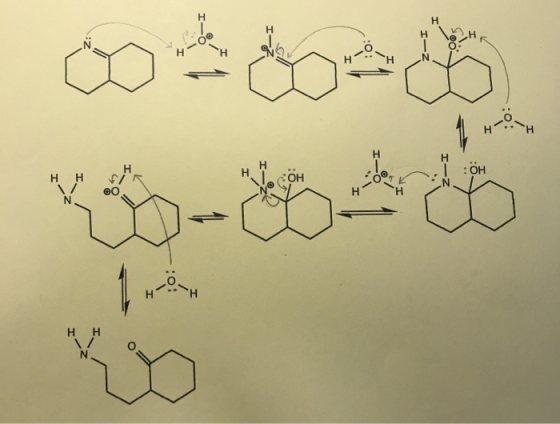
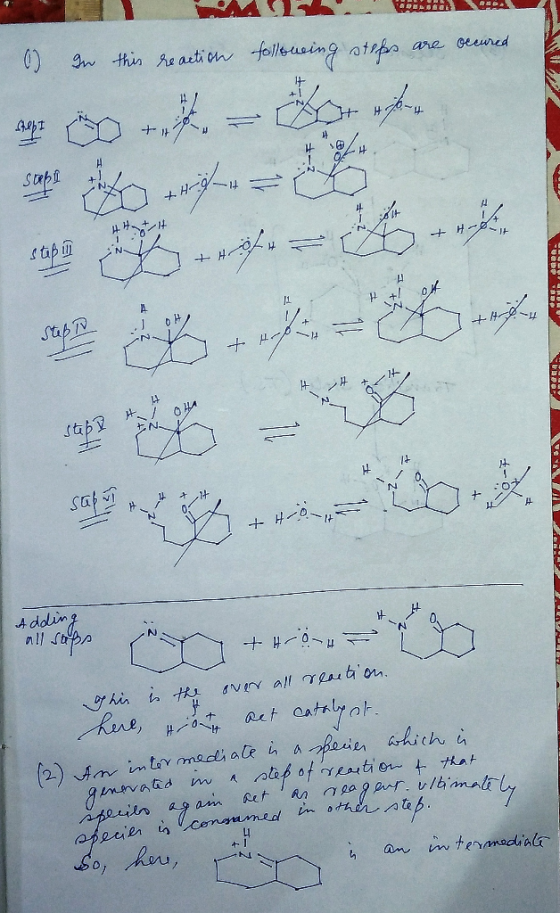
Write an overall balnaced chemical equation for the mechanism.
2. Draw an example of an...
1. [05 pts.] Draw the chemical equation for preparation of Aspirin. (No mechanism) 2. [15 pts.)...
 1. [05 pts.] Draw the chemical equation for preparation of Aspirin. (No mechanism) 2. [15 pts.) Show the detailed mechanism movement of electrons. for reaction. Show all arrow to indicate 3. [09 pts.] Briefly explain the roles of Salicylic acid, Acetic anhydride and phosphoric acid in the reaction. 4. [05 pts.] What type of reaction is preparation of Aspirin? 5. [06 pts.] Briefly describe esterification and give an example using Acyl chloride as one of the reactants.
Chymotrypsin What evidence in chymotrypsin mechanism supports the claim that chymotrypsin catalysis involves general acid-base catalysis...
Chymotrypsin What evidence in chymotrypsin mechanism supports the claim that chymotrypsin catalysis involves general acid-base catalysis and covalent catalysis? Draw the chemical structure of the transition state (resembles the intermediate structure) in the step that forms the enzyme-product covalent adduct. In comparison to the substrate, how is the tetrahedral transition state preferentially stabilized by enzyme? Chymotrypsin mechanism: Write all the steps in the mechanism and understand what each step accomplishes.
1. For each reaction below, draw the reaction mechanism for the rate determining step. On the...
 1. For each reaction below, draw the reaction mechanism for the rate determining step. On the starting structures, draw all appropriate arrows to indicate the flow of electrons. Fill in the box above the arrows with the reaction mechanism as SN1 or SN2. Draw the first key transition state and product(s). Use dotted lines to indicate bonds that are in the process of being broken or made. Write all formal charges. H H-02 + HC Transition State H3C H-OCH, +...
mechanism for the rate determining step. On the 1. For each reaction below, draw the reaction...
 mechanism for the rate determining step. On the 1. For each reaction below, draw the reaction mechanism for the rate determi starting structures, draw all appropriate arrows to indicate the flow of electrons. Fill in the the arrows with the reaction mechanism as SN1 or SN2. Draw the first key transition State product(s). Use dotted lines to indicate bonds that are in the ed lines to indicate bonds that are in the process of being broken or made. Write all...
QUESTIONS AND PROBLEMS Voltaic Cells 1. Write a balanced chemical equation for the overall cell reaction...
 QUESTIONS AND PROBLEMS Voltaic Cells 1. Write a balanced chemical equation for the overall cell reaction represented as a. (Pt) H2/H (Pt) Fe +/Fe2+ b. Cd/Cd2+ | Ni?+/Ni c. (PL) CI-/C1, | (Pt) MnO,-/Mn an aqueous gram of the Write the overall equa 6. Follow tl cell in which aqucous solt rrverale The
1. For each reaction below, draw the reaction mechanism for the rate determining step. On the...
 1. For each reaction below, draw the reaction mechanism for the rate determining step. On the starting structures, draw all appropriate arrows to indicate the flow of electrons. Fill in the box above the arrows with the reaction mechanism as SN1 or SN2. Draw the first key transition state and product(s). Use dotted lines to indicate bonds that are in the process of being broken or made. Write all formal charges. H-0 HC CH Transition State HIC CH H-OCH, +...
1. For each reaction below, draw the reaction mechanism for the rate determining step. On the...
 1. For each reaction below, draw the reaction mechanism for the rate determining step. On the starting structures, draw all appropriate arrows to indicate the flow of electrons. Fill in the box above the arrows with the reaction mechanism as SN1 or SN2. Draw the first key transition state and product(s). Use dotted lines to indicate bonds that are in the process of being broken or made. Write all formal charges н H- Н,с Transition State Нас н— осн, Нас...
1. For each reaction below, draw the reaction mechanism for the rate determining step. On the...
 1. For each reaction below, draw the reaction mechanism for the rate determining step. On the starting structures, draw all appropriate arrows to indicate the flow of electrons. Fill in the box above the arrows with the reaction mechanism as SN1 or SN2. Draw the first key transition state and product(s). Use dotted lines to indicate bonds that are in the process of being broken or made. Write all formal charges. *- _ - нс" Transition State HAC CHS H-OCH,...
Write the overall chemical equation and the net balanced chemical equation for the following (include physical...
Write the overall chemical equation and the net balanced chemical equation for the following (include physical states): A) AgNO3 (aq) with NaCl B) AgNO3 (aq) with K2CO3 C) AgNO3 (aq) with CaCO3
Write the overall chemical equation and the net balanced chemical equation for the following (include physical...
Write the overall chemical equation and the net balanced chemical equation for the following (include physical states): A) HCl (aq) with K2CO3 B) HCl (aq) with CaCO3 C) HCl (aq) with Na2CO3 D) HCl (aq) with KBr
 1. [05 pts.] Draw the chemical equation for preparation of Aspirin. (No mechanism) 2. [15 pts.) Show the detailed mechanism movement of electrons. for reaction. Show all arrow to indicate 3. [09 pts.] Briefly explain the roles of Salicylic acid, Acetic anhydride and phosphoric acid in the reaction. 4. [05 pts.] What type of reaction is preparation of Aspirin? 5. [06 pts.] Briefly describe esterification and give an example using Acyl chloride as one of the reactants.
 1. For each reaction below, draw the reaction mechanism for the rate determining step. On the starting structures, draw all appropriate arrows to indicate the flow of electrons. Fill in the box above the arrows with the reaction mechanism as SN1 or SN2. Draw the first key transition state and product(s). Use dotted lines to indicate bonds that are in the process of being broken or made. Write all formal charges. H H-02 + HC Transition State H3C H-OCH, +...
 mechanism for the rate determining step. On the 1. For each reaction below, draw the reaction mechanism for the rate determi starting structures, draw all appropriate arrows to indicate the flow of electrons. Fill in the the arrows with the reaction mechanism as SN1 or SN2. Draw the first key transition State product(s). Use dotted lines to indicate bonds that are in the ed lines to indicate bonds that are in the process of being broken or made. Write all...
 QUESTIONS AND PROBLEMS Voltaic Cells 1. Write a balanced chemical equation for the overall cell reaction represented as a. (Pt) H2/H (Pt) Fe +/Fe2+ b. Cd/Cd2+ | Ni?+/Ni c. (PL) CI-/C1, | (Pt) MnO,-/Mn an aqueous gram of the Write the overall equa 6. Follow tl cell in which aqucous solt rrverale The
 1. For each reaction below, draw the reaction mechanism for the rate determining step. On the starting structures, draw all appropriate arrows to indicate the flow of electrons. Fill in the box above the arrows with the reaction mechanism as SN1 or SN2. Draw the first key transition state and product(s). Use dotted lines to indicate bonds that are in the process of being broken or made. Write all formal charges. H-0 HC CH Transition State HIC CH H-OCH, +...
 1. For each reaction below, draw the reaction mechanism for the rate determining step. On the starting structures, draw all appropriate arrows to indicate the flow of electrons. Fill in the box above the arrows with the reaction mechanism as SN1 or SN2. Draw the first key transition state and product(s). Use dotted lines to indicate bonds that are in the process of being broken or made. Write all formal charges н H- Н,с Transition State Нас н— осн, Нас...
 1. For each reaction below, draw the reaction mechanism for the rate determining step. On the starting structures, draw all appropriate arrows to indicate the flow of electrons. Fill in the box above the arrows with the reaction mechanism as SN1 or SN2. Draw the first key transition state and product(s). Use dotted lines to indicate bonds that are in the process of being broken or made. Write all formal charges. *- _ - нс" Transition State HAC CHS H-OCH,...
Most questions answered within 3 hours.
-
Where is the error in this code sequence?
String s1 = "Hello";
String s2 = "ello";...
asked 10 months ago -
Financial data for Joel de Paris, Inc., for last year
follow:
Joel de Paris, Inc.
Balance...
asked 10 months ago -
Consider this reaction:
Al2(SO4)3 (aq)+ BaCl3
(aq) Al2Cl6 (aq)- +
3BaSO4(s) . What is the...
asked 10 months ago -
Suppose that Savneet is considering increasing her
recent random sample from 20 car rentals to 40...
asked 10 months ago -
Trucks arrive at an unloading terminal at an average rate of 120
per hour.
Trucks arrive...
asked 10 months ago -
Why are methanol and ethanol completely soluble in water while
octanol is not very little soluble....
asked 10 months ago -
A facilities manager at a university reads in a research report
that the mean amount of...
asked 10 months ago -
When the CuSO4 is rehydrated by adding water to the anhydrous
compound, is this an endothermic...
asked 10 months ago -
A ray of sunlight is passing from diamond into crown glass; the
angle of incidence is...
asked 10 months ago -
A block of mass 0.249 kg is placed on top of a light, vertical
spring of...
asked 10 months ago -
how do the kidneys compensate in the presences of acidosis
a) trigger hyperventilate
b) reserve acid...
asked 10 months ago -
Question 501 pts
The rental rate of capital to the firm increases. Which of the
following...
asked 10 months ago