What are the partial pressures of O2 and CO2 within the alveolar air, arteries, and veins...
What are the partial pressures of O2 and CO2 within the alveolar air, arteries, and veins of mammals? How do these changes during a cardiorespiratory cycle?
Homework Answers
Partial pressure- Pressure contributed by an individual gas in a mixture of gases is called partial pressure and represented as pO2 for oxygen and pCO2 for carbon-dioxide.
Partial pressure of O2 –
In Alveoli – 104 mm Hg
In Arteries- 95 mmHg
In Vein – 40 mmHg
At tissue – 40 mmHg
Partial pressure of Co2-
In Alveoli – 40 mm Hg
In Arteries- 40 mmHg
In Vein – 45 mmHg
At tissue – 45 mmHg
Cardiovascular cycle- During breathing process alveoli in the lungs are the prime site of exchange of gases but gaseous exchanges also occur between blood and tissue. Gas exchanged at all this site by simple diffusion based on the pressure gradient. Thickness of cell membrane involved in diffusion and solubility of gases are also some important factor that can affect the rate of diffusion.
Exchange of O2 at alveoli- Here pO2 is high (104) in alveoli compared to pO2 in deoxygenated blood (40) so oxygen diffuse into blood from the alveoli and fresh oxygenated blood travel through pulmonary vein to systemic arteries where pO2 is 95 mmHg and pCO2 is 40 mmHg.
In body tissue- Here pO2 is 40 which is less than pO2 of 95 in systemic arteries so oxygen get diffused in tissue and CO2 in tissue with pCO2 45 is greater than pCO2 of fresh blood (pCO2= 40) get diffused back in vein.
Exchange of CO2 at alveoli- in deoxygenated blood pCO2 (45) which is higher than pCO2 (40) of alveoli so CO2 diffused into alveoli.
As the solubility of CO2 is 20-52 times higher than O2, the
amount of CO2 that can diffuse through the diffusion membrane per
unit difference in partial pressure is much higher compared to that
of O2. The diffusion layer made up of three layer thin squamous
epithelium of alveoli, the endothelium of alveolar capillaries and
basement substance between them. Hence the entire factor in body is
favorable in for the diffusion of O2 from alveoli to tissue and of
CO2 from tissue to alveoli.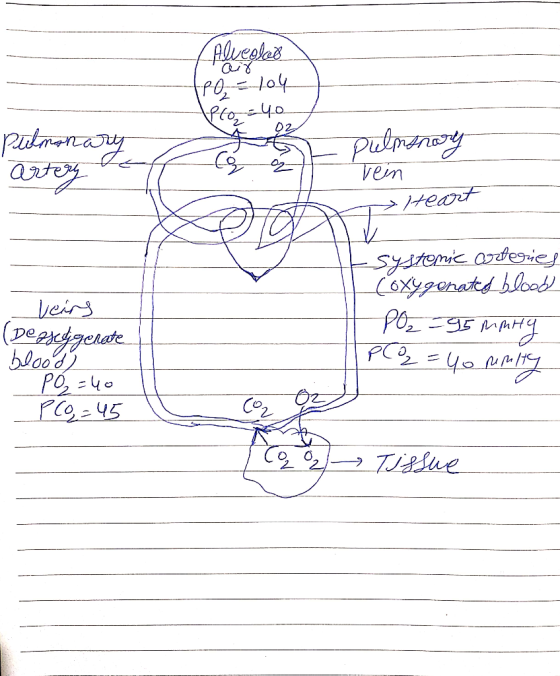
Hope this help you, good luck
Add Answer to:
What are the partial pressures of O2 and
CO2 within the alveolar air, arteries, and veins...
A person inhales air richer in O2 and exhales air richer in CO2 and water vapor....
A person inhales air richer in O2 and exhales air richer in CO2 and water vapor. During each hour of sleep, a person exhales a total of about 300. L of this CO2−enriched and H2O-enriched air. (a) If the partial pressures of CO2 and H2O in exhaled air are each 29.3 torr at 37.0 C, calculate the masses of CO2 and of H2O exhaled in 1 h of sleep ____g CO2 ____g H2O (b) How many grams of body mass...
Question 35 2 pts The partial pressure of Oz (PO) of air in the city of...
 Question 35 2 pts The partial pressure of Oz (PO) of air in the city of Beaveropolis is 100 mmHg. The PO2 in body tissues of a person living in Beaveropolis is 40 mmHg. What is true? The PO in the alveolar air spaces of this person is less than 100 mmHg The PO2 of blood in pulmonary veins is 100 mmHg Driving force for O2 movement from systemic capillaries into tissues is 60 mmHg The PO2 of blood in...
5. A sample of exhaled air contains four gases with the following partial pressures: N2 (563...
5. A sample of exhaled air contains four gases with the following partial pressures: N2 (563 mm Hg), O2 (118 mm Hg), CO2 (30 mm Hg), and H2O (50 mm Hg). What is the total pressure of the sample? According to Dalton's Law, the total pressure is the sum of all of the individual gas pressures. That is, just add them up. 6. What volume of ammonia is produced when 0.500 mole of nitrogen reacts completely in the following equation?...
Be sure to answer all parts. A person inhales air richer in O2 and exhales air...
Be sure to answer all parts. A person inhales air richer in O2 and exhales air richer in CO2 and water vapor. During each hour of sleep, a person exhales a total of about 300. L of this CO2−enriched and H2O-enriched air. (a) If the partial pressures of CO2 and H2O in exhaled air are each 28.3 torr at 37.0°C, calculate the masses of CO2 and of H2O exhaled in 1 h of sleep. -g CO2 -g H2O (b) How...
Air is a mixture of gases with the following mass percentage composition: 75.52% N2, 23.15% O2,...
 Air is a mixture of gases with the following mass percentage
composition: 75.52% N2, 23.15% O2, 1.28% Ar, and 0.046% CO2 (a)
What are the partial pressures of N2, O2, Ar, and CO2, when the
total pressure is 1.100 atm? (b) Calculate the molar Gibbs energy
of mixing of air at 25 °C assuming ideal-gas behavior. (c)
Determine the molar enthalpy of mixing and the molar entropy of
mixing for air at 1.100 atm and 25 °C.
5. (3 pts)...
Air is a mixture of gases with the following mass percentage
composition: 75.52% N2, 23.15% O2, 1.28% Ar, and 0.046% CO2 (a)
What are the partial pressures of N2, O2, Ar, and CO2, when the
total pressure is 1.100 atm? (b) Calculate the molar Gibbs energy
of mixing of air at 25 °C assuming ideal-gas behavior. (c)
Determine the molar enthalpy of mixing and the molar entropy of
mixing for air at 1.100 atm and 25 °C.
5. (3 pts)...
Be sure to answer all parts. A person inhales air richer in O2 and exhales air...
Be sure to answer all parts. A person inhales air richer in O2 and exhales air richer in CO2 and water vapor. During each hour of sleep, a person exhales a total of about 300. L of this CO2−enriched and H2O-enriched air. (a) If the partial pressures of CO2 and H2O in exhaled air are each 29.1 torr at 37.0°C, calculate the masses of CO2 and of H2O exhaled in 1 h of sleep. _____g CO2 _____ g H2O (b)...
How do partial pressures of oxygen and CO2 vary around the body and how does this...
How do partial pressures of oxygen and CO2 vary around the body and how does this affect exchange (i.e.) direction of movement of gases in different parts of the body (lung capillary beds vs. systemic capillary beds)
The partial pressure of an air sample is given in the table below. What is the mole fraction of N2 in this air sample?...
The partial pressure of an air sample is given in the table below. What is the mole fraction of N2 in this air sample? Gases O2 N2 CO2 H2O Partial pressure (mmHg) 93 565 38 49
Question 7 1 pts Compared with oxygen, at what rate does CO2 diffuse across the alveolar-capillary...
 Question 7 1 pts Compared with oxygen, at what rate does CO2 diffuse across the alveolar-capillary membrane? O CO2 diffuses 20 times faster than O2 O CO2 diffuses 44 times slower than 02 O CO2 diffuses 20 times slower than 02 O CO2 diffuses 44 times faster than 02 Question 8 1 pts What is the term for the situation when the transfer of gas across the alveolar wall is dependent upon the blood flow past the alveolus? O perfusion...
What are the mole fractions of the components of air inside the lungs when they have...
What are the mole fractions of the components of air inside the lungs when they have the following partial pressures: 570 torr N2; 103 torr O2; 40 torr CO2; 47 torr water vapor?
 Question 35 2 pts The partial pressure of Oz (PO) of air in the city of Beaveropolis is 100 mmHg. The PO2 in body tissues of a person living in Beaveropolis is 40 mmHg. What is true? The PO in the alveolar air spaces of this person is less than 100 mmHg The PO2 of blood in pulmonary veins is 100 mmHg Driving force for O2 movement from systemic capillaries into tissues is 60 mmHg The PO2 of blood in...
 Air is a mixture of gases with the following mass percentage
composition: 75.52% N2, 23.15% O2, 1.28% Ar, and 0.046% CO2 (a)
What are the partial pressures of N2, O2, Ar, and CO2, when the
total pressure is 1.100 atm? (b) Calculate the molar Gibbs energy
of mixing of air at 25 °C assuming ideal-gas behavior. (c)
Determine the molar enthalpy of mixing and the molar entropy of
mixing for air at 1.100 atm and 25 °C.
5. (3 pts)...
Air is a mixture of gases with the following mass percentage
composition: 75.52% N2, 23.15% O2, 1.28% Ar, and 0.046% CO2 (a)
What are the partial pressures of N2, O2, Ar, and CO2, when the
total pressure is 1.100 atm? (b) Calculate the molar Gibbs energy
of mixing of air at 25 °C assuming ideal-gas behavior. (c)
Determine the molar enthalpy of mixing and the molar entropy of
mixing for air at 1.100 atm and 25 °C.
5. (3 pts)...
 Question 7 1 pts Compared with oxygen, at what rate does CO2 diffuse across the alveolar-capillary membrane? O CO2 diffuses 20 times faster than O2 O CO2 diffuses 44 times slower than 02 O CO2 diffuses 20 times slower than 02 O CO2 diffuses 44 times faster than 02 Question 8 1 pts What is the term for the situation when the transfer of gas across the alveolar wall is dependent upon the blood flow past the alveolus? O perfusion...
Most questions answered within 3 hours.
-
Where is the error in this code sequence?
String s1 = "Hello";
String s2 = "ello";...
asked 11 months ago -
Financial data for Joel de Paris, Inc., for last year
follow:
Joel de Paris, Inc.
Balance...
asked 11 months ago -
Consider this reaction:
Al2(SO4)3 (aq)+ BaCl3
(aq) Al2Cl6 (aq)- +
3BaSO4(s) . What is the...
asked 11 months ago -
Suppose that Savneet is considering increasing her
recent random sample from 20 car rentals to 40...
asked 11 months ago -
Trucks arrive at an unloading terminal at an average rate of 120
per hour.
Trucks arrive...
asked 11 months ago -
Why are methanol and ethanol completely soluble in water while
octanol is not very little soluble....
asked 11 months ago -
A facilities manager at a university reads in a research report
that the mean amount of...
asked 11 months ago -
When the CuSO4 is rehydrated by adding water to the anhydrous
compound, is this an endothermic...
asked 11 months ago -
A ray of sunlight is passing from diamond into crown glass; the
angle of incidence is...
asked 11 months ago -
A block of mass 0.249 kg is placed on top of a light, vertical
spring of...
asked 11 months ago -
how do the kidneys compensate in the presences of acidosis
a) trigger hyperventilate
b) reserve acid...
asked 11 months ago -
Question 501 pts
The rental rate of capital to the firm increases. Which of the
following...
asked 11 months ago