
Homework Answers
Add Answer to:
*4. Modified version of Lathi Prob. 1.2.2: 12 15 24 ...... Figure P1.2-1 a) Decompose the...
Kindly provide calculation and show each step. Thanks (a) Given the signal x(t) in Figure 2,...
 Kindly provide calculation and show each step. Thanks
(a) Given the signal x(t) in Figure 2, sketch the signal for: xit) 12 10 - 2- 0.2 0.4 0.6 2 14 1.6 1.8 2 0.8 Figure 2 i. x(t+2) [4 Marks] ii. x(t/3) [4 Marks] iii. x(2t) [4 Marks] iv. -X(t) [4 Marks] (b) Given the signal x(t) in Figure 3, sketch the signal for x-(2t-2): xit 25 2 1.5 1 0.5 -0.5 0.5 1 1.5 2 2.5 3.5 Figure 3...
Kindly provide calculation and show each step. Thanks
(a) Given the signal x(t) in Figure 2, sketch the signal for: xit) 12 10 - 2- 0.2 0.4 0.6 2 14 1.6 1.8 2 0.8 Figure 2 i. x(t+2) [4 Marks] ii. x(t/3) [4 Marks] iii. x(2t) [4 Marks] iv. -X(t) [4 Marks] (b) Given the signal x(t) in Figure 3, sketch the signal for x-(2t-2): xit 25 2 1.5 1 0.5 -0.5 0.5 1 1.5 2 2.5 3.5 Figure 3...
wi() (V) 3 2 1 1 234 56 7 t (ms) 4. Express the signal above...
 wi() (V) 3 2 1 1 234 56 7 t (ms) 4. Express the signal above (a) in terms of unit step and ramp functions, and (b) in terms of puls functions. (c) Show that your answers to (a) and (b) are equivalent.
Please finish these questions. Thank you Given find the Fourier transform of the following: (a) e dt 2T(2 1) 4 cos (2t) (Using properties of Fourier Transform to find) a) Suppose a signal m(t) is giv...
 Please finish these questions. Thank you
Given find the Fourier transform of the following: (a) e dt 2T(2 1) 4 cos (2t) (Using properties of Fourier Transform to find) a) Suppose a signal m(t) is given by m()-1+sin(2 fm) where fm-10 Hz. Sketch the signal m(t) in time domain b) Find the Fourier transform M(jo) of m(t) and sketch the magnitude of M(jo) c) If m(t) is amplitude modulated with a carrier signal by x(t)-m(t)cos(27r f,1) (where fe-1000 Hz), sketch...
Please finish these questions. Thank you
Given find the Fourier transform of the following: (a) e dt 2T(2 1) 4 cos (2t) (Using properties of Fourier Transform to find) a) Suppose a signal m(t) is given by m()-1+sin(2 fm) where fm-10 Hz. Sketch the signal m(t) in time domain b) Find the Fourier transform M(jo) of m(t) and sketch the magnitude of M(jo) c) If m(t) is amplitude modulated with a carrier signal by x(t)-m(t)cos(27r f,1) (where fe-1000 Hz), sketch...
7 Draw the continuous time signal. x(t)={r(t)-r(t-2)-r(t-4)+r(t-6)}+{u(t+4)-2u(t+2)+2u(t)-u(t-6)} where [u(t) is unit step signal and r(t) is...
 7 Draw the continuous time signal. x(t)={r(t)-r(t-2)-r(t-4)+r(t-6)}+{u(t+4)-2u(t+2)+2u(t)-u(t-6)} where [u(t) is unit step signal and r(t) is unit ramp signal]. And sketch the following i. yl(t)=x[-1-2) ii. y2(t)=x[3-t] 15 Marks
Problem 1. (15 points each) For the signal f (t) f(t) 3 2 せ - 1...
 Problem 1. (15 points each) For the signal f (t) f(t) 3 2 せ - 1 2 3 a) Describe signal f (t) in a compact form by using unit step functions b) Find and sketch(t) dt
1. Consider the signal represented in Figure 1. a) Write an analytical formula to represent the...
 1. Consider the signal represented in Figure 1. a) Write an analytical formula to represent the signal x(t). b) Consider the signal x(t). For each of the following combinations, draw the signal and indicate its duration, extension and area: Xa(t) = x(t – 3); xo(t) = x(2t); Ic(t) = x(-3(t + 1)); Id(t) = 2x(2t) – x(t) – 2x(-(t + 4)); Le(t) = xd(t) + rect(476). c) Compute the Fourier transform of r(t). AX(t) 2 1 2 5 7 t...
For a signal representation shown graphically, it can be represented in terms of some basic signals...
 For a signal representation shown graphically, it can be represented in terms of some basic signals such as unit step function. Consider the graphical representation of signal as in Figure Q1. (a) State the expression of x(t) in terms of the unit step function. (4 marks) (b) Find the expression for xo(t) and xe(t). (8 marks) (c) Plot y(t) = 3x(2t - 1). (5 marks) (d) Determine the energy and power of the signal x(t) given in Figure Q1. 0...
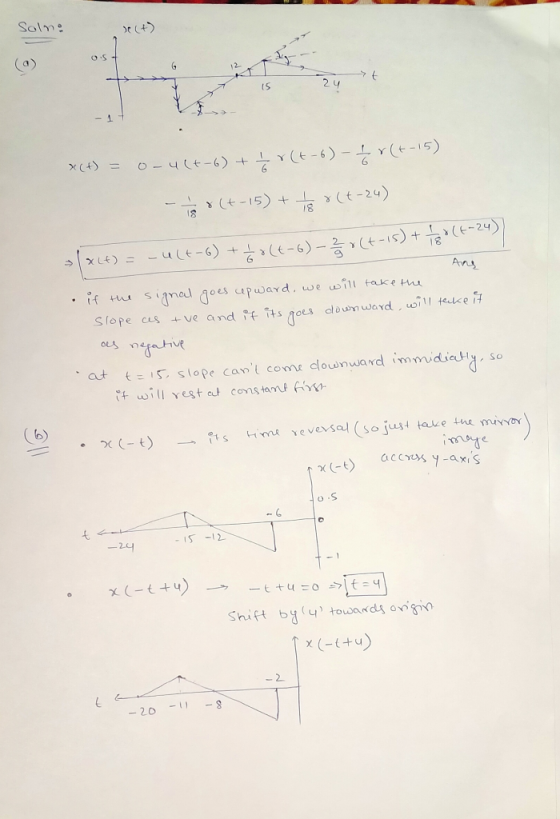
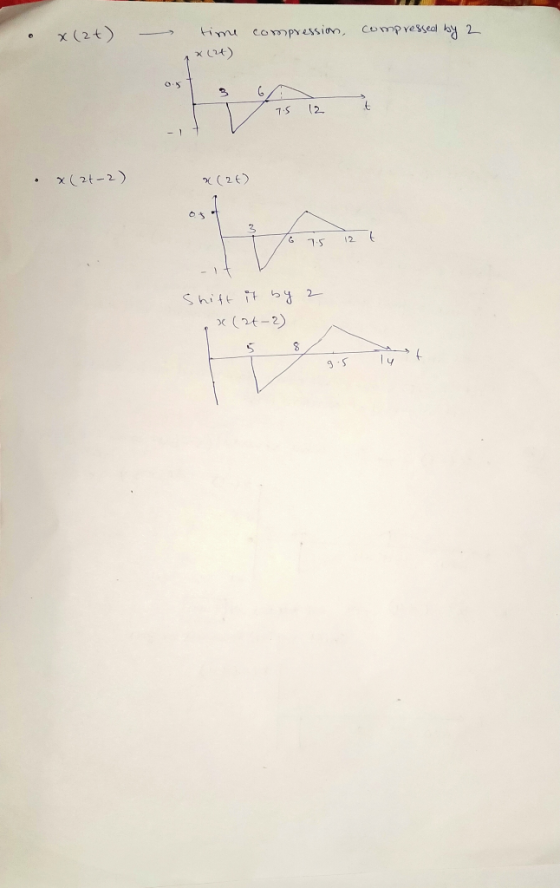
For the signal g(t) shown in the following figure: a. Sketch the signals: 4. i) g(20)...
 For the signal g(t) shown in the following figure: a. Sketch the signals: 4. i) g(20) ii) g(t-12) iii) g(6t) iv) g(3-t) find the energies of all the signals in part (a) b. g(t) 0.5 0 12 15 24
I'm not sure, is the final amswers a) 12 >(FT)> 24 pi s(w) b) x(w)= 5[pi...
 I'm
not sure, is the final amswers
a) 12 >(FT)> 24 pi s(w)
b) x(w)= 5[pi s (w+7) + 1/j(w+7) ]
c) sin 2t >(FT)> pi/2j [ s(w-2) - s(w+2)]
Did I get them correct?
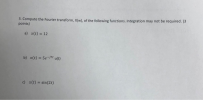
), of the following functions. Integration may not be required. 3 3 Compute the Fourier transform, X points) a) x(t) 12 -j7t b) x(t) - 5e-17 u(t) sin(2t) c) x(t)
I'm
not sure, is the final amswers
a) 12 >(FT)> 24 pi s(w)
b) x(w)= 5[pi s (w+7) + 1/j(w+7) ]
c) sin 2t >(FT)> pi/2j [ s(w-2) - s(w+2)]
Did I get them correct?
), of the following functions. Integration may not be required. 3 3 Compute the Fourier transform, X points) a) x(t) 12 -j7t b) x(t) - 5e-17 u(t) sin(2t) c) x(t)
Question 4 Given z(t) as shown in the figure a) Sketch z(t 1) b) Sketch a(t...
 Question 4 Given z(t) as shown in the figure a) Sketch z(t 1) b) Sketch a(t -2) c) Sketch z(2t +1) d) Sketch r(4-t/2) 2.5 115 Question 5 Given z(t) as shown in the figure, sketch -3zt 0
 Kindly provide calculation and show each step. Thanks
(a) Given the signal x(t) in Figure 2, sketch the signal for: xit) 12 10 - 2- 0.2 0.4 0.6 2 14 1.6 1.8 2 0.8 Figure 2 i. x(t+2) [4 Marks] ii. x(t/3) [4 Marks] iii. x(2t) [4 Marks] iv. -X(t) [4 Marks] (b) Given the signal x(t) in Figure 3, sketch the signal for x-(2t-2): xit 25 2 1.5 1 0.5 -0.5 0.5 1 1.5 2 2.5 3.5 Figure 3...
Kindly provide calculation and show each step. Thanks
(a) Given the signal x(t) in Figure 2, sketch the signal for: xit) 12 10 - 2- 0.2 0.4 0.6 2 14 1.6 1.8 2 0.8 Figure 2 i. x(t+2) [4 Marks] ii. x(t/3) [4 Marks] iii. x(2t) [4 Marks] iv. -X(t) [4 Marks] (b) Given the signal x(t) in Figure 3, sketch the signal for x-(2t-2): xit 25 2 1.5 1 0.5 -0.5 0.5 1 1.5 2 2.5 3.5 Figure 3...
 wi() (V) 3 2 1 1 234 56 7 t (ms) 4. Express the signal above (a) in terms of unit step and ramp functions, and (b) in terms of puls functions. (c) Show that your answers to (a) and (b) are equivalent.
 Please finish these questions. Thank you
Given find the Fourier transform of the following: (a) e dt 2T(2 1) 4 cos (2t) (Using properties of Fourier Transform to find) a) Suppose a signal m(t) is given by m()-1+sin(2 fm) where fm-10 Hz. Sketch the signal m(t) in time domain b) Find the Fourier transform M(jo) of m(t) and sketch the magnitude of M(jo) c) If m(t) is amplitude modulated with a carrier signal by x(t)-m(t)cos(27r f,1) (where fe-1000 Hz), sketch...
Please finish these questions. Thank you
Given find the Fourier transform of the following: (a) e dt 2T(2 1) 4 cos (2t) (Using properties of Fourier Transform to find) a) Suppose a signal m(t) is given by m()-1+sin(2 fm) where fm-10 Hz. Sketch the signal m(t) in time domain b) Find the Fourier transform M(jo) of m(t) and sketch the magnitude of M(jo) c) If m(t) is amplitude modulated with a carrier signal by x(t)-m(t)cos(27r f,1) (where fe-1000 Hz), sketch...
 7 Draw the continuous time signal. x(t)={r(t)-r(t-2)-r(t-4)+r(t-6)}+{u(t+4)-2u(t+2)+2u(t)-u(t-6)} where [u(t) is unit step signal and r(t) is unit ramp signal]. And sketch the following i. yl(t)=x[-1-2) ii. y2(t)=x[3-t] 15 Marks
 Problem 1. (15 points each) For the signal f (t) f(t) 3 2 せ - 1 2 3 a) Describe signal f (t) in a compact form by using unit step functions b) Find and sketch(t) dt
 1. Consider the signal represented in Figure 1. a) Write an analytical formula to represent the signal x(t). b) Consider the signal x(t). For each of the following combinations, draw the signal and indicate its duration, extension and area: Xa(t) = x(t – 3); xo(t) = x(2t); Ic(t) = x(-3(t + 1)); Id(t) = 2x(2t) – x(t) – 2x(-(t + 4)); Le(t) = xd(t) + rect(476). c) Compute the Fourier transform of r(t). AX(t) 2 1 2 5 7 t...
 For a signal representation shown graphically, it can be represented in terms of some basic signals such as unit step function. Consider the graphical representation of signal as in Figure Q1. (a) State the expression of x(t) in terms of the unit step function. (4 marks) (b) Find the expression for xo(t) and xe(t). (8 marks) (c) Plot y(t) = 3x(2t - 1). (5 marks) (d) Determine the energy and power of the signal x(t) given in Figure Q1. 0...
 For the signal g(t) shown in the following figure: a. Sketch the signals: 4. i) g(20) ii) g(t-12) iii) g(6t) iv) g(3-t) find the energies of all the signals in part (a) b. g(t) 0.5 0 12 15 24
 I'm
not sure, is the final amswers
a) 12 >(FT)> 24 pi s(w)
b) x(w)= 5[pi s (w+7) + 1/j(w+7) ]
c) sin 2t >(FT)> pi/2j [ s(w-2) - s(w+2)]
Did I get them correct?
), of the following functions. Integration may not be required. 3 3 Compute the Fourier transform, X points) a) x(t) 12 -j7t b) x(t) - 5e-17 u(t) sin(2t) c) x(t)
I'm
not sure, is the final amswers
a) 12 >(FT)> 24 pi s(w)
b) x(w)= 5[pi s (w+7) + 1/j(w+7) ]
c) sin 2t >(FT)> pi/2j [ s(w-2) - s(w+2)]
Did I get them correct?
), of the following functions. Integration may not be required. 3 3 Compute the Fourier transform, X points) a) x(t) 12 -j7t b) x(t) - 5e-17 u(t) sin(2t) c) x(t)
 Question 4 Given z(t) as shown in the figure a) Sketch z(t 1) b) Sketch a(t -2) c) Sketch z(2t +1) d) Sketch r(4-t/2) 2.5 115 Question 5 Given z(t) as shown in the figure, sketch -3zt 0
Most questions answered within 3 hours.
-
Where is the error in this code sequence?
String s1 = "Hello";
String s2 = "ello";...
asked 10 months ago -
Financial data for Joel de Paris, Inc., for last year
follow:
Joel de Paris, Inc.
Balance...
asked 10 months ago -
Consider this reaction:
Al2(SO4)3 (aq)+ BaCl3
(aq) Al2Cl6 (aq)- +
3BaSO4(s) . What is the...
asked 10 months ago -
Suppose that Savneet is considering increasing her
recent random sample from 20 car rentals to 40...
asked 10 months ago -
Trucks arrive at an unloading terminal at an average rate of 120
per hour.
Trucks arrive...
asked 10 months ago -
Why are methanol and ethanol completely soluble in water while
octanol is not very little soluble....
asked 10 months ago -
A facilities manager at a university reads in a research report
that the mean amount of...
asked 10 months ago -
When the CuSO4 is rehydrated by adding water to the anhydrous
compound, is this an endothermic...
asked 10 months ago -
A ray of sunlight is passing from diamond into crown glass; the
angle of incidence is...
asked 10 months ago -
A block of mass 0.249 kg is placed on top of a light, vertical
spring of...
asked 10 months ago -
how do the kidneys compensate in the presences of acidosis
a) trigger hyperventilate
b) reserve acid...
asked 10 months ago -
Question 501 pts
The rental rate of capital to the firm increases. Which of the
following...
asked 10 months ago