
Homework Answers
![o] given 202 A i + v. suor 14 150 Ⓡ at Methode Node Node voltage A apply V -15 V VA = 2 + I = 0 20 from son circuit I = 0.125](http://img.homeworklib.com/questions/11c66cb0-2408-11eb-96bf-ad522e013a88.png?x-oss-process=image/resize,w_560)
![Now apply KVL in dotted loop VA+5 VA + Vo =0 a Vo=-40 → Vo = -0.25V, put Vain Equation © 0.55[-0-25 v.] +0.125 Vo = 0.75 -0.0](http://img.homeworklib.com/questions/12662830-2408-11eb-bf8f-a74d47140648.png?x-oss-process=image/resize,w_560)
Add Answer to:
2. In the circuit below, use the node-voltage method to find v, and the power dissipated...
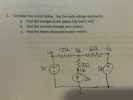
Any help would be appreciated! 12 1. Consider the circuit below. Use the node-voltage method to:...
 Any help would be appreciated!
12
1. Consider the circuit below. Use the node-voltage method to: a. Find the voltages at the points A,B, and C. +D b. Find the currents through each resistor C. Find the Power dissipated in each resistor. UA 122 VB 62 vc 3352 3u sv - 1 vo A 2A sve
Any help would be appreciated!
12
1. Consider the circuit below. Use the node-voltage method to: a. Find the voltages at the points A,B, and C. +D b. Find the currents through each resistor C. Find the Power dissipated in each resistor. UA 122 VB 62 vc 3352 3u sv - 1 vo A 2A sve
4.22 a) Use the node-voltage method to find v, and a the power delivered by the...
 4.22 a) Use the node-voltage method to find v, and a the power delivered by the 2 A current source sintax in the circuit in Fig. P4.22. Use node a as the reference node. b) Repeat part (a), but use node b as the refer- ence node. c) Compare the choice of reference node in (a) and (b). Which is better, and why? Figure P4.22 25 V 20Ω に! 2 A 150Ω 55Ω
2. Use the node-voltage method to find the phasor voltage V, in the circuit shown in...
 2. Use the node-voltage method to find the phasor voltage V, in the circuit shown in Figure Express the voltage both in polar and rectangular form. 3412 I+-8N Á vš50 (-) 2.4 1. () 10+j10
The source voltage vg in the circuit in figure equals 32 V. Use the node-voltage method...
 The source voltage vg in the circuit in figure equals 32 V. Use
the node-voltage method to find the power developed by the 32 V
source.
****NOT A 20V BUT A 32 V SOURCE. DISREGARD WHAT THE PICTURE
SAYS. JUST USE THE PICTURE FOR THE CIRCUIT***
Use the node-voltage method to find the power devel- oped by the 20 V source in the circuit 35 i 2Ω 1Ω 4Ω ぢ> 3.125 v
The source voltage vg in the circuit in figure equals 32 V. Use
the node-voltage method to find the power developed by the 32 V
source.
****NOT A 20V BUT A 32 V SOURCE. DISREGARD WHAT THE PICTURE
SAYS. JUST USE THE PICTURE FOR THE CIRCUIT***
Use the node-voltage method to find the power devel- oped by the 20 V source in the circuit 35 i 2Ω 1Ω 4Ω ぢ> 3.125 v
a) Use the node-voltage method to find the magnitude of total power developed in the circuit....
 a) Use the node-voltage method to find the magnitude of total
power developed in the circuit.
b) Find the magnitude of the total power absorbed in the
circuit
Consider the circuit shown in (Figure 1). Suppose that R-1300 Ω and k-2500 Figure 200 Ω 20 mA kis
a) Use the node-voltage method to find the magnitude of total
power developed in the circuit.
b) Find the magnitude of the total power absorbed in the
circuit
Consider the circuit shown in (Figure 1). Suppose that R-1300 Ω and k-2500 Figure 200 Ω 20 mA kis
When solving PLEASE use NODE ANALYSIS 3.11 Find V, and the power dissipated in all the...
 When solving PLEASE use NODE ANALYSIS
3.11 Find V, and the power dissipated in all the resistors in the circuit of Fig. 3.60. 12 2 62 60 V 122 24 V
When solving PLEASE use NODE ANALYSIS
3.11 Find V, and the power dissipated in all the resistors in the circuit of Fig. 3.60. 12 2 62 60 V 122 24 V
Use the node-voltage method to find how much power the current source extracts from the circuit(Figure...
 Use the node-voltage method to find how much power the current
source extracts from the circuit(Figure 1) if i = 2.6A and
v = 60V .
Thanks
Use the node-voltage method to find how much power the current
source extracts from the circuit(Figure 1) if i = 2.6A and
v = 60V .
Thanks
2. The voltage across the 22.522 resistor in the circuit below is 90 V, positive at...
 2. The voltage across the 22.522 resistor in the circuit below is 90 V, positive at the upper terminal A 90 V 222.5 1 240 V 512 20.02 mise (a) Find the power dissipated in each resistor (b) Find the power delivered by the voltage source.
Learning Goal: To use the node-voltage method to solve circuits with branches containing only a voltage...
 Learning Goal: To use the node-voltage method to solve circuits with branches containing only a voltage source. The node-voltage method is a general technique for solving circuits. Fundamentally, it involves writing KCL equations at essential nodes. When the circuit contains a dependent source, you must write a constraint equation for each dependent source, in addition to the KCL equations. When the circuit contains one or more voltage sources that are the only components in branches connecting two essential nodes, the...
Find voltage A voltage b current a power dissipated by R1 power dissipated by R2 R1...
 Find
voltage A
voltage b
current a
power dissipated by R1
power dissipated by R2
R1 va 5k + Vb - V1 - 15 V R2 10k 11 4mA Figure 1: Passive DC Network
Find
voltage A
voltage b
current a
power dissipated by R1
power dissipated by R2
R1 va 5k + Vb - V1 - 15 V R2 10k 11 4mA Figure 1: Passive DC Network
 Any help would be appreciated!
12
1. Consider the circuit below. Use the node-voltage method to: a. Find the voltages at the points A,B, and C. +D b. Find the currents through each resistor C. Find the Power dissipated in each resistor. UA 122 VB 62 vc 3352 3u sv - 1 vo A 2A sve
Any help would be appreciated!
12
1. Consider the circuit below. Use the node-voltage method to: a. Find the voltages at the points A,B, and C. +D b. Find the currents through each resistor C. Find the Power dissipated in each resistor. UA 122 VB 62 vc 3352 3u sv - 1 vo A 2A sve
 4.22 a) Use the node-voltage method to find v, and a the power delivered by the 2 A current source sintax in the circuit in Fig. P4.22. Use node a as the reference node. b) Repeat part (a), but use node b as the refer- ence node. c) Compare the choice of reference node in (a) and (b). Which is better, and why? Figure P4.22 25 V 20Ω に! 2 A 150Ω 55Ω
 2. Use the node-voltage method to find the phasor voltage V, in the circuit shown in Figure Express the voltage both in polar and rectangular form. 3412 I+-8N Á vš50 (-) 2.4 1. () 10+j10
 The source voltage vg in the circuit in figure equals 32 V. Use
the node-voltage method to find the power developed by the 32 V
source.
****NOT A 20V BUT A 32 V SOURCE. DISREGARD WHAT THE PICTURE
SAYS. JUST USE THE PICTURE FOR THE CIRCUIT***
Use the node-voltage method to find the power devel- oped by the 20 V source in the circuit 35 i 2Ω 1Ω 4Ω ぢ> 3.125 v
The source voltage vg in the circuit in figure equals 32 V. Use
the node-voltage method to find the power developed by the 32 V
source.
****NOT A 20V BUT A 32 V SOURCE. DISREGARD WHAT THE PICTURE
SAYS. JUST USE THE PICTURE FOR THE CIRCUIT***
Use the node-voltage method to find the power devel- oped by the 20 V source in the circuit 35 i 2Ω 1Ω 4Ω ぢ> 3.125 v
 a) Use the node-voltage method to find the magnitude of total
power developed in the circuit.
b) Find the magnitude of the total power absorbed in the
circuit
Consider the circuit shown in (Figure 1). Suppose that R-1300 Ω and k-2500 Figure 200 Ω 20 mA kis
a) Use the node-voltage method to find the magnitude of total
power developed in the circuit.
b) Find the magnitude of the total power absorbed in the
circuit
Consider the circuit shown in (Figure 1). Suppose that R-1300 Ω and k-2500 Figure 200 Ω 20 mA kis
 When solving PLEASE use NODE ANALYSIS
3.11 Find V, and the power dissipated in all the resistors in the circuit of Fig. 3.60. 12 2 62 60 V 122 24 V
When solving PLEASE use NODE ANALYSIS
3.11 Find V, and the power dissipated in all the resistors in the circuit of Fig. 3.60. 12 2 62 60 V 122 24 V
 Use the node-voltage method to find how much power the current
source extracts from the circuit(Figure 1) if i = 2.6A and
v = 60V .
Thanks
Use the node-voltage method to find how much power the current
source extracts from the circuit(Figure 1) if i = 2.6A and
v = 60V .
Thanks
 2. The voltage across the 22.522 resistor in the circuit below is 90 V, positive at the upper terminal A 90 V 222.5 1 240 V 512 20.02 mise (a) Find the power dissipated in each resistor (b) Find the power delivered by the voltage source.
 Learning Goal: To use the node-voltage method to solve circuits with branches containing only a voltage source. The node-voltage method is a general technique for solving circuits. Fundamentally, it involves writing KCL equations at essential nodes. When the circuit contains a dependent source, you must write a constraint equation for each dependent source, in addition to the KCL equations. When the circuit contains one or more voltage sources that are the only components in branches connecting two essential nodes, the...
 Find
voltage A
voltage b
current a
power dissipated by R1
power dissipated by R2
R1 va 5k + Vb - V1 - 15 V R2 10k 11 4mA Figure 1: Passive DC Network
Find
voltage A
voltage b
current a
power dissipated by R1
power dissipated by R2
R1 va 5k + Vb - V1 - 15 V R2 10k 11 4mA Figure 1: Passive DC Network
Most questions answered within 3 hours.
-
Where is the error in this code sequence?
String s1 = "Hello";
String s2 = "ello";...
asked 11 months ago -
Financial data for Joel de Paris, Inc., for last year
follow:
Joel de Paris, Inc.
Balance...
asked 11 months ago -
Consider this reaction:
Al2(SO4)3 (aq)+ BaCl3
(aq) Al2Cl6 (aq)- +
3BaSO4(s) . What is the...
asked 11 months ago -
Suppose that Savneet is considering increasing her
recent random sample from 20 car rentals to 40...
asked 11 months ago -
Trucks arrive at an unloading terminal at an average rate of 120
per hour.
Trucks arrive...
asked 11 months ago -
Why are methanol and ethanol completely soluble in water while
octanol is not very little soluble....
asked 11 months ago -
A facilities manager at a university reads in a research report
that the mean amount of...
asked 11 months ago -
When the CuSO4 is rehydrated by adding water to the anhydrous
compound, is this an endothermic...
asked 11 months ago -
A ray of sunlight is passing from diamond into crown glass; the
angle of incidence is...
asked 11 months ago -
A block of mass 0.249 kg is placed on top of a light, vertical
spring of...
asked 11 months ago -
how do the kidneys compensate in the presences of acidosis
a) trigger hyperventilate
b) reserve acid...
asked 11 months ago -
Question 501 pts
The rental rate of capital to the firm increases. Which of the
following...
asked 11 months ago