The total charge that has entered a circuit element is q(t) = 6 (1 - e-8t)...
The total charge that has entered a circuit element is
q(t) = 6 (1 -
e-8t) when t ≥ 0
and q(t) = 0 when t < 0. The current
in the element for t ≥ 0 can be represented as
A where B and a are real constants. Determine
the values of B and a.
Homework Answers
Request Answer!
We need at least 10 more requests to produce the answer.
0 / 10 have requested this problem solution
The more requests, the faster the answer.
Add Answer to:
The total charge that has entered a circuit element is
q(t) = 6 (1 -
e-8t)...
The total amount of charge that has entered a wire at time t is given by...
The total amount of charge that has entered a wire at time t is given by the expression Q=(74C)(1−e−t/(2.0s)), where t is in seconds and t≥0. Part B What is the maximum value of the current? Express your answer using two significant figures.
The total amount of charge in coulombs that has entered a wire at time t is...
The total amount of charge in coulombs that has entered a wire at time t is given by the expression Q=4t?t2, where t is in seconds and t?0. Find an expression for the current I in the wire at time t, where t is in seconds and I is in amperes. Graph I versus t for the interval 0?t?4s.
In a series resistance-capacitance DC circuit, the instantaneous charge Q on the capacitor as a... In...
In a series resistance-capacitance DC circuit, the instantaneous charge Q on the capacitor as a... In a series resistance-capacitance DC circuit, the instantaneous charge Q on the capacitor as a function of time (where t=0 is the moment the circuit is energized by closing a switch) is given by the equation Q(t)=CV(1-e-t/(RC), where C, V, and R are constants. Further, the instantaneous charging current Ic is the rate of change of charge on the capacitor, or Ic=dQ/dt a. Find the...
The equations for the charge Q(t) and current i (t) in the following LRC circuit are Question 3 (...
 3
The equations for the charge Q(t) and current i (t) in the following LRC circuit are Question 3 (5 points) Saved 0 amps dt C 10 amps i(t) dt 10 amps where the applied voltage VA -Vp V cos at as soon as the switch S is closed at t 0 Question 4 (5 points Saved ift) 10 amps -10 amps 0 amps Qrt The general solution is: please hand in at your recitation, the graphs of when Q(0)-i(0-0,...
3
The equations for the charge Q(t) and current i (t) in the following LRC circuit are Question 3 (5 points) Saved 0 amps dt C 10 amps i(t) dt 10 amps where the applied voltage VA -Vp V cos at as soon as the switch S is closed at t 0 Question 4 (5 points Saved ift) 10 amps -10 amps 0 amps Qrt The general solution is: please hand in at your recitation, the graphs of when Q(0)-i(0-0,...
Problem 7.2-10 is(t), A 7.8 88 2 0.40F v(t) 3.9 t, S 0.50 1.00 Consider this circuit together wit...
 Circuits Chapter #7
Problem 7.2-10 is(t), A 7.8 88 2 0.40F v(t) 3.9 t, S 0.50 1.00 Consider this circuit together with the plot that describes the current source current. The initial voltage across the capacitor in this circuit is v(o) 19 V. Between times O and 0.50 seconds the capacitor voltage can be represented as v(t) = A + B t2 . Determine the values of the constants A and B: V/s2 A= Between times t 0.50 and 1.00...
Circuits Chapter #7
Problem 7.2-10 is(t), A 7.8 88 2 0.40F v(t) 3.9 t, S 0.50 1.00 Consider this circuit together with the plot that describes the current source current. The initial voltage across the capacitor in this circuit is v(o) 19 V. Between times O and 0.50 seconds the capacitor voltage can be represented as v(t) = A + B t2 . Determine the values of the constants A and B: V/s2 A= Between times t 0.50 and 1.00...
Given the current, i(t), entering a device, determine how much charge, Q, has entered the device...
 Given the current, i(t), entering a device, determine how much charge, Q, has entered the device at t= 2 msec. Air), A. 3x10. A., Outlines i 6x6 -A, 14tL3s. 3x10't + 12x10 A Jet24.s. A., 420 ms. 6 3 Device time. 3 a. 7.5 nC. b. 10.5uC. Oc. 12 nc. d. 1.5 uC. e. 6 nc.
(s) l?l1t? quantiv ol charge. Q. Ill CoUlombS passing through an electrical circuit is: Q -...
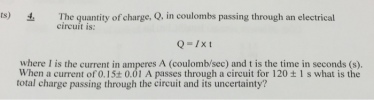 (s) l?l1t? quantiv ol charge. Q. Ill CoUlombS passing through an electrical circuit is: Q - ix t where I is the current in �imperes A (coulomb/sec) and t is the time in seconds (s). When a current ot?0. 15� 0.01 A passes through a circuit t�r 120 � 1 s what is the total charge passing through �he circuit and its uncertainty?
Find the charge q(t) on the capacitor and the current i(t) in the given LRC-series circuit 1-1 h,...
 Find the charge q(t) on the capacitor and the current i(t) in the given LRC-series circuit 1-1 h, R-100 Ω, C-0.0004 f, E(t)-20 V, q(0)-0 C, i(0) 3 A Find the maximum charge on the capacitor. (Round your answer to four decimal places.) Need Help? Read It Talk to a Tutor
Find the charge q(t) on the capacitor and the current i(t) in the given LRC-series circuit 1-1 h, R-100 Ω, C-0.0004 f, E(t)-20 V, q(0)-0 C, i(0) 3 A...
Find the charge q(t) on the capacitor and the current i(t) in the given LRC-series circuit 1-1 h, R-100 Ω, C-0.0004 f, E(t)-20 V, q(0)-0 C, i(0) 3 A Find the maximum charge on the capacitor. (Round your answer to four decimal places.) Need Help? Read It Talk to a Tutor
Find the charge q(t) on the capacitor and the current i(t) in the given LRC-series circuit 1-1 h, R-100 Ω, C-0.0004 f, E(t)-20 V, q(0)-0 C, i(0) 3 A...
Find the charge q(t) on the capacitor and the current i(t) in the given LRC-series circuit....
 Find the charge q(t) on the capacitor and the current i(t) in the given LRC-series circuit. 5 h, R 2 1 f, E(t) 20 = 0 A 10 , C 200 V, q(0) 0 C, i(0) q(t) C i(t) A Find the maximum charge on the capacitor. (Round your answer to three decimal places.) C C II
Find the charge q(t) on the capacitor and the current i(t) in the given LRC-series circuit. 5 h, R 2 1 f, E(t)...
Find the charge q(t) on the capacitor and the current i(t) in the given LRC-series circuit. 5 h, R 2 1 f, E(t) 20 = 0 A 10 , C 200 V, q(0) 0 C, i(0) q(t) C i(t) A Find the maximum charge on the capacitor. (Round your answer to three decimal places.) C C II
Find the charge q(t) on the capacitor and the current i(t) in the given LRC-series circuit. 5 h, R 2 1 f, E(t)...
6.3 Exercises In Exercises 1-5 find the current in the RLC circuit, assuming that E(t) =...
 6.3 Exercises In Exercises 1-5 find the current in the RLC circuit, assuming that E(t) = 0 fort > 0. 1. R = 3 ohms; L = 1 henrysC = .01 farads; Q. = 0 coulombs, 10 = 2 amperes. 11. Show that if E(t) = U coswt +V sin wt where U and V are constants then the steady state current in the RLC circuit shown in Figure 6.3.1 is w?RE(t) + (1/C - Lw?) E' (t) I where...
 3
The equations for the charge Q(t) and current i (t) in the following LRC circuit are Question 3 (5 points) Saved 0 amps dt C 10 amps i(t) dt 10 amps where the applied voltage VA -Vp V cos at as soon as the switch S is closed at t 0 Question 4 (5 points Saved ift) 10 amps -10 amps 0 amps Qrt The general solution is: please hand in at your recitation, the graphs of when Q(0)-i(0-0,...
3
The equations for the charge Q(t) and current i (t) in the following LRC circuit are Question 3 (5 points) Saved 0 amps dt C 10 amps i(t) dt 10 amps where the applied voltage VA -Vp V cos at as soon as the switch S is closed at t 0 Question 4 (5 points Saved ift) 10 amps -10 amps 0 amps Qrt The general solution is: please hand in at your recitation, the graphs of when Q(0)-i(0-0,...
 Circuits Chapter #7
Problem 7.2-10 is(t), A 7.8 88 2 0.40F v(t) 3.9 t, S 0.50 1.00 Consider this circuit together with the plot that describes the current source current. The initial voltage across the capacitor in this circuit is v(o) 19 V. Between times O and 0.50 seconds the capacitor voltage can be represented as v(t) = A + B t2 . Determine the values of the constants A and B: V/s2 A= Between times t 0.50 and 1.00...
Circuits Chapter #7
Problem 7.2-10 is(t), A 7.8 88 2 0.40F v(t) 3.9 t, S 0.50 1.00 Consider this circuit together with the plot that describes the current source current. The initial voltage across the capacitor in this circuit is v(o) 19 V. Between times O and 0.50 seconds the capacitor voltage can be represented as v(t) = A + B t2 . Determine the values of the constants A and B: V/s2 A= Between times t 0.50 and 1.00...
 Given the current, i(t), entering a device, determine how much charge, Q, has entered the device at t= 2 msec. Air), A. 3x10. A., Outlines i 6x6 -A, 14tL3s. 3x10't + 12x10 A Jet24.s. A., 420 ms. 6 3 Device time. 3 a. 7.5 nC. b. 10.5uC. Oc. 12 nc. d. 1.5 uC. e. 6 nc.
 (s) l?l1t? quantiv ol charge. Q. Ill CoUlombS passing through an electrical circuit is: Q - ix t where I is the current in �imperes A (coulomb/sec) and t is the time in seconds (s). When a current ot?0. 15� 0.01 A passes through a circuit t�r 120 � 1 s what is the total charge passing through �he circuit and its uncertainty?
 Find the charge q(t) on the capacitor and the current i(t) in the given LRC-series circuit 1-1 h, R-100 Ω, C-0.0004 f, E(t)-20 V, q(0)-0 C, i(0) 3 A Find the maximum charge on the capacitor. (Round your answer to four decimal places.) Need Help? Read It Talk to a Tutor
Find the charge q(t) on the capacitor and the current i(t) in the given LRC-series circuit 1-1 h, R-100 Ω, C-0.0004 f, E(t)-20 V, q(0)-0 C, i(0) 3 A...
Find the charge q(t) on the capacitor and the current i(t) in the given LRC-series circuit 1-1 h, R-100 Ω, C-0.0004 f, E(t)-20 V, q(0)-0 C, i(0) 3 A Find the maximum charge on the capacitor. (Round your answer to four decimal places.) Need Help? Read It Talk to a Tutor
Find the charge q(t) on the capacitor and the current i(t) in the given LRC-series circuit 1-1 h, R-100 Ω, C-0.0004 f, E(t)-20 V, q(0)-0 C, i(0) 3 A...
 Find the charge q(t) on the capacitor and the current i(t) in the given LRC-series circuit. 5 h, R 2 1 f, E(t) 20 = 0 A 10 , C 200 V, q(0) 0 C, i(0) q(t) C i(t) A Find the maximum charge on the capacitor. (Round your answer to three decimal places.) C C II
Find the charge q(t) on the capacitor and the current i(t) in the given LRC-series circuit. 5 h, R 2 1 f, E(t)...
Find the charge q(t) on the capacitor and the current i(t) in the given LRC-series circuit. 5 h, R 2 1 f, E(t) 20 = 0 A 10 , C 200 V, q(0) 0 C, i(0) q(t) C i(t) A Find the maximum charge on the capacitor. (Round your answer to three decimal places.) C C II
Find the charge q(t) on the capacitor and the current i(t) in the given LRC-series circuit. 5 h, R 2 1 f, E(t)...
 6.3 Exercises In Exercises 1-5 find the current in the RLC circuit, assuming that E(t) = 0 fort > 0. 1. R = 3 ohms; L = 1 henrysC = .01 farads; Q. = 0 coulombs, 10 = 2 amperes. 11. Show that if E(t) = U coswt +V sin wt where U and V are constants then the steady state current in the RLC circuit shown in Figure 6.3.1 is w?RE(t) + (1/C - Lw?) E' (t) I where...
Most questions answered within 3 hours.
-
Where is the error in this code sequence?
String s1 = "Hello";
String s2 = "ello";...
asked 10 months ago -
Financial data for Joel de Paris, Inc., for last year
follow:
Joel de Paris, Inc.
Balance...
asked 10 months ago -
Consider this reaction:
Al2(SO4)3 (aq)+ BaCl3
(aq) Al2Cl6 (aq)- +
3BaSO4(s) . What is the...
asked 10 months ago -
Suppose that Savneet is considering increasing her
recent random sample from 20 car rentals to 40...
asked 10 months ago -
Trucks arrive at an unloading terminal at an average rate of 120
per hour.
Trucks arrive...
asked 10 months ago -
Why are methanol and ethanol completely soluble in water while
octanol is not very little soluble....
asked 10 months ago -
A facilities manager at a university reads in a research report
that the mean amount of...
asked 10 months ago -
When the CuSO4 is rehydrated by adding water to the anhydrous
compound, is this an endothermic...
asked 10 months ago -
A ray of sunlight is passing from diamond into crown glass; the
angle of incidence is...
asked 10 months ago -
A block of mass 0.249 kg is placed on top of a light, vertical
spring of...
asked 10 months ago -
how do the kidneys compensate in the presences of acidosis
a) trigger hyperventilate
b) reserve acid...
asked 10 months ago -
Question 501 pts
The rental rate of capital to the firm increases. Which of the
following...
asked 10 months ago