
Homework Answers

Add Answer to:
FORCES Name Mech HW-33 TAS, represent the system consisting of links and 2 of the chain...
Mech Newton's second and third laws HW-40 2. Two crates, A and B, are in an...
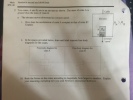 Mech Newton's second and third laws HW-40 2. Two crates, A and B, are in an elevator as shown. The mass of crate A is Cable greater than the mass of crate B. a. The elevator moves downward at constant speed. Elevator i. How does the acceleration of crate A compare to that of crate B? Explain. A MA Constant ii. In the spaces provided below, draw and label separate free-body speed diagrams for the crates. Free-body diagram for Free-body...
Whenever you face a problem involving forces, always start with a free-body diagram.
 Learning Goal: To gain practice drawing free-body diagramsWhenever you face a problem involving forces, always start with a free-body diagram.To draw a free-body diagram use the following steps:Isolate the object of interest. It is customary to represent the object of interest as a point in your diagram.Identify all the forces acting on the object and their directions. Do not include forces acting on other objects in the problem. Also, do not include quantities, such as velocities and accelerations, that do...
Part 3: Let system A now contain just the lower brick on the stack of two...
 Part 3:
Let system A now contain just the lower brick on the
stack of two bricks. Call the top brick system C. Now we have three
systems, one for each brick. The hand is pushing horizontally with
a constant speed. In this situation the coefficient of friction
between the bricks and table is less than that in question 1 (where
the friction was not negligible and the coefficient of friction was
not given).
A. Compare the magnitude of the...
Part 3:
Let system A now contain just the lower brick on the
stack of two bricks. Call the top brick system C. Now we have three
systems, one for each brick. The hand is pushing horizontally with
a constant speed. In this situation the coefficient of friction
between the bricks and table is less than that in question 1 (where
the friction was not negligible and the coefficient of friction was
not given).
A. Compare the magnitude of the...
In the analysis of a beam you are tasked to find the reaction forces on a...
 In the analysis of a beam you are tasked to find the reaction forces on a loaded beam shown in the figure below Two slightly different free body diagrams on the same loaded beam are drawn: DIAGRAM 1 AGRAM 2 cos(9) ich statement regarding the two diagrams is correct? ct one: b. Ax =-C, and A,--C, d. The two diagrams do not represent the same system. e. Neither diagram represents the physical system.
5) ( 40 /oints) Consider the system shown below The weight orali other olycs is nedpble...
 5) ( 40 /oints) Consider the system shown below The weight orali other olycs is nedpble Draw free body diagrams of all the objects in the system and Label them Follow the rules we've leamest in slass in rcgarding which obiects should be drawn and what to includs Includo free boty diagram of the whole frame You do NOT need to include dimensions or angles on your free body diagrams. With cach free body diagram, construct all equations noeded to...
More details and instructions in picture below 1) draw the forces acting on each mass *pulleys...
 More details and instructions in picture below
1) draw the forces acting on each mass *pulleys are "ideal".
(use appropriate coordinate systems)
2) sum the forces in x,y and find acceleration
Free Body Diagram. Three masses mi, m2, and m3 are attached by a light rope that does not stretch. The rope goes over two massless and frictionless pulleys. Draw the complete free body diagram on each of the three masses. The coefficient of kinetic friction between mi and the...
More details and instructions in picture below
1) draw the forces acting on each mass *pulleys are "ideal".
(use appropriate coordinate systems)
2) sum the forces in x,y and find acceleration
Free Body Diagram. Three masses mi, m2, and m3 are attached by a light rope that does not stretch. The rope goes over two massless and frictionless pulleys. Draw the complete free body diagram on each of the three masses. The coefficient of kinetic friction between mi and the...
Problem #1(10pts) Consider the system shown in the figure consisting of a circular cross section eylinder with center ABC. A counterclockwise torque of 10 kN-m is applied to the cylinder at D Det...
 Problem #1(10pts) Consider the system shown in the figure consisting of a circular cross section eylinder with center ABC. A counterclockwise torque of 10 kN-m is applied to the cylinder at D Determine the force (P) applied at point B on the bar to prevent rot cylinder equal to 0.25 m and the coefficient of static friction equal to 0.40 ation of the cylinder. Take the radius of the 0.15 m , Hint: You need to consider free body diagram...
Name Student ID Score last first IV. [18 points total] A block oscillates on a spring as shown at right. At time , the...
 Name Student ID Score last first IV. [18 points total] A block oscillates on a spring as shown at right. At time , the block moves downward at its maximum speed; at time t2, the spring is stretched and the block is at its turn-around point. A. [3 pts] In the space at right, draw a free-body diagram for the block at instant. Label the forces to indicate (1) the type of force, (2) the object exerting the force, and...
Spreading forces over surfaces I. Block that floats when released A cubical block is observed to...
 Spreading forces over surfaces I. Block that floats when released A cubical block is observed to float in a beaker of water. The block is then held near the center of the beaker as shown and released. A. Describe the motion of the block after it is released. Lab section B. Draw a free-body diagram for the block at the instant that it is Free-body diagram for block at instant it is released released. Rather than drawing a single force...
Answer them in the format of the second image. Steps and neat please. Thank you Problems...
 Answer them in the format of
the second image. Steps and neat please. Thank you
Problems 1 through 5 (4 points each - partial credit is possible): Complete the free body diagrams on your answer sheet for the systems shown below. Label each force or couple you add and specify the direction of any force that is not horizontal or vertical to the page. Friction and weight are to be neglected. Do not attempt to enforce equilibrium, except that two-force...
Answer them in the format of
the second image. Steps and neat please. Thank you
Problems 1 through 5 (4 points each - partial credit is possible): Complete the free body diagrams on your answer sheet for the systems shown below. Label each force or couple you add and specify the direction of any force that is not horizontal or vertical to the page. Friction and weight are to be neglected. Do not attempt to enforce equilibrium, except that two-force...
 Mech Newton's second and third laws HW-40 2. Two crates, A and B, are in an elevator as shown. The mass of crate A is Cable greater than the mass of crate B. a. The elevator moves downward at constant speed. Elevator i. How does the acceleration of crate A compare to that of crate B? Explain. A MA Constant ii. In the spaces provided below, draw and label separate free-body speed diagrams for the crates. Free-body diagram for Free-body...
 Learning Goal: To gain practice drawing free-body diagramsWhenever you face a problem involving forces, always start with a free-body diagram.To draw a free-body diagram use the following steps:Isolate the object of interest. It is customary to represent the object of interest as a point in your diagram.Identify all the forces acting on the object and their directions. Do not include forces acting on other objects in the problem. Also, do not include quantities, such as velocities and accelerations, that do...
 Part 3:
Let system A now contain just the lower brick on the
stack of two bricks. Call the top brick system C. Now we have three
systems, one for each brick. The hand is pushing horizontally with
a constant speed. In this situation the coefficient of friction
between the bricks and table is less than that in question 1 (where
the friction was not negligible and the coefficient of friction was
not given).
A. Compare the magnitude of the...
Part 3:
Let system A now contain just the lower brick on the
stack of two bricks. Call the top brick system C. Now we have three
systems, one for each brick. The hand is pushing horizontally with
a constant speed. In this situation the coefficient of friction
between the bricks and table is less than that in question 1 (where
the friction was not negligible and the coefficient of friction was
not given).
A. Compare the magnitude of the...
 In the analysis of a beam you are tasked to find the reaction forces on a loaded beam shown in the figure below Two slightly different free body diagrams on the same loaded beam are drawn: DIAGRAM 1 AGRAM 2 cos(9) ich statement regarding the two diagrams is correct? ct one: b. Ax =-C, and A,--C, d. The two diagrams do not represent the same system. e. Neither diagram represents the physical system.
 5) ( 40 /oints) Consider the system shown below The weight orali other olycs is nedpble Draw free body diagrams of all the objects in the system and Label them Follow the rules we've leamest in slass in rcgarding which obiects should be drawn and what to includs Includo free boty diagram of the whole frame You do NOT need to include dimensions or angles on your free body diagrams. With cach free body diagram, construct all equations noeded to...
 More details and instructions in picture below
1) draw the forces acting on each mass *pulleys are "ideal".
(use appropriate coordinate systems)
2) sum the forces in x,y and find acceleration
Free Body Diagram. Three masses mi, m2, and m3 are attached by a light rope that does not stretch. The rope goes over two massless and frictionless pulleys. Draw the complete free body diagram on each of the three masses. The coefficient of kinetic friction between mi and the...
More details and instructions in picture below
1) draw the forces acting on each mass *pulleys are "ideal".
(use appropriate coordinate systems)
2) sum the forces in x,y and find acceleration
Free Body Diagram. Three masses mi, m2, and m3 are attached by a light rope that does not stretch. The rope goes over two massless and frictionless pulleys. Draw the complete free body diagram on each of the three masses. The coefficient of kinetic friction between mi and the...
 Problem #1(10pts) Consider the system shown in the figure consisting of a circular cross section eylinder with center ABC. A counterclockwise torque of 10 kN-m is applied to the cylinder at D Determine the force (P) applied at point B on the bar to prevent rot cylinder equal to 0.25 m and the coefficient of static friction equal to 0.40 ation of the cylinder. Take the radius of the 0.15 m , Hint: You need to consider free body diagram...
 Name Student ID Score last first IV. [18 points total] A block oscillates on a spring as shown at right. At time , the block moves downward at its maximum speed; at time t2, the spring is stretched and the block is at its turn-around point. A. [3 pts] In the space at right, draw a free-body diagram for the block at instant. Label the forces to indicate (1) the type of force, (2) the object exerting the force, and...
 Spreading forces over surfaces I. Block that floats when released A cubical block is observed to float in a beaker of water. The block is then held near the center of the beaker as shown and released. A. Describe the motion of the block after it is released. Lab section B. Draw a free-body diagram for the block at the instant that it is Free-body diagram for block at instant it is released released. Rather than drawing a single force...
 Answer them in the format of
the second image. Steps and neat please. Thank you
Problems 1 through 5 (4 points each - partial credit is possible): Complete the free body diagrams on your answer sheet for the systems shown below. Label each force or couple you add and specify the direction of any force that is not horizontal or vertical to the page. Friction and weight are to be neglected. Do not attempt to enforce equilibrium, except that two-force...
Answer them in the format of
the second image. Steps and neat please. Thank you
Problems 1 through 5 (4 points each - partial credit is possible): Complete the free body diagrams on your answer sheet for the systems shown below. Label each force or couple you add and specify the direction of any force that is not horizontal or vertical to the page. Friction and weight are to be neglected. Do not attempt to enforce equilibrium, except that two-force...
Most questions answered within 3 hours.
-
Where is the error in this code sequence?
String s1 = "Hello";
String s2 = "ello";...
asked 10 months ago -
Financial data for Joel de Paris, Inc., for last year
follow:
Joel de Paris, Inc.
Balance...
asked 10 months ago -
Consider this reaction:
Al2(SO4)3 (aq)+ BaCl3
(aq) Al2Cl6 (aq)- +
3BaSO4(s) . What is the...
asked 10 months ago -
Suppose that Savneet is considering increasing her
recent random sample from 20 car rentals to 40...
asked 10 months ago -
Trucks arrive at an unloading terminal at an average rate of 120
per hour.
Trucks arrive...
asked 10 months ago -
Why are methanol and ethanol completely soluble in water while
octanol is not very little soluble....
asked 10 months ago -
A facilities manager at a university reads in a research report
that the mean amount of...
asked 10 months ago -
When the CuSO4 is rehydrated by adding water to the anhydrous
compound, is this an endothermic...
asked 10 months ago -
A ray of sunlight is passing from diamond into crown glass; the
angle of incidence is...
asked 10 months ago -
A block of mass 0.249 kg is placed on top of a light, vertical
spring of...
asked 10 months ago -
how do the kidneys compensate in the presences of acidosis
a) trigger hyperventilate
b) reserve acid...
asked 10 months ago -
Question 501 pts
The rental rate of capital to the firm increases. Which of the
following...
asked 10 months ago