Don't need answer to 1 and 2. NEED solution for rest of questions please.
Homework Answers
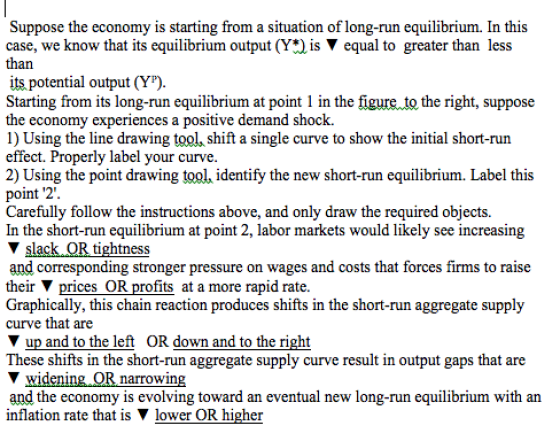
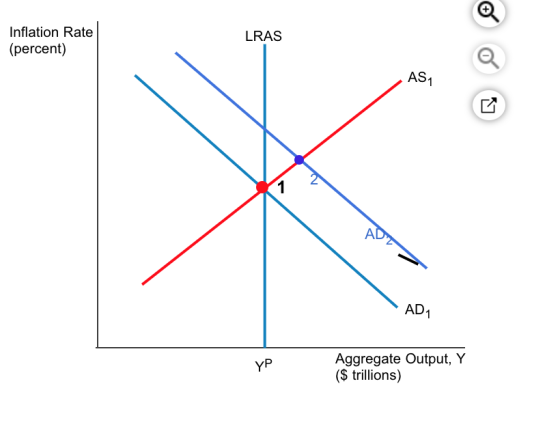
At point 2, the actual output is higher than the potential output. Therefore, the unemployment is lower than the natural rate of employment.
Thus, the labour market is tight
(Tight means very low unemployment- demand high but supply of labour low)
Due to this, there would be an upward pressure on wages. As a result, firms will be forced to increase their prices
Higher wage costs would force producers to reduce production, therefore supply curve would shift inwards (to the left)
Therefore, the output gap narrows as actual output decreases to come in line with the potential output.
The new long run equilibrium would have higher inflation as the wages have increased, demand has increased.
Add Answer to:
Don't need answer to 1 and 2. NEED solution for rest of
questions please.
Suppose the...
LRAS In the graph to the right illustrating the AD-AS model, assume the economy was in...
 LRAS In the graph to the right illustrating the AD-AS model, assume the economy was in equilibrium at point E1. Then, assume there was a decline in spending on new houses. Where does short-run equilibrium occur? Where does long-run equilibrium occur? 1.) Using the point drawing tool, plot the point that represents short-run equilibrium. Label this point E2. Price level, P. SRAS a SRAS2E1 2.) Using the point drawing tool, plot the point that represents long-run equilibrium. Label this point...
2. Phillips Curve. An economy has the following functions for its short run aggregate supply (SRAS),...
 2. Phillips Curve. An economy has the following functions for its short run aggregate supply (SRAS), Okun's Law (OL), and Phillips Curve (PC): SRAS: P = EP + (1/2)(y - 3) OL: (Y-Y) = -4(u-u") PC:T = ET - (1/5)( - 6) The economy begins at its natural rate of output with a stable price level equal to $5. a.) Output is at its natural level when the price level is equal to expectations. Calculate the natural rate of output...
HELP!! Need to know how to do the graphs for these. And can you please explain...
 HELP!! Need to know how to do the graphs for these. And can you
please explain it to me so I can learn it?
Part 2: Short Answer Questions (30 points) Problem 3: Short run and long run economic analysis (20 points) Suppue thar he gonemanses hosabs incentive to consume. Consider the impact of this event on the short run economy and long run economy using the AD/AS model. Draw here the following the AD/AS diagram. Assume, for the sake...
HELP!! Need to know how to do the graphs for these. And can you
please explain it to me so I can learn it?
Part 2: Short Answer Questions (30 points) Problem 3: Short run and long run economic analysis (20 points) Suppue thar he gonemanses hosabs incentive to consume. Consider the impact of this event on the short run economy and long run economy using the AD/AS model. Draw here the following the AD/AS diagram. Assume, for the sake...
supply curve to shift leftward to SRAS, as shown in the graph at right. The economy is currently in short-run equilibrium at point E, and the reduction in supply is expected to be permanent. LRAS...
 supply curve to shift leftward to SRAS, as shown in the graph at right. The economy is currently in short-run equilibrium at point E, and the reduction in supply is expected to be permanent. LRAS SRAS SRAS 1.) Using the line drawing and/or 3-point curved line drawing tool, show the adjustment to long-run equilibrium in this situation. Properly label your new curve(s). 2.) Using the point drawing tool, identify the new long-run equilibrium point and label the point 'E2 Carefully...
Describe three types of short-run macroeconomic equilibrium.
 Describe three types of short-run macroeconomic equilibrium. A macroeconomic equilibrium in which real GDP is less than potential GDP is _______ equilibrium. And one in which real GDP equals potential GDP is _______ equlibrium. A. a below full-employment, a full-employment B. a full-employment, a below full-employment C. a full-employment, an inflationary D. a below full-employment, a recessionary The graph shows an economy's long-run aggregate supply curve. The economy is at an above full-employment equilibrium. Draw an aggregate demand curve and a short-run aggregate supply curve. Label them. In the graph,...
The graph shows the economy in long-run equilibrium Then the world economy expands and the demand...
 The graph shows the economy in long-run equilibrium Then the world economy expands and the demand for U.S.-produced goods increases Price level (GDP deflator, 2009-100) 14 Draw a curve that shows 1) the effect of increased demand for U.S.-produced goods. Label it 1 2) the effect of a rising money wage rate that returns the economy to full employment. Label it 2. Draw a point at the new long-run equilibrium 13 SAS 12 An economy is in a long-run equilibrium....
Keynesian Analyses Graph: You may use your preferred drawing tool such as Paint, Word, PowerPoint or...
Keynesian Analyses Graph: You may use your preferred drawing tool such as Paint, Word, PowerPoint or you can use pencil and paper for this assignment. You are to illustrate/graph long run aggregate supply curve, short run aggregate supply curve and aggregate demand curve in equilibrium. The equilibrium price level is $110 and equilibrium output level is 12 trillion. Show a shift of the curve that leads to an inflationary gap. Label the new curve and label the inflationary gap. Capture...
1) The long-run aggregate supply curve shifts to the right when there is A) a decrease...
 1) The long-run aggregate supply curve shifts to the right when there is A) a decrease in the total amount of capital in the economy. B) a decrease in the total amount of labor supplied in the economy. C) a decrease in the available technology. D) a decline in the natural rate of unemployment. 2) The short-run aggregate supply curve shifts to the right when A) output gap is higher. B) output gap is lower. C) expected inflation is higher....
Consider the aggregate demand – aggregate supply (AD-AS) model. Assume the economy is initially at its...
Consider the aggregate demand – aggregate supply (AD-AS) model. Assume the economy is initially at its long-run equilibrium. Produce a new graph, draw the aggregated demand curve, short-run aggregate supply curve, and the long-run aggregate supply curve and label the curves. Label both the horizonal and vertical axes clearly. Label the long-run equilibrium as A and its corresponding output level as Y1 Now assume a positive supply shock hits the economy. In the graph, show the short-run effects of this...
Suppose that workers and firms perfectly forecast inflation, so that the real wage remains unchanged as...
 Suppose that workers and firms perfectly forecast inflation, so that the real wage remains unchanged as the price level rises over time. Prices and wages rise at the same rate, which implies that the real wage stays constant. The following graph shows the aggregate demand curve (AD) in an economy in long-run equilibrium. Assume the natural rate of unemployment is 6%, and potential output is $50 trillion. Use the orange points (square symbol) to draw the aggregate supply curve in...
 LRAS In the graph to the right illustrating the AD-AS model, assume the economy was in equilibrium at point E1. Then, assume there was a decline in spending on new houses. Where does short-run equilibrium occur? Where does long-run equilibrium occur? 1.) Using the point drawing tool, plot the point that represents short-run equilibrium. Label this point E2. Price level, P. SRAS a SRAS2E1 2.) Using the point drawing tool, plot the point that represents long-run equilibrium. Label this point...
 2. Phillips Curve. An economy has the following functions for its short run aggregate supply (SRAS), Okun's Law (OL), and Phillips Curve (PC): SRAS: P = EP + (1/2)(y - 3) OL: (Y-Y) = -4(u-u") PC:T = ET - (1/5)( - 6) The economy begins at its natural rate of output with a stable price level equal to $5. a.) Output is at its natural level when the price level is equal to expectations. Calculate the natural rate of output...
 HELP!! Need to know how to do the graphs for these. And can you
please explain it to me so I can learn it?
Part 2: Short Answer Questions (30 points) Problem 3: Short run and long run economic analysis (20 points) Suppue thar he gonemanses hosabs incentive to consume. Consider the impact of this event on the short run economy and long run economy using the AD/AS model. Draw here the following the AD/AS diagram. Assume, for the sake...
HELP!! Need to know how to do the graphs for these. And can you
please explain it to me so I can learn it?
Part 2: Short Answer Questions (30 points) Problem 3: Short run and long run economic analysis (20 points) Suppue thar he gonemanses hosabs incentive to consume. Consider the impact of this event on the short run economy and long run economy using the AD/AS model. Draw here the following the AD/AS diagram. Assume, for the sake...
 supply curve to shift leftward to SRAS, as shown in the graph at right. The economy is currently in short-run equilibrium at point E, and the reduction in supply is expected to be permanent. LRAS SRAS SRAS 1.) Using the line drawing and/or 3-point curved line drawing tool, show the adjustment to long-run equilibrium in this situation. Properly label your new curve(s). 2.) Using the point drawing tool, identify the new long-run equilibrium point and label the point 'E2 Carefully...
 The graph shows the economy in long-run equilibrium Then the world economy expands and the demand for U.S.-produced goods increases Price level (GDP deflator, 2009-100) 14 Draw a curve that shows 1) the effect of increased demand for U.S.-produced goods. Label it 1 2) the effect of a rising money wage rate that returns the economy to full employment. Label it 2. Draw a point at the new long-run equilibrium 13 SAS 12 An economy is in a long-run equilibrium....
 1) The long-run aggregate supply curve shifts to the right when there is A) a decrease in the total amount of capital in the economy. B) a decrease in the total amount of labor supplied in the economy. C) a decrease in the available technology. D) a decline in the natural rate of unemployment. 2) The short-run aggregate supply curve shifts to the right when A) output gap is higher. B) output gap is lower. C) expected inflation is higher....
 Suppose that workers and firms perfectly forecast inflation, so that the real wage remains unchanged as the price level rises over time. Prices and wages rise at the same rate, which implies that the real wage stays constant. The following graph shows the aggregate demand curve (AD) in an economy in long-run equilibrium. Assume the natural rate of unemployment is 6%, and potential output is $50 trillion. Use the orange points (square symbol) to draw the aggregate supply curve in...
Most questions answered within 3 hours.
-
Where is the error in this code sequence?
String s1 = "Hello";
String s2 = "ello";...
asked 10 months ago -
Financial data for Joel de Paris, Inc., for last year
follow:
Joel de Paris, Inc.
Balance...
asked 10 months ago -
Consider this reaction:
Al2(SO4)3 (aq)+ BaCl3
(aq) Al2Cl6 (aq)- +
3BaSO4(s) . What is the...
asked 10 months ago -
Suppose that Savneet is considering increasing her
recent random sample from 20 car rentals to 40...
asked 10 months ago -
Trucks arrive at an unloading terminal at an average rate of 120
per hour.
Trucks arrive...
asked 10 months ago -
Why are methanol and ethanol completely soluble in water while
octanol is not very little soluble....
asked 10 months ago -
A facilities manager at a university reads in a research report
that the mean amount of...
asked 10 months ago -
When the CuSO4 is rehydrated by adding water to the anhydrous
compound, is this an endothermic...
asked 10 months ago -
A ray of sunlight is passing from diamond into crown glass; the
angle of incidence is...
asked 10 months ago -
A block of mass 0.249 kg is placed on top of a light, vertical
spring of...
asked 10 months ago -
how do the kidneys compensate in the presences of acidosis
a) trigger hyperventilate
b) reserve acid...
asked 10 months ago -
Question 501 pts
The rental rate of capital to the firm increases. Which of the
following...
asked 10 months ago