This is a question from data structures and algorithms.
Please help me with this question with correct answer. Please
answer fully. I’m stucked.
Homework Answers
`Hey,
Note: Brother in case of any queries, just comment in box I would be very happy to assist all your queries
a)
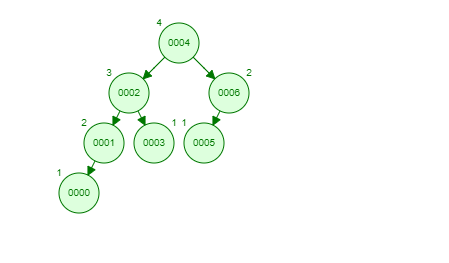
b)
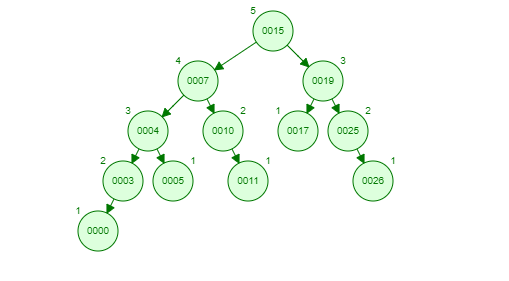
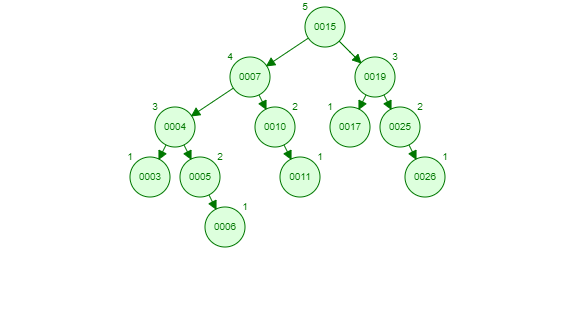
Kindly revert for any queries
Thanks.
Add Answer to:
This is a question from data structures and algorithms.
Please help me with this question with...
Data Structures and Algorithms What is the: a. maximum number of levels that a binary search...
Data Structures and Algorithms What is the: a. maximum number of levels that a binary search tree with 100 nodes can have? b. minimum number of levels that a binary search tree with 100 nodes can have? c. maximum total number of nodes in a binary tree that has N levels? (Remember that the root is level 0.) d. maximum number of nodes in the Nth level of a binary tree? e. number of ancestors of a node in the...
C++ Data Structures and Algorithms Binary Trees: Implementation Answer the following question(s) concerning implementing recursive functions...
C++ Data Structures and Algorithms Binary Trees: Implementation Answer the following question(s) concerning implementing recursive functions to perform operations on linked lists of nodes arranged as binary trees. For these questions, use the following struct definition for the nodes of the tree (we will not templatize the node here, so you do not have to write template functions for these questions, just assume trees of <int>values): struct BinaryTreeNode { int item; BinaryTreeNode* left; BinaryTreeNode* right; }; Write a recursive function...
ALGORITHM AND DATA STRUCTURES Question Question 1: Convert the following binary tree into a heap using...
ALGORITHM AND DATA STRUCTURES Question Question 1: Convert the following binary tree into a heap using the Heapify algorithm. Draw the diagrams of the tree step by step after every alteration. Question 2: Show the heap that results when the items are inserted into the heap one by one, starting with one that is empty. 7, 3, 8, 1, 4, 20, 11, 33, 45, 23, 6 Question 3. Draw the 2-3-4 tree that results when values are inserted in the...
Data structures Exercises: For the following binary tree (Index-Value): 0 1 2 3 4 5 6...
Data structures Exercises: For the following binary tree (Index-Value): 0 1 2 3 4 5 6 7 8 9 A C E G B P D X F H Give the pre-order traversal. Give the post-order traversal. Give the in-order traversal. Determine the height of the tree. Using these values: 8 6 4 3 5 9 2 1 6 Build a binary search tree. Build an AVL Tree. Build a 2-3 Tree. Build a min-heap. Build a max-heap. Apply a...
Please Help me with the following This stem and leaf plot shows the height of several...
Please Help me with the following This stem and leaf plot shows the height of several trees. Height in Feet and Inches of Several Trees 5 0,2,5,8,11 6 0 7 6,8 8 5,6,6,7,9,11 What is the number of trees that are LESS than 8 feet tall? 17 8 11 7 This stem and leaf plot shows the height of several trees. Height in Feet and Inches of Several Trees 5 0,2,5,8,11 6 0 7 6,8 8 5,6,6,7,9,11 What is the...
just need to answer the second question 3 AVL Trees Assume the following notation/operations on AVL trees....
 just need to answer the second question
3 AVL Trees Assume the following notation/operations on AVL trees. An empty AVL tree is denoted E. A non-empty AVL tree T has three attributes: . The key T.key is the root node's key. The left child T.left is T's left subtree, which is an AVL tree (possibly E). The right child T.right is T's right subtree, which is an AVL tree (possibly E) [3 marks] Describe an alternative version of the RANGECOUNT(T,...
just need to answer the second question
3 AVL Trees Assume the following notation/operations on AVL trees. An empty AVL tree is denoted E. A non-empty AVL tree T has three attributes: . The key T.key is the root node's key. The left child T.left is T's left subtree, which is an AVL tree (possibly E). The right child T.right is T's right subtree, which is an AVL tree (possibly E) [3 marks] Describe an alternative version of the RANGECOUNT(T,...
Can anyone help me find the best answer for this question please "Give one example from...
Can anyone help me find the best answer for this question please "Give one example from your own experience that the rate changes as a result of temperature. Explain what is going on"
Data Structures & Algorithms . Solve this problem in java(not C language) . Question 1(Queue) Write...
Data Structures & Algorithms . Solve this problem in java(not C language) . Question 1(Queue) Write a program that display list of choices for the user to interact with the program as follow: Queue Operations Menu: 1.Add a new item 2.Delete the first item 3.Show number of items in the Queue 4.Find an item 5.Show all items 6.Exit
Answer the following questions regarding the following data structures: i. 11 ii. 4 iii. 2 iv....
Answer the following questions regarding the following data structures: i. 11 ii. 4 iii. 2 iv. 5 v. 7 vi. 5 / \ / /|\ / \ /|\ \ 17 22 2 3 4 5 3 7 3 4 8 7 /\ /\ \ \| / \ / \ /|\ \ / \ 6 2 9 33 3 9 2 5 8 1 2 5 9 6 9 Which are valid trees? List all correct answers. Which are valid binary...
Data Structures and Algorithms Help please :) POLJOPP 3. Consider QuickSort on the array Aſlanand assume...
 Data Structures and Algorithms
Help please :)
POLJOPP 3. Consider QuickSort on the array Aſlanand assume that the pivot element x (used to split the array Allo:hil into two portions such that all elements in the left portion Allom) are sx and all elements in the right portion Aſm:hi) are >x) is the last element of the array to be split (i. e., A[hi]). For a specific value of n at least 11 (your choice), construct an assignment of the...
Data Structures and Algorithms
Help please :)
POLJOPP 3. Consider QuickSort on the array Aſlanand assume that the pivot element x (used to split the array Allo:hil into two portions such that all elements in the left portion Allom) are sx and all elements in the right portion Aſm:hi) are >x) is the last element of the array to be split (i. e., A[hi]). For a specific value of n at least 11 (your choice), construct an assignment of the...
 just need to answer the second question
3 AVL Trees Assume the following notation/operations on AVL trees. An empty AVL tree is denoted E. A non-empty AVL tree T has three attributes: . The key T.key is the root node's key. The left child T.left is T's left subtree, which is an AVL tree (possibly E). The right child T.right is T's right subtree, which is an AVL tree (possibly E) [3 marks] Describe an alternative version of the RANGECOUNT(T,...
just need to answer the second question
3 AVL Trees Assume the following notation/operations on AVL trees. An empty AVL tree is denoted E. A non-empty AVL tree T has three attributes: . The key T.key is the root node's key. The left child T.left is T's left subtree, which is an AVL tree (possibly E). The right child T.right is T's right subtree, which is an AVL tree (possibly E) [3 marks] Describe an alternative version of the RANGECOUNT(T,...
 Data Structures and Algorithms
Help please :)
POLJOPP 3. Consider QuickSort on the array Aſlanand assume that the pivot element x (used to split the array Allo:hil into two portions such that all elements in the left portion Allom) are sx and all elements in the right portion Aſm:hi) are >x) is the last element of the array to be split (i. e., A[hi]). For a specific value of n at least 11 (your choice), construct an assignment of the...
Data Structures and Algorithms
Help please :)
POLJOPP 3. Consider QuickSort on the array Aſlanand assume that the pivot element x (used to split the array Allo:hil into two portions such that all elements in the left portion Allom) are sx and all elements in the right portion Aſm:hi) are >x) is the last element of the array to be split (i. e., A[hi]). For a specific value of n at least 11 (your choice), construct an assignment of the...
Most questions answered within 3 hours.
-
Where is the error in this code sequence?
String s1 = "Hello";
String s2 = "ello";...
asked 11 months ago -
Financial data for Joel de Paris, Inc., for last year
follow:
Joel de Paris, Inc.
Balance...
asked 11 months ago -
Consider this reaction:
Al2(SO4)3 (aq)+ BaCl3
(aq) Al2Cl6 (aq)- +
3BaSO4(s) . What is the...
asked 11 months ago -
Suppose that Savneet is considering increasing her
recent random sample from 20 car rentals to 40...
asked 11 months ago -
Trucks arrive at an unloading terminal at an average rate of 120
per hour.
Trucks arrive...
asked 11 months ago -
Why are methanol and ethanol completely soluble in water while
octanol is not very little soluble....
asked 11 months ago -
A facilities manager at a university reads in a research report
that the mean amount of...
asked 11 months ago -
When the CuSO4 is rehydrated by adding water to the anhydrous
compound, is this an endothermic...
asked 11 months ago -
A ray of sunlight is passing from diamond into crown glass; the
angle of incidence is...
asked 11 months ago -
A block of mass 0.249 kg is placed on top of a light, vertical
spring of...
asked 11 months ago -
how do the kidneys compensate in the presences of acidosis
a) trigger hyperventilate
b) reserve acid...
asked 11 months ago -
Question 501 pts
The rental rate of capital to the firm increases. Which of the
following...
asked 11 months ago