if you have 10^31 collisions, why do you divide by 6*10^23 avogadros number to get the...
if you have 10^31 collisions, why do you divide by 6*10^23 avogadros number to get the reaction rate?
Homework Answers
Solution:
Since, rate of reaction is expressed in moles litre^-1 sec^-1.
In collision theory, the collision number ( 10^31 collision) is expressed in molecules time^-1 volume^-1.
We divide collision number by Avagadro's number (NA) to convert the rate of reaction in terms of number of molecules time^-1 volume^-1 to number of moles time^-1 volume^-1.
Add Answer to:
if you have 10^31 collisions, why do you divide by 6*10^23
avogadros number to get the...
Please explain number one in detail, I'm trying to understand how and why you divide vs...
 Please explain number one in detail, I'm trying to
understand how and why you divide vs multiply the $30 Million USD
by the forward rate!
Please explain number one in detail, I'm trying to
understand how and why you divide vs multiply the $30 Million USD
by the forward rate!
Spongebob Corporation issued $700,000, 10%, 23 year bonds on December 31, 2018, when the market rate...
 Spongebob Corporation issued $700,000, 10%, 23 year bonds on December 31, 2018, when the market rate of interest was 12%. The bonds pay interest semi-annually each June 30 and December 31. What is the face value of the bond? exact number, no tolerance Spongebob Corporation issued $700,000, 10%, 23 year bonds on December 31, 2018, when the market rate of interest was 12%. The bonds pay interest semi-annually each June 30 and December 31. What is the stated rate of...
number 10, only the answer is x+2 over 8. but idk how you get that answer...
 number 10, only the answer is x+2 over 8. but idk how you get
that answer
In Problems 10 - 13, find the inverse of the given function (or state why the function has no inverse 10. f(3) = 8x - 2 11. 9(x) = 23 - 2
number 10, only the answer is x+2 over 8. but idk how you get
that answer
In Problems 10 - 13, find the inverse of the given function (or state why the function has no inverse 10. f(3) = 8x - 2 11. 9(x) = 23 - 2
6. In order to get a bonus at work you have to be able to do...
6. In order to get a bonus at work you have to be able to do a job in the fastest 12.92% of all people at work who do that job. If the time to do this job is normally distributed with a mean of 15 minutes and a standard deviation of 3 minutes what is the maximum time you have to do the job and still qualify for the bonus? (4) 7. You want to offer a warranty on...
Why do we divide enthalpies in the first problem but multiply enthalpies in the second problem....
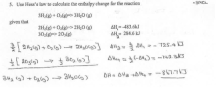 Why do we divide
enthalpies in the first problem but multiply enthalpies in the
second problem. What is different about these two problems that we
have to use a different tactic to find the enthalpy of the third
equation.
5. Use Hess's law to calculate the enthalpy change for the reaction 3PICL given that 2Hg)0(82H0() 302(g)203(g) AH-483.6k AH 284.6 k 699 →
Why do we divide
enthalpies in the first problem but multiply enthalpies in the
second problem. What is different about these two problems that we
have to use a different tactic to find the enthalpy of the third
equation.
5. Use Hess's law to calculate the enthalpy change for the reaction 3PICL given that 2Hg)0(82H0() 302(g)203(g) AH-483.6k AH 284.6 k 699 →
Insert the numbers 10, 23, 52, 29, 8, 33, 27, 4, 17 and 6 into a...
Insert the numbers 10, 23, 52, 29, 8, 33, 27, 4, 17 and 6 into a hash table of size 11. Assume that the table is initially empty and uses chaining to resolve collisions. Use a simple division-based hash function. Draw the resulting hash table. (b) Search for the numbers 35, 41 and 18 in this hash table. For each number, how many hash table elements did you have to examine? (c) In an unsuccessful search in a hash table...
Explain why each change in conditions would affect the reaction rate of reaction when sodium metal...
Explain why each change in conditions would affect the reaction rate of reaction when sodium metal reacts with chlorine gas to form NaCl? As volume increases the reaction rate will decrease because ? As concentration increases the reaction rate will increase because? As the surface area of a molecule is increased the reaction rate will increase because? As temperature decreases the reaction rate will decrease because? As pressure decreases the reaction rate will decrease because? As a catalyst is added...
Ages Number of students 15-18 10 19-22 5 23-26 9 27-30 7 31-34 6 35-38 10...
Ages Number of students 15-18 10 19-22 5 23-26 9 27-30 7 31-34 6 35-38 10 Find the relative frequency for the class with lower class limit 19 Relative Frequency = % Give your answer as a percent, rounded to two decimal places
how do I draw graph for this? collisions between ernzyme and substrate is tion rate. Sketch...
 how do I draw graph for this?
collisions between ernzyme and substrate is tion rate. Sketch this relationship on the axes in Figure 6.5 and label both axes. Lab Topic 6: Enaymes 6-5 expected to increase the reac- Figure 6.5. Eflect of temperature on Teaction rate But heat energy has another effect in addition to speeding up the move- ment of molecules. It can also disrupt the delicate attractions between the chemical side groups of amino acids, causing the enzyme...
how do I draw graph for this?
collisions between ernzyme and substrate is tion rate. Sketch this relationship on the axes in Figure 6.5 and label both axes. Lab Topic 6: Enaymes 6-5 expected to increase the reac- Figure 6.5. Eflect of temperature on Teaction rate But heat energy has another effect in addition to speeding up the move- ment of molecules. It can also disrupt the delicate attractions between the chemical side groups of amino acids, causing the enzyme...
6. Chemists tried to brominate the alkene shown below and do a SN2 with cyanide. Why...
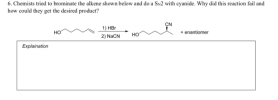 6. Chemists tried to brominate the alkene shown below and do a
SN2 with cyanide. Why did this reaction fail and how could they get
the desired product?
6. Chemists tried to brominate the alkene shown below and do a SN2 with cyanide. Why did this reaction fail and how could they get the desired product? CN но + enantiomer 2) NaCN HO Explaination
6. Chemists tried to brominate the alkene shown below and do a
SN2 with cyanide. Why did this reaction fail and how could they get
the desired product?
6. Chemists tried to brominate the alkene shown below and do a SN2 with cyanide. Why did this reaction fail and how could they get the desired product? CN но + enantiomer 2) NaCN HO Explaination
 Please explain number one in detail, I'm trying to
understand how and why you divide vs multiply the $30 Million USD
by the forward rate!
Please explain number one in detail, I'm trying to
understand how and why you divide vs multiply the $30 Million USD
by the forward rate!
 Spongebob Corporation issued $700,000, 10%, 23 year bonds on December 31, 2018, when the market rate of interest was 12%. The bonds pay interest semi-annually each June 30 and December 31. What is the face value of the bond? exact number, no tolerance Spongebob Corporation issued $700,000, 10%, 23 year bonds on December 31, 2018, when the market rate of interest was 12%. The bonds pay interest semi-annually each June 30 and December 31. What is the stated rate of...
 number 10, only the answer is x+2 over 8. but idk how you get
that answer
In Problems 10 - 13, find the inverse of the given function (or state why the function has no inverse 10. f(3) = 8x - 2 11. 9(x) = 23 - 2
number 10, only the answer is x+2 over 8. but idk how you get
that answer
In Problems 10 - 13, find the inverse of the given function (or state why the function has no inverse 10. f(3) = 8x - 2 11. 9(x) = 23 - 2
 Why do we divide
enthalpies in the first problem but multiply enthalpies in the
second problem. What is different about these two problems that we
have to use a different tactic to find the enthalpy of the third
equation.
5. Use Hess's law to calculate the enthalpy change for the reaction 3PICL given that 2Hg)0(82H0() 302(g)203(g) AH-483.6k AH 284.6 k 699 →
Why do we divide
enthalpies in the first problem but multiply enthalpies in the
second problem. What is different about these two problems that we
have to use a different tactic to find the enthalpy of the third
equation.
5. Use Hess's law to calculate the enthalpy change for the reaction 3PICL given that 2Hg)0(82H0() 302(g)203(g) AH-483.6k AH 284.6 k 699 →
 how do I draw graph for this?
collisions between ernzyme and substrate is tion rate. Sketch this relationship on the axes in Figure 6.5 and label both axes. Lab Topic 6: Enaymes 6-5 expected to increase the reac- Figure 6.5. Eflect of temperature on Teaction rate But heat energy has another effect in addition to speeding up the move- ment of molecules. It can also disrupt the delicate attractions between the chemical side groups of amino acids, causing the enzyme...
how do I draw graph for this?
collisions between ernzyme and substrate is tion rate. Sketch this relationship on the axes in Figure 6.5 and label both axes. Lab Topic 6: Enaymes 6-5 expected to increase the reac- Figure 6.5. Eflect of temperature on Teaction rate But heat energy has another effect in addition to speeding up the move- ment of molecules. It can also disrupt the delicate attractions between the chemical side groups of amino acids, causing the enzyme...
 6. Chemists tried to brominate the alkene shown below and do a
SN2 with cyanide. Why did this reaction fail and how could they get
the desired product?
6. Chemists tried to brominate the alkene shown below and do a SN2 with cyanide. Why did this reaction fail and how could they get the desired product? CN но + enantiomer 2) NaCN HO Explaination
6. Chemists tried to brominate the alkene shown below and do a
SN2 with cyanide. Why did this reaction fail and how could they get
the desired product?
6. Chemists tried to brominate the alkene shown below and do a SN2 with cyanide. Why did this reaction fail and how could they get the desired product? CN но + enantiomer 2) NaCN HO Explaination
Most questions answered within 3 hours.
-
Where is the error in this code sequence?
String s1 = "Hello";
String s2 = "ello";...
asked 10 months ago -
Financial data for Joel de Paris, Inc., for last year
follow:
Joel de Paris, Inc.
Balance...
asked 10 months ago -
Consider this reaction:
Al2(SO4)3 (aq)+ BaCl3
(aq) Al2Cl6 (aq)- +
3BaSO4(s) . What is the...
asked 10 months ago -
Suppose that Savneet is considering increasing her
recent random sample from 20 car rentals to 40...
asked 10 months ago -
Trucks arrive at an unloading terminal at an average rate of 120
per hour.
Trucks arrive...
asked 10 months ago -
Why are methanol and ethanol completely soluble in water while
octanol is not very little soluble....
asked 10 months ago -
A facilities manager at a university reads in a research report
that the mean amount of...
asked 10 months ago -
When the CuSO4 is rehydrated by adding water to the anhydrous
compound, is this an endothermic...
asked 10 months ago -
A ray of sunlight is passing from diamond into crown glass; the
angle of incidence is...
asked 10 months ago -
A block of mass 0.249 kg is placed on top of a light, vertical
spring of...
asked 10 months ago -
how do the kidneys compensate in the presences of acidosis
a) trigger hyperventilate
b) reserve acid...
asked 10 months ago -
Question 501 pts
The rental rate of capital to the firm increases. Which of the
following...
asked 10 months ago