
Homework Answers
ANSWER
A measure of free energy, the potential energy of a reaction, can be used to predict properties of chemical reactions. In the late 1800's, J. W. Gibbs showed that free energy (G) of a system can be defined as
G = H - TS
where H is the heat energy of the system, T is the temperature, and S is entropy. Heat energy (H) is a measure of the energy in a chemical bond: tightly bound molecules have higher heat energy. Entropy (S) is a measure of the disorder in a system. Molecules distributed randomly have high entropy (large S) while ordered molecules have low entropy (small S).
Every chemical reaction results in a change in free energy which we can measure as
DG = Gproducts - Greactants = Hproducts - Hreactants - T(Sproducts - Sreactants) = DH - TDS
A chemical reaction will have a DH < 0 if the heat energy of the reactants is greater than the products. A reaction will have DS < 0 if the reaction results in increased order and DS > 0 if the reaction results in increased entropy.
The net direction of a chemical reaction will be from higher to lower energy. In other words, if the energy of the reactants is higher than the energy of the products, Greactants > Gproducts, the reaction will occur spontaneously. In such a case, DG < 0, and the free energy of the system decreases with the reaction. In the opposite case, DG > 0, and energy is required for the reaction to occur.
In a mixture of reactants and products, the chemical reaction and its reverse occur until chemical equilibrium is achieved. If we begin with a large concentration of reactants, the free energy of reactants is much greater than products and the reaction proceeds. As the concentration of reactants decreases as products are formed, the difference in free energy decreases until the free energy of the products and reactants are equal. Therefore at chemical equilibrium, DG = 0.
Clearly, the free energy of a chemical reaction depends on the heat energy and entropy of the reactants and products. Free energy also depends on the concentration of reactants and products. This is because the movement of molecules from a more to less concentrated state can perform work. Reference books refer to DGo' as the standard free energy of a reaction when temperature is 298 Kelvin, pressure is 1 atm, pH is 7.0, and initial concentrations of reactants and products are equal.
When the concentrations of reactants and products are variable, we can determine DG as
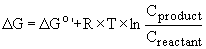
where R is the universal gas constant, T is temperature, and Cproduct, Creactant are the initial concentrations of the products and reactants.
We can plot DG as a function of Cproduct/Creactant to see how the free energy of the reaction changes as reactants are converted to product (Cproduct/Creactant increases). As an example we will look at chemical reaction of photosynthesiswhich has a standard free energy DGo' = +686 kcal/mol. The reverse reaction has DGo' = -686 kcal/mol.
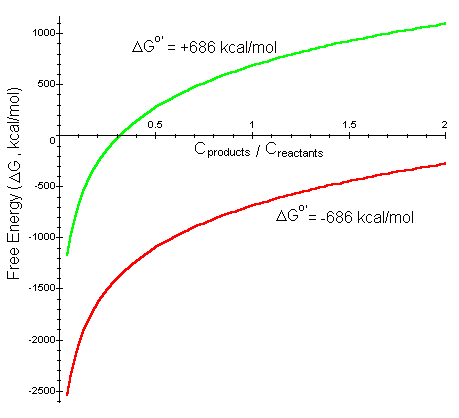
When the concentration of the reactants is much greater than the products (Cproduct/Creactant much less than 1), for both photosynthesis and the reverse reaction, DG is negative so the reaction progresses spontaneously. For the reverse reaction, as the concentration of product increases, the reaction approaches a chemical equilibrium where DG = 0. For photosynthesis, however, as the amount of product increases, DG quickly becomes positive even though less than half of the reactants have been converted to product (Cproduct/Creactant < 0.5). In other words, for more product to be created, this reaction is not spontaneous, and energy is required for the chemical reaction to occur.
We can also use this equation for DG as a function of product and reactant concentrations to determine the equilibrium constant of a reaction. The equilibrium constant (Keq) is Cproduct/Creactant when chemical equilibrium is achieved (DG = 0). By setting DG = 0 and solving for Keq we find
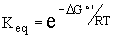
We can plot Keq as a function of DGo', we can see how the equilibrium constant is affected by the standard free energy of a chemical reaction.

For chemical reactions where the free energy of the reactants is much greater than the free energy of the products (DGo' < 0), the reaction proceeds spontaneously and the net result is a large ratio of product to reactant (large Keq). For reactions where DGo' > 0, very little of the reactant may be converted to product without the input of additional energy into the system.
Add Answer to:
9- The hydrolysis of Sucrose (Sucrose+ HO change (AG) of- 6.3 Glucose + Fructose) has a...
The hydrolysis of sucrose (C12H22O11) into glucose and fructose in acidic water has a rate constant...
The hydrolysis of sucrose (C12H22O11) into glucose and fructose in acidic water has a rate constant of 1.8×10⁻⁴s−1 at 25 ∘C.Assuming the reaction is first order in sucrose, determine the mass of sucrose that is hydrolyzed when 2.40 L of a 0.140 mol⋅L−1 sucrose solution is allowed to react for 195 minutes.
A3. The synthesis of sucrose from glucose and fructose is facilitated through the use of ATP...
 A3. The synthesis of sucrose from glucose and fructose is facilitated through the use of ATP as an energy source. The reaction equations for the process, with their Gibbs energy signs, are shown below. glucose + fructose — sucrose ATP + H20 = ADP + Pi AG = Positive AG = Negative glucose + fructose + ATP> sucrose + ADP + Pi Overall AG = Negative Answer A, B, and C. A. The two reactions shown above the line are...
The hydrolysis of sucrose (C12H22O11) into glucose and fructose in acidic water has a rate constant...
The hydrolysis of sucrose (C12H22O11) into glucose and fructose in acidic water has a rate constant of 1.8×10⁻⁴s−1 at 25 ∘C. Assuming the reaction is first order in sucrose, determine the mass of sucrose that is hydrolyzed when 2.60 L of a 0.120 M sucrose solution is allowed to react for 195 min.
The hydrolysis of sucrose (C12H22O11) into glucose and fructose in acidic water has a rate constant...
The hydrolysis of sucrose (C12H22O11) into glucose and fructose in acidic water has a rate constant of 1.8×10⁻⁴s−1 at 25 ∘C. Assuming the reaction is first order in sucrose, determine the mass of sucrose that is hydrolyzed when 2.40 L of a 0.160 M sucrose solution is allowed to react for 195 min .
The hydrolysis of sucrose (C12H22O11) into glucose and fructose in acidic water has a rate constant...
The hydrolysis of sucrose (C12H22O11) into glucose and fructose in acidic water has a rate constant of 1.8×10⁻⁴s−1 at 25 ∘C. Assuming the reaction is first order in sucrose, determine the mass of sucrose that is hydrolyzed when 2.70 L of a 0.120 M sucrose solution is allowed to react for 195 min .
HELP! Table sugar consists primarily of a molecule called sucrose a disaccharide (two-sugar molecule) formed from...
 HELP!
Table sugar consists primarily of a molecule called sucrose a disaccharide (two-sugar molecule) formed from the monosaccharides glucose and fructose In order to digest sucrose, animals must first break this molecule into glucose and fructose through a hydrolysis reaction. HO HO HO HO OH OH HO OH HO OH HO OH OH OH OH Sucrose Glucose Fructose Copyright © The President and Fellows of Harvard College Consider a hydrolysis reaction that breaks down the hypothetical compound QR: QR +...
HELP!
Table sugar consists primarily of a molecule called sucrose a disaccharide (two-sugar molecule) formed from the monosaccharides glucose and fructose In order to digest sucrose, animals must first break this molecule into glucose and fructose through a hydrolysis reaction. HO HO HO HO OH OH HO OH HO OH HO OH OH OH OH Sucrose Glucose Fructose Copyright © The President and Fellows of Harvard College Consider a hydrolysis reaction that breaks down the hypothetical compound QR: QR +...
Identify the following reaction: Glucose + Fructose rightarrow Sucrose + Water dehydration synthesis reaction hydrolysis reaction...
 Identify the following reaction: Glucose + Fructose rightarrow Sucrose + Water dehydration synthesis reaction hydrolysis reaction exchange reaction reversible reaction ionic reaction
The hydrolysis of sucrose (C12H22O11) into glucose and fructose in acidic solution is a first-order reaction...
The hydrolysis of sucrose (C12H22O11) into glucose and fructose in acidic solution is a first-order reaction with a rate constant of 1.8 x 10⁻⁴ s−1 at 25 oC. Determine the mass (g) of sucrose that is consumed when 2.84 L of a 0.190 M sucrose solution is allowed to react for 247 minutes. Enter your answer as an integer.
The standard free energy change (deltaG naught prime) for glucose 1-phosphate hydrolysis (i.e. glucose 1-phosphate +...
The standard free energy change (deltaG naught prime) for glucose 1-phosphate hydrolysis (i.e. glucose 1-phosphate + H2O --> glucose + phosphate) is -20.9 kJ/mol. If glucose and phosphate are both at 4.8 mM, what is the equilibrium concentration of glucose 1-phosphate at 25 deg C? Assume a gas constant of 8.314 J/mol K.
Sucrose is readily hydrolyzed i.e. broken down back to glucose and fructose by reaction with acidic...
Sucrose is readily hydrolyzed i.e. broken down back to glucose and fructose by reaction with acidic solution. The hydrolysis can be monitored by measuring the angle of rotation of plane-polarized light passing through the solution because the concentration of sucrose can be inferred from this angle. An experiment on the hydrolysis of sucrose in 0.5 M HCl(aq) produced the following data: Assume that the reaction is first-order in sucrose, and determine the rate constant k of the reaction and the...
 A3. The synthesis of sucrose from glucose and fructose is facilitated through the use of ATP as an energy source. The reaction equations for the process, with their Gibbs energy signs, are shown below. glucose + fructose — sucrose ATP + H20 = ADP + Pi AG = Positive AG = Negative glucose + fructose + ATP> sucrose + ADP + Pi Overall AG = Negative Answer A, B, and C. A. The two reactions shown above the line are...
 HELP!
Table sugar consists primarily of a molecule called sucrose a disaccharide (two-sugar molecule) formed from the monosaccharides glucose and fructose In order to digest sucrose, animals must first break this molecule into glucose and fructose through a hydrolysis reaction. HO HO HO HO OH OH HO OH HO OH HO OH OH OH OH Sucrose Glucose Fructose Copyright © The President and Fellows of Harvard College Consider a hydrolysis reaction that breaks down the hypothetical compound QR: QR +...
HELP!
Table sugar consists primarily of a molecule called sucrose a disaccharide (two-sugar molecule) formed from the monosaccharides glucose and fructose In order to digest sucrose, animals must first break this molecule into glucose and fructose through a hydrolysis reaction. HO HO HO HO OH OH HO OH HO OH HO OH OH OH OH Sucrose Glucose Fructose Copyright © The President and Fellows of Harvard College Consider a hydrolysis reaction that breaks down the hypothetical compound QR: QR +...
 Identify the following reaction: Glucose + Fructose rightarrow Sucrose + Water dehydration synthesis reaction hydrolysis reaction exchange reaction reversible reaction ionic reaction
Most questions answered within 3 hours.
-
Where is the error in this code sequence?
String s1 = "Hello";
String s2 = "ello";...
asked 11 months ago -
Financial data for Joel de Paris, Inc., for last year
follow:
Joel de Paris, Inc.
Balance...
asked 11 months ago -
Consider this reaction:
Al2(SO4)3 (aq)+ BaCl3
(aq) Al2Cl6 (aq)- +
3BaSO4(s) . What is the...
asked 11 months ago -
Suppose that Savneet is considering increasing her
recent random sample from 20 car rentals to 40...
asked 11 months ago -
Trucks arrive at an unloading terminal at an average rate of 120
per hour.
Trucks arrive...
asked 11 months ago -
Why are methanol and ethanol completely soluble in water while
octanol is not very little soluble....
asked 11 months ago -
A facilities manager at a university reads in a research report
that the mean amount of...
asked 11 months ago -
When the CuSO4 is rehydrated by adding water to the anhydrous
compound, is this an endothermic...
asked 11 months ago -
A ray of sunlight is passing from diamond into crown glass; the
angle of incidence is...
asked 11 months ago -
A block of mass 0.249 kg is placed on top of a light, vertical
spring of...
asked 11 months ago -
how do the kidneys compensate in the presences of acidosis
a) trigger hyperventilate
b) reserve acid...
asked 11 months ago -
Question 501 pts
The rental rate of capital to the firm increases. Which of the
following...
asked 11 months ago