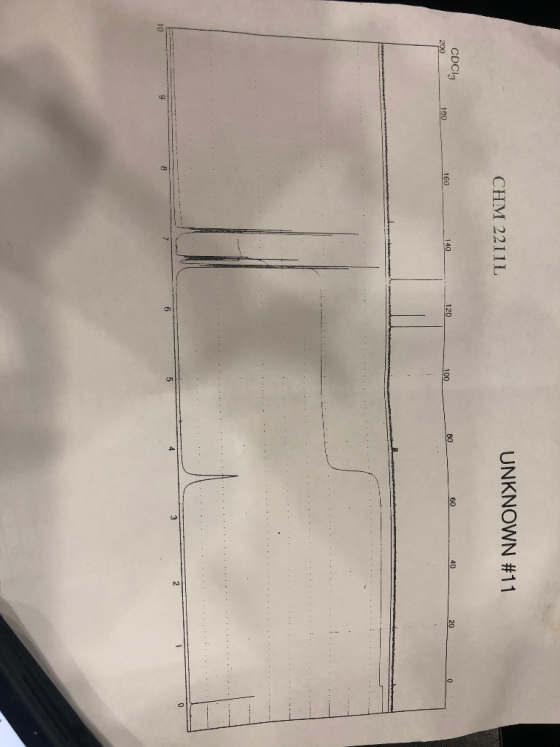
Assign the peaks to the appropriate protons NMR
Homework Answers
7.2 is the normal value aromatic protons,it is the h nmr peak.
In 13C nmr aromatic carbons becomes 128 delta value.so in this picture 7.2 is the 1 h nmr peak
Add Answer to:
Assign the peaks to the appropriate protons NMR
CHM 2211L UNKNOWN #11 CDC13 60 200 100...
b. Assign the indicated protons (a, b,c,d) in the Wittig product H NMR (CDC13, 60 MHz),...
 b. Assign the indicated protons (a, b,c,d) in the Wittig product H NMR (CDC13, 60 MHz), (1 point) - W Ha 0 Hz YO Aromatic protons V Hb Hd US Z-40 SITI SCE - 43100 81257 72273 _-78728 -87449 We www WwWY www 60 0 55 50 45 Chemical Shutt pom) 50 c. Calculate two coupling constants. One for Ha and one for Hb of the Wittig product. If you need help, watch the Garcia mini lecture video that was...
for the following 2 compounds, please calculate, and show the calculations for, the degree of unsaturation, assign the IR spectrum peaks, assign the 13C NMR peaks, assign the 1H NMR peaks, and draw th...
 for the following 2 compounds, please calculate, and
show the calculations for, the degree of unsaturation, assign the
IR spectrum peaks, assign the 13C NMR peaks, assign the 1H NMR
peaks, and draw the structure for the unknown compound.
CHIM 245 Spectroscopy Problem Set #2 In this problem set there are two unknown compounds. You are provided with the formula, IR spectrum, "C NMR spectrum, and 'H NMR spectrum for each compound. Each unknown is worth 10 points, with an...
for the following 2 compounds, please calculate, and
show the calculations for, the degree of unsaturation, assign the
IR spectrum peaks, assign the 13C NMR peaks, assign the 1H NMR
peaks, and draw the structure for the unknown compound.
CHIM 245 Spectroscopy Problem Set #2 In this problem set there are two unknown compounds. You are provided with the formula, IR spectrum, "C NMR spectrum, and 'H NMR spectrum for each compound. Each unknown is worth 10 points, with an...
5) Assign the peaks in the 'H NMR spectrum of your product. Draw your structure on...
 5) Assign the peaks in the 'H NMR spectrum of your product. Draw your structure on the NMR spectrum and label each set of inequivalent protons. Use these labels in assigning the peaks. In some cases the aromatic peaks may overlap, so it is OK to assign groups of protons to a series of overlapping peaks if necessary. Try to be as specific as possible in your assignment, though. Discuss in detail how the NMR spectrum is only consistent with...
Assign the peaks in the 1H NMR shown below to the correct protons in molecule 2....
 Assign the peaks in the 1H NMR shown below to the correct
protons in molecule 2. The portuon of the NMR between 8-6.5 ppm has
been magnified for easier viewing.
4) Assign the peaks in the 'H NMR shown below to the correct protons in molecule 2. The portion of the NMR between 8-6.5 ppm has been magnified for easier viewing. 2H 1H2H1H Зн molecule 2 Зн PPM
Assign the peaks in the 1H NMR shown below to the correct
protons in molecule 2. The portuon of the NMR between 8-6.5 ppm has
been magnified for easier viewing.
4) Assign the peaks in the 'H NMR shown below to the correct protons in molecule 2. The portion of the NMR between 8-6.5 ppm has been magnified for easier viewing. 2H 1H2H1H Зн molecule 2 Зн PPM
Assign the protons to their respective peaks for Dibenzalacetone on H NMR spectra.
 Assign the protons to their respective peaks for Dibenzalacetone
on H NMR spectra.
.9 7.2 MP .. 41-113℃ rn 7.4 7.3 7.2 110 1.577 H20
.9 7.2
MP .. 41-113℃ rn 7.4 7.3 7.2
110 1.577 H20
Assign the protons to their respective peaks for Dibenzalacetone
on H NMR spectra.
.9 7.2 MP .. 41-113℃ rn 7.4 7.3 7.2 110 1.577 H20
.9 7.2
MP .. 41-113℃ rn 7.4 7.3 7.2
110 1.577 H20
Deduce the structure of this ketone by its proton NMR, and assign the appropriate peaks. The options for the unknown ket...
 Deduce the structure of this ketone by its proton NMR, and
assign the appropriate peaks.
The options for the unknown ketone are: 2-butanone, 4-pentanone,
4-methyl-2-pentanone, cyclopentanone, 2-heptanone, d-l,
3-methylcyclohexanone, 2-octanone, cycloheptanone, acetophenone,
and butyrophenone.
Beside the photo, no additional information was given, including
more specific multiplicity of peaks. However, I am almost certain
that the correct structure is d-l, 3-methylcyclohexanone, I am just
having trouble assigning the peaks.
Second Unknown Ketone THS cticiろ 80 75 70 6.5 6.0 5.5 5.0...
Deduce the structure of this ketone by its proton NMR, and
assign the appropriate peaks.
The options for the unknown ketone are: 2-butanone, 4-pentanone,
4-methyl-2-pentanone, cyclopentanone, 2-heptanone, d-l,
3-methylcyclohexanone, 2-octanone, cycloheptanone, acetophenone,
and butyrophenone.
Beside the photo, no additional information was given, including
more specific multiplicity of peaks. However, I am almost certain
that the correct structure is d-l, 3-methylcyclohexanone, I am just
having trouble assigning the peaks.
Second Unknown Ketone THS cticiろ 80 75 70 6.5 6.0 5.5 5.0...
Please help identify which compound these NMR's match. If possible label the proton NMR peaks with...
 Please help identify which compound these NMR's match.
If possible label the proton NMR peaks with the protons on the
compound.
Unknown B-C NMR OLL COL 72.09 87.70, 72.09, 13C NMR (101 MHz, cdc13) 68.56, 39.78, 25.09, 23.13 WWWWWMWWN 105 100 95 90 85 80 75 70 65 60 55 50 45 40 35 30 25 20 15 10 ppi Unknown B - H NMR 1H NMR (400 MHz, cdc13) 2.48 (s, 1H), 2.02 (s, 1H), 1.91 (m, 2H), 1.71...
Please help identify which compound these NMR's match.
If possible label the proton NMR peaks with the protons on the
compound.
Unknown B-C NMR OLL COL 72.09 87.70, 72.09, 13C NMR (101 MHz, cdc13) 68.56, 39.78, 25.09, 23.13 WWWWWMWWN 105 100 95 90 85 80 75 70 65 60 55 50 45 40 35 30 25 20 15 10 ppi Unknown B - H NMR 1H NMR (400 MHz, cdc13) 2.48 (s, 1H), 2.02 (s, 1H), 1.91 (m, 2H), 1.71...
Interpret the IR and NMR spectra for an unknown substance. Label all peaks and protons. Correctly...
 Interpret the IR and NMR spectra for an unknown substance.
Label all peaks and protons. Correctly Identify
the compound and draw its structure.
The unknown compound may be one of the following:
1,2-dichloropropane
2-chloro-2-methylpropane
1-bromobutane
2-bromobutane
1-bromo-3-methylbutane
bromocyclohexane
ethanol
1-propanol
2-propanol
1-butanol
2-butanol
2-methyl-2-propanol
n-pentane
2,2,4-tri-methylpentane
toluene
1,2-dimethylbenzene
1,3-dimethylbenzene 1,4-dimethylbenzene
ethylbenzene
n-butylbenzene
2-butylbenzene
isobutylbenzene
cyclohexene
alpha-methylstyrene
10 NAME 15 VENUMBERS COPYRIGHT 1992 -3 và DOL 140 120 100 80 60 40 20 PPM
Interpret the IR and NMR spectra for an unknown substance.
Label all peaks and protons. Correctly Identify
the compound and draw its structure.
The unknown compound may be one of the following:
1,2-dichloropropane
2-chloro-2-methylpropane
1-bromobutane
2-bromobutane
1-bromo-3-methylbutane
bromocyclohexane
ethanol
1-propanol
2-propanol
1-butanol
2-butanol
2-methyl-2-propanol
n-pentane
2,2,4-tri-methylpentane
toluene
1,2-dimethylbenzene
1,3-dimethylbenzene 1,4-dimethylbenzene
ethylbenzene
n-butylbenzene
2-butylbenzene
isobutylbenzene
cyclohexene
alpha-methylstyrene
10 NAME 15 VENUMBERS COPYRIGHT 1992 -3 và DOL 140 120 100 80 60 40 20 PPM
Provide the correct structure for your unknown based on the spectroscopic data provided. Provide the correct...
 Provide the correct structure for your unknown based on the
spectroscopic data provided. Provide the correct name for your
compound. Either the IUPAC name, or a commonly accepted name (i.e.,
ethyl acetate in place of ethyl ethanoate) will be accepted.IR
spectrum: Assign as many peaks as possible. In particular, you
should assign peaks that were important in making your structural
interpretation (i.e. functional group peaks such as OH, C=O, N-H,
etc.).
1H-NMR spectrum: Assign all the peaks in the spectrum...
Provide the correct structure for your unknown based on the
spectroscopic data provided. Provide the correct name for your
compound. Either the IUPAC name, or a commonly accepted name (i.e.,
ethyl acetate in place of ethyl ethanoate) will be accepted.IR
spectrum: Assign as many peaks as possible. In particular, you
should assign peaks that were important in making your structural
interpretation (i.e. functional group peaks such as OH, C=O, N-H,
etc.).
1H-NMR spectrum: Assign all the peaks in the spectrum...
The 1H NMR for 2,3-dibromobutane has a doublet at 1.8 ppm and a quartet at 4.5 ppm. Draw the compound and assign the peaks in the spectrum to their respective protons.
The 1H NMR for 2,3-dibromobutane has a doublet at 1.8 ppm and a quartet at 4.5 ppm. Draw the compound and assign the peaks in the spectrum to their respective protons.
 b. Assign the indicated protons (a, b,c,d) in the Wittig product H NMR (CDC13, 60 MHz), (1 point) - W Ha 0 Hz YO Aromatic protons V Hb Hd US Z-40 SITI SCE - 43100 81257 72273 _-78728 -87449 We www WwWY www 60 0 55 50 45 Chemical Shutt pom) 50 c. Calculate two coupling constants. One for Ha and one for Hb of the Wittig product. If you need help, watch the Garcia mini lecture video that was...
 for the following 2 compounds, please calculate, and
show the calculations for, the degree of unsaturation, assign the
IR spectrum peaks, assign the 13C NMR peaks, assign the 1H NMR
peaks, and draw the structure for the unknown compound.
CHIM 245 Spectroscopy Problem Set #2 In this problem set there are two unknown compounds. You are provided with the formula, IR spectrum, "C NMR spectrum, and 'H NMR spectrum for each compound. Each unknown is worth 10 points, with an...
for the following 2 compounds, please calculate, and
show the calculations for, the degree of unsaturation, assign the
IR spectrum peaks, assign the 13C NMR peaks, assign the 1H NMR
peaks, and draw the structure for the unknown compound.
CHIM 245 Spectroscopy Problem Set #2 In this problem set there are two unknown compounds. You are provided with the formula, IR spectrum, "C NMR spectrum, and 'H NMR spectrum for each compound. Each unknown is worth 10 points, with an...
 5) Assign the peaks in the 'H NMR spectrum of your product. Draw your structure on the NMR spectrum and label each set of inequivalent protons. Use these labels in assigning the peaks. In some cases the aromatic peaks may overlap, so it is OK to assign groups of protons to a series of overlapping peaks if necessary. Try to be as specific as possible in your assignment, though. Discuss in detail how the NMR spectrum is only consistent with...
 Assign the peaks in the 1H NMR shown below to the correct
protons in molecule 2. The portuon of the NMR between 8-6.5 ppm has
been magnified for easier viewing.
4) Assign the peaks in the 'H NMR shown below to the correct protons in molecule 2. The portion of the NMR between 8-6.5 ppm has been magnified for easier viewing. 2H 1H2H1H Зн molecule 2 Зн PPM
Assign the peaks in the 1H NMR shown below to the correct
protons in molecule 2. The portuon of the NMR between 8-6.5 ppm has
been magnified for easier viewing.
4) Assign the peaks in the 'H NMR shown below to the correct protons in molecule 2. The portion of the NMR between 8-6.5 ppm has been magnified for easier viewing. 2H 1H2H1H Зн molecule 2 Зн PPM
 Assign the protons to their respective peaks for Dibenzalacetone
on H NMR spectra.
.9 7.2 MP .. 41-113℃ rn 7.4 7.3 7.2 110 1.577 H20
.9 7.2
MP .. 41-113℃ rn 7.4 7.3 7.2
110 1.577 H20
Assign the protons to their respective peaks for Dibenzalacetone
on H NMR spectra.
.9 7.2 MP .. 41-113℃ rn 7.4 7.3 7.2 110 1.577 H20
.9 7.2
MP .. 41-113℃ rn 7.4 7.3 7.2
110 1.577 H20
 Deduce the structure of this ketone by its proton NMR, and
assign the appropriate peaks.
The options for the unknown ketone are: 2-butanone, 4-pentanone,
4-methyl-2-pentanone, cyclopentanone, 2-heptanone, d-l,
3-methylcyclohexanone, 2-octanone, cycloheptanone, acetophenone,
and butyrophenone.
Beside the photo, no additional information was given, including
more specific multiplicity of peaks. However, I am almost certain
that the correct structure is d-l, 3-methylcyclohexanone, I am just
having trouble assigning the peaks.
Second Unknown Ketone THS cticiろ 80 75 70 6.5 6.0 5.5 5.0...
Deduce the structure of this ketone by its proton NMR, and
assign the appropriate peaks.
The options for the unknown ketone are: 2-butanone, 4-pentanone,
4-methyl-2-pentanone, cyclopentanone, 2-heptanone, d-l,
3-methylcyclohexanone, 2-octanone, cycloheptanone, acetophenone,
and butyrophenone.
Beside the photo, no additional information was given, including
more specific multiplicity of peaks. However, I am almost certain
that the correct structure is d-l, 3-methylcyclohexanone, I am just
having trouble assigning the peaks.
Second Unknown Ketone THS cticiろ 80 75 70 6.5 6.0 5.5 5.0...
 Please help identify which compound these NMR's match.
If possible label the proton NMR peaks with the protons on the
compound.
Unknown B-C NMR OLL COL 72.09 87.70, 72.09, 13C NMR (101 MHz, cdc13) 68.56, 39.78, 25.09, 23.13 WWWWWMWWN 105 100 95 90 85 80 75 70 65 60 55 50 45 40 35 30 25 20 15 10 ppi Unknown B - H NMR 1H NMR (400 MHz, cdc13) 2.48 (s, 1H), 2.02 (s, 1H), 1.91 (m, 2H), 1.71...
Please help identify which compound these NMR's match.
If possible label the proton NMR peaks with the protons on the
compound.
Unknown B-C NMR OLL COL 72.09 87.70, 72.09, 13C NMR (101 MHz, cdc13) 68.56, 39.78, 25.09, 23.13 WWWWWMWWN 105 100 95 90 85 80 75 70 65 60 55 50 45 40 35 30 25 20 15 10 ppi Unknown B - H NMR 1H NMR (400 MHz, cdc13) 2.48 (s, 1H), 2.02 (s, 1H), 1.91 (m, 2H), 1.71...
 Interpret the IR and NMR spectra for an unknown substance.
Label all peaks and protons. Correctly Identify
the compound and draw its structure.
The unknown compound may be one of the following:
1,2-dichloropropane
2-chloro-2-methylpropane
1-bromobutane
2-bromobutane
1-bromo-3-methylbutane
bromocyclohexane
ethanol
1-propanol
2-propanol
1-butanol
2-butanol
2-methyl-2-propanol
n-pentane
2,2,4-tri-methylpentane
toluene
1,2-dimethylbenzene
1,3-dimethylbenzene 1,4-dimethylbenzene
ethylbenzene
n-butylbenzene
2-butylbenzene
isobutylbenzene
cyclohexene
alpha-methylstyrene
10 NAME 15 VENUMBERS COPYRIGHT 1992 -3 và DOL 140 120 100 80 60 40 20 PPM
Interpret the IR and NMR spectra for an unknown substance.
Label all peaks and protons. Correctly Identify
the compound and draw its structure.
The unknown compound may be one of the following:
1,2-dichloropropane
2-chloro-2-methylpropane
1-bromobutane
2-bromobutane
1-bromo-3-methylbutane
bromocyclohexane
ethanol
1-propanol
2-propanol
1-butanol
2-butanol
2-methyl-2-propanol
n-pentane
2,2,4-tri-methylpentane
toluene
1,2-dimethylbenzene
1,3-dimethylbenzene 1,4-dimethylbenzene
ethylbenzene
n-butylbenzene
2-butylbenzene
isobutylbenzene
cyclohexene
alpha-methylstyrene
10 NAME 15 VENUMBERS COPYRIGHT 1992 -3 và DOL 140 120 100 80 60 40 20 PPM
 Provide the correct structure for your unknown based on the
spectroscopic data provided. Provide the correct name for your
compound. Either the IUPAC name, or a commonly accepted name (i.e.,
ethyl acetate in place of ethyl ethanoate) will be accepted.IR
spectrum: Assign as many peaks as possible. In particular, you
should assign peaks that were important in making your structural
interpretation (i.e. functional group peaks such as OH, C=O, N-H,
etc.).
1H-NMR spectrum: Assign all the peaks in the spectrum...
Provide the correct structure for your unknown based on the
spectroscopic data provided. Provide the correct name for your
compound. Either the IUPAC name, or a commonly accepted name (i.e.,
ethyl acetate in place of ethyl ethanoate) will be accepted.IR
spectrum: Assign as many peaks as possible. In particular, you
should assign peaks that were important in making your structural
interpretation (i.e. functional group peaks such as OH, C=O, N-H,
etc.).
1H-NMR spectrum: Assign all the peaks in the spectrum...
Most questions answered within 3 hours.
-
Where is the error in this code sequence?
String s1 = "Hello";
String s2 = "ello";...
asked 10 months ago -
Financial data for Joel de Paris, Inc., for last year
follow:
Joel de Paris, Inc.
Balance...
asked 10 months ago -
Consider this reaction:
Al2(SO4)3 (aq)+ BaCl3
(aq) Al2Cl6 (aq)- +
3BaSO4(s) . What is the...
asked 10 months ago -
Suppose that Savneet is considering increasing her
recent random sample from 20 car rentals to 40...
asked 10 months ago -
Trucks arrive at an unloading terminal at an average rate of 120
per hour.
Trucks arrive...
asked 10 months ago -
Why are methanol and ethanol completely soluble in water while
octanol is not very little soluble....
asked 10 months ago -
A facilities manager at a university reads in a research report
that the mean amount of...
asked 10 months ago -
When the CuSO4 is rehydrated by adding water to the anhydrous
compound, is this an endothermic...
asked 10 months ago -
A ray of sunlight is passing from diamond into crown glass; the
angle of incidence is...
asked 10 months ago -
A block of mass 0.249 kg is placed on top of a light, vertical
spring of...
asked 10 months ago -
how do the kidneys compensate in the presences of acidosis
a) trigger hyperventilate
b) reserve acid...
asked 10 months ago -
Question 501 pts
The rental rate of capital to the firm increases. Which of the
following...
asked 10 months ago