
Homework Answers
Project (a)
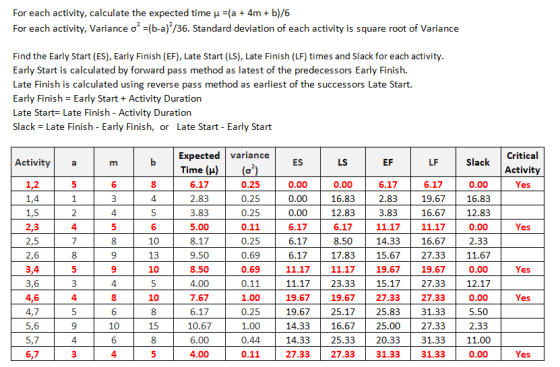
Critical path is the longest path in the network.
It can be identified by 0 slack time.
Critical path is : 1-2-3-4-6-7
Expected time and planned time of project completion = 31.33
Variance = Sum of variances of critical activities = (0.25+0.11+0.69+1+0.11) = 2.17
Standard deviation = sqrt(2.17) = 1.47
z value = (31.33-31.33) / 1.47 = 0
Probability, P(z) = NORMSDIST(0) = 0.5
Probabilities that the events will occur without delay = 0.5
Add Answer to:
Use the data in the table to calculate the expected activity times, di, and then...
9,18 In Exercise 9.16, suppose that the estimates (a, b, m) are given in Table 9.16...
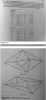 9,18 In Exercise 9.16, suppose that the estimates (a, b, m) are given in Table 9.16 and that activity times follow a beta distribution. Use the data in the table to calculate the expected activity times, di, and then compute the critical path for each event using dg as the completion time for activity (i, j). Assume that the solution that you obtain is the "planned" time to complete each event, and then find the probabilities that the events will...
Consider the following. (Assume that the dice are distinguishable and that what is observed are t...
Consider the following. (Assume that the dice are distinguishable and that what is observed are the numbers that face up.) HINT [See Examples 1-3.] Two distinguishable dice are rolled; the numbers add to 7. Describe the sample space S of the experiment. (Select all that apply.) (4,1) (4,2) (4,3) (4,4) (4,5) (4,6) (6,1) (6,2) (6,3) (6,4) (6,5) (6,6) (3,1) (3,2) (3,3) (3,4) (3,5) (3,6) (3,1) (3,2) (3,3) (3,4) (3,5) (3,6) (3,7) (2,1) (2,2) (2,3) (2,4) (2,5) (2,6) (2,7) (1,1) (1,2)...
Consider the project described in the table below a. Find the critical path. Why is this...
 Consider the project described in the table below a. Find the critical path. Why is this “critical"? b. If your customer tells you that he absolutely must have the project completed by day 40 what should you tell the customer? Develop a quantitative reason for your answer and be very specific as to how you would handle this situation. Activity a 1,2 2,4 3,4 12 10 15 18 12 12 4,7 5,7 6,8 7,9 8,9 10 15 20
The following table of probabilistic time estimates (in weeks) and activity predecessors are provided for a...
The following table of probabilistic time estimates (in weeks) and activity predecessors are provided for a project. Time Estimates (weeks) Activity a m b Activity Predecessor A 3 5 7 -- B 4 8 10 A C 2 3 5 A D 6 9 12 B, C E 5 9 15 D Table 9.2 Reference: Ref 9-2 Using Table 9.2, the variance for activity E is Select one: A. 2.582. B. 1.667. C. 1.291. D. 2.778.
PERT: Calculate the probability of finishing the project in 25 days or less Activity 10-20 10-30...
 PERT: Calculate the probability of finishing the project in 25
days or less
Activity 10-20 10-30 20-40 30-40 20-30 16 15 10 12 10 13 4 10 Dummy a is the optimistic duration m is the most likely duration b is the pessimistic duration
PERT: Calculate the probability of finishing the project in 25
days or less
Activity 10-20 10-30 20-40 30-40 20-30 16 15 10 12 10 13 4 10 Dummy a is the optimistic duration m is the most likely duration b is the pessimistic duration
The following table of probabilistic time estimates (in weeks) and activity predecessors are provided for a project....
The following table of probabilistic time estimates (in weeks) and activity predecessors are provided for a project. Time Estimates (weeks) Activity a m b Activity Predecessor A 3 5 7 -- B 4 8 10 A C 2 3 5 A D 6 9 12 B, C E 5 9 15 D Table 9.2 Reference: Ref 9-2 Using Table 9.2, the earliest start (ES) time for activity D is Select one: A. 21.67 weeks. B. 8.17 weeks. C. 12.67 weeks....
Use a PERT network to establish the expected duration for the project described in the table...
Use a PERT network to establish the expected duration for the project described in the table below: (SHOW the PERT NETWORK) Activity Predecessors Duration a m b Exp. Duration Var. Crash Week 1 Crash Week 2 A - 3 6 9 700 100 B A 6 7 14 600 200 C A 4 6 14 400 600 D B, C 4 6 8 200 600 E B, C 6 9 12 400 300 F C 4 6 14...
please show me all the work i want to see it step by step please thank...
 please show me all the work i want to see it step by step
please thank you
REVIEW QUESTIONS AND EXERCISES 9.1 (a) Using PERT, calculate expected project duration and determine the critical path in the network defined by the data below. (b) What is the probability of completing this project in 32 weeks or less? Duration (Weeks) Successor Activity Description Prefab Wall Forms Туре 40 Constant 2 10 50, 60, 70 Excavate Cols and Walls Constant 3 20 в0,...
please show me all the work i want to see it step by step
please thank you
REVIEW QUESTIONS AND EXERCISES 9.1 (a) Using PERT, calculate expected project duration and determine the critical path in the network defined by the data below. (b) What is the probability of completing this project in 32 weeks or less? Duration (Weeks) Successor Activity Description Prefab Wall Forms Туре 40 Constant 2 10 50, 60, 70 Excavate Cols and Walls Constant 3 20 в0,...
622 HW 4 MC Simulation-190212 (1) -Compatibility Mode Mailings Review View Help Tell me what you...
 622 HW 4 MC Simulation-190212 (1) -Compatibility Mode Mailings Review View Help Tell me what you want to do 1 Normal Heading 1 ieSubtitle Emphasis Strong List Par Static MC Project Cost Simulation: Consider the Project described that was characterized by the following activity edge table in which two people were required to complete each task (each working 8 hours a day). Activity Nodes Labor Cost (S/h) Min Max Likely S 10 S 150 S 120 S 100 $ 150...
Experiment Sd 2. Use the data in Table 1 to calculate the percent change in amplitude...
 Experiment Sd 2. Use the data in Table 1 to calculate the percent change in amplitude (Am ) activity that occurs between the 0-20 sand 60-80 intervals. Do the same for What accounts for the difference in the percent change observed in grip streng the two time intervals? change in amplitude (AmV) in electrical intervals. Do the same for grip strength. age observed in grip strength and Am V for 3. Compare mean grip strengths and Am V for the...
 9,18 In Exercise 9.16, suppose that the estimates (a, b, m) are given in Table 9.16 and that activity times follow a beta distribution. Use the data in the table to calculate the expected activity times, di, and then compute the critical path for each event using dg as the completion time for activity (i, j). Assume that the solution that you obtain is the "planned" time to complete each event, and then find the probabilities that the events will...
 Consider the project described in the table below a. Find the critical path. Why is this “critical"? b. If your customer tells you that he absolutely must have the project completed by day 40 what should you tell the customer? Develop a quantitative reason for your answer and be very specific as to how you would handle this situation. Activity a 1,2 2,4 3,4 12 10 15 18 12 12 4,7 5,7 6,8 7,9 8,9 10 15 20
 PERT: Calculate the probability of finishing the project in 25
days or less
Activity 10-20 10-30 20-40 30-40 20-30 16 15 10 12 10 13 4 10 Dummy a is the optimistic duration m is the most likely duration b is the pessimistic duration
PERT: Calculate the probability of finishing the project in 25
days or less
Activity 10-20 10-30 20-40 30-40 20-30 16 15 10 12 10 13 4 10 Dummy a is the optimistic duration m is the most likely duration b is the pessimistic duration
 please show me all the work i want to see it step by step
please thank you
REVIEW QUESTIONS AND EXERCISES 9.1 (a) Using PERT, calculate expected project duration and determine the critical path in the network defined by the data below. (b) What is the probability of completing this project in 32 weeks or less? Duration (Weeks) Successor Activity Description Prefab Wall Forms Туре 40 Constant 2 10 50, 60, 70 Excavate Cols and Walls Constant 3 20 в0,...
please show me all the work i want to see it step by step
please thank you
REVIEW QUESTIONS AND EXERCISES 9.1 (a) Using PERT, calculate expected project duration and determine the critical path in the network defined by the data below. (b) What is the probability of completing this project in 32 weeks or less? Duration (Weeks) Successor Activity Description Prefab Wall Forms Туре 40 Constant 2 10 50, 60, 70 Excavate Cols and Walls Constant 3 20 в0,...
 622 HW 4 MC Simulation-190212 (1) -Compatibility Mode Mailings Review View Help Tell me what you want to do 1 Normal Heading 1 ieSubtitle Emphasis Strong List Par Static MC Project Cost Simulation: Consider the Project described that was characterized by the following activity edge table in which two people were required to complete each task (each working 8 hours a day). Activity Nodes Labor Cost (S/h) Min Max Likely S 10 S 150 S 120 S 100 $ 150...
 Experiment Sd 2. Use the data in Table 1 to calculate the percent change in amplitude (Am ) activity that occurs between the 0-20 sand 60-80 intervals. Do the same for What accounts for the difference in the percent change observed in grip streng the two time intervals? change in amplitude (AmV) in electrical intervals. Do the same for grip strength. age observed in grip strength and Am V for 3. Compare mean grip strengths and Am V for the...
Most questions answered within 3 hours.
-
Where is the error in this code sequence?
String s1 = "Hello";
String s2 = "ello";...
asked 10 months ago -
Financial data for Joel de Paris, Inc., for last year
follow:
Joel de Paris, Inc.
Balance...
asked 10 months ago -
Consider this reaction:
Al2(SO4)3 (aq)+ BaCl3
(aq) Al2Cl6 (aq)- +
3BaSO4(s) . What is the...
asked 10 months ago -
Suppose that Savneet is considering increasing her
recent random sample from 20 car rentals to 40...
asked 10 months ago -
Trucks arrive at an unloading terminal at an average rate of 120
per hour.
Trucks arrive...
asked 10 months ago -
Why are methanol and ethanol completely soluble in water while
octanol is not very little soluble....
asked 10 months ago -
A facilities manager at a university reads in a research report
that the mean amount of...
asked 10 months ago -
When the CuSO4 is rehydrated by adding water to the anhydrous
compound, is this an endothermic...
asked 10 months ago -
A ray of sunlight is passing from diamond into crown glass; the
angle of incidence is...
asked 10 months ago -
A block of mass 0.249 kg is placed on top of a light, vertical
spring of...
asked 10 months ago -
how do the kidneys compensate in the presences of acidosis
a) trigger hyperventilate
b) reserve acid...
asked 10 months ago -
Question 501 pts
The rental rate of capital to the firm increases. Which of the
following...
asked 10 months ago